Ahavat Emet Cave, Tel Zion, Binyamin
- Location
- Within the boundaries of the settlement of Tel Zion
- Elevation
- 794 m above sea level
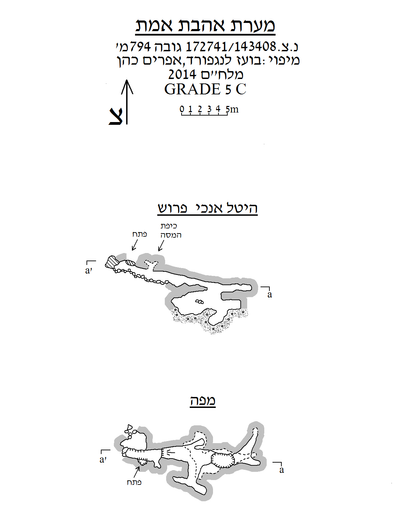 Cave mapView the map (PDF)
Description of the cave:
Ahavat Emet Cave is a small cave (total length 28 m and cumulative depth 5 m) that formed by phreatic dissolution processes in limestone of Cenomanian age (Amminadav Formation).
An initial report on the cave was submitted by Amos Frumkin, who visited the site on 6.5.14, after being led to the cave entrance by the children of the settlement of Tel Zion. On 9.6.14 the cave was surveyed a second time. During the visit the cave space was mapped and a comprehensive foot survey was carried out around the entrance.
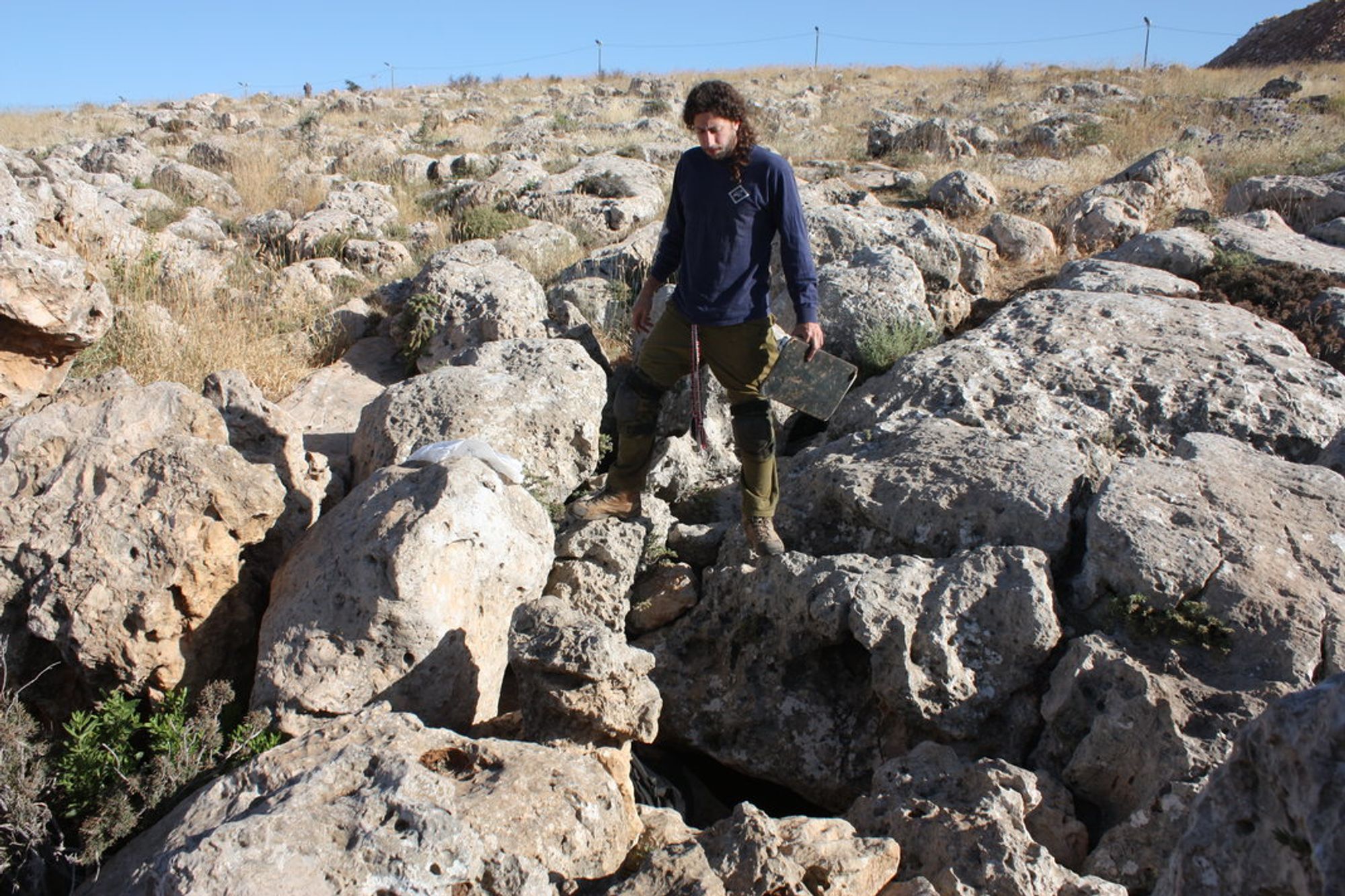
The cave entrance is exposed at the edge of a developed rocky field (karrenfeld) that "survived" as an open area at the northern end of Ahavat Emet Street in the settlement of Tel Zion. The entrance measures 0.6X0.4 m and its general shape is arched. The location of the entrance, among large boulders that hide it, makes it hard to find and identify in the field. The cave entrance leads to a low, semi-lit space, as a result of sunlight penetrating through the entrance and also through two tiny openings that formed from the development of the karren from the surface down to the cave space. From the entrance area the space continues as a sloping corridor extending west. The corridor ceiling is straight except at points where shallow dissolution domes developed. The corridor floor slopes down gently in the direction of its development and is covered with many stones and some debris that entered from the surface. About 4 m west of the entrance the main corridor splits into 3 secondary corridors:
- The main one continues west and is immediately interrupted by a wide vertical shaft descending to the lower level of the cave. Immediately after the shaft the main corridor splits again into two short branches.
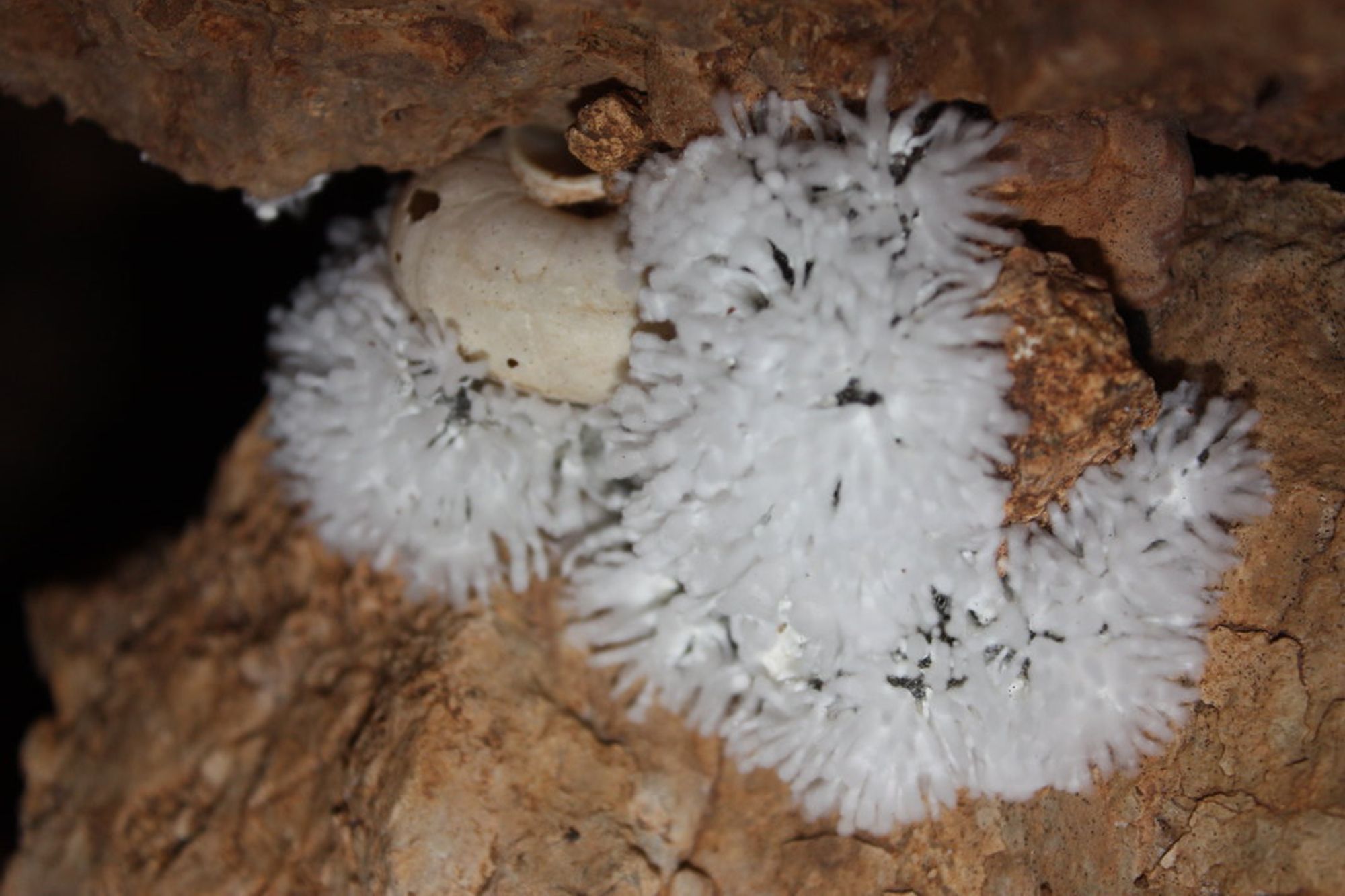
- The second split turns south and after about 2 m connects to a perpendicular passage that continues mainly west. At the end of this passage there is a significant concentration of rock hyrax droppings, on which grows a fungus that looks like a black filamentous net.
- The third split looks like a narrow slit in the northern wall of the corridor. Passage through the slit is difficult but possible, and leads to a tiny intermediate space from which one can barely pass to the lower level of the cave.
At the junction between the levels there are a few rock hyrax droppings on which fungi also grow, but in forms different from those that appeared in the upper part of the cave. Some of the fungi look like the cap mushrooms that grow on the surface after rain, only smaller. Some of the fungi resemble snowflakes, and some have the form of mold and rot.
The lower level of the cave consists mainly of a rounded room, measuring 2X4 m and reaching a height of 2 m at its peak. Conditions in this part of the cave are darker and damper, unlike the upper part of the cave space, which extends close to the surface so that light penetrates it at various points. The floor of the room at the bottom of the cave is horizontal and covered with many stones and mud. In the area of this room and in the shaft descending from the main corridor, impressive pottery sherds and flint items were found. The pottery sherds are small and worn.
The pottery is coarse and has temper, which is reminiscent of ancient (Chalcolithic-Bronze) ceramics or rather of coarse Muslim ceramics. The presence of the flint items allows one to think that the pottery sherds fit the early periods better. The flint items found in the cave include a number of tiny and medium flakes as well as a square blade reminiscent in shape of the Canaanite blades. The blade has continuous retouch along one of its sides. A clear gloss from use appears on this section. Another item looks like an elliptical scraper. Alongside these two items a core coated with a limestone cortex was also found.
Many bones are scattered throughout the cave space, but mainly in its lower part. One of these bones was found burnt, and it is unclear whether it was burnt in the distant past or by the candles of the visitors that are scattered in abundance in all parts of the cave. According to the tooth finds it appears that at the site there is at least one herbivore and two canid carnivores (apparently a small fox and a larger dog).
In the various parts of the cave the following were also found: at least 4 species of snails and a number of arthropods (springtail, myriapod, 3 different species of beetles, gnats, small flies, as well as spiders of the genera: shashan, pholcid (rae'dan), and a few more unidentified).
Notes:
- Access to the cave entrance is possible by driving through the settlement of Tel Zion. From the entrance to the settlement one should go up to its northwestern part, where Ahavat Emet Street is located.
- A great deal of debris is scattered in all parts of the cave. Some of the debris came from the surface through the karren, parts of which cross the cave space, and some originates from visitors who frequent the cave.
- Despite the significant presence of rock hyraxes inside the cave spaces, no harmful arthropods such as fleas and ticks were found at the site.
Written by: Boaz Langford