Nahal HaBesor Cave - Nahal HaBesor
- Grid ref.
- 120899/039137
- Location
- Nahal HaBesor
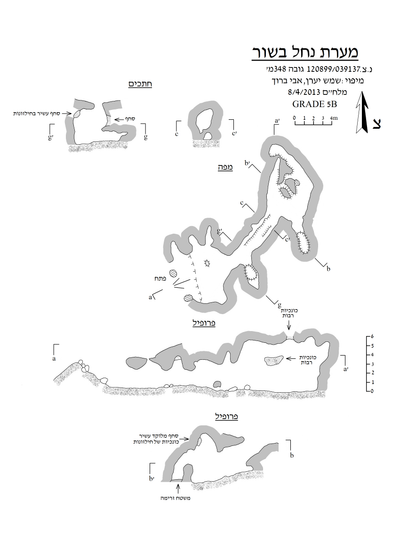 Cave mapView the map (PDF)
General:
Nahal HaBesor Cave is a small cave consisting mainly of an elongated corridor and a number of secondary passages. The total length of the cave is 35 m and its maximum depth reaches 6 m. Dissolution domes and rounded dissolution marks indicate that the cave was formed below the water table, in the confined aquifer of the Shivta Formation. Processes later than the formation of the cave apparently include flow through the main corridor, which created a keyhole-shaped section, as well as the accumulation and removal of various sediments.
Description of the space:
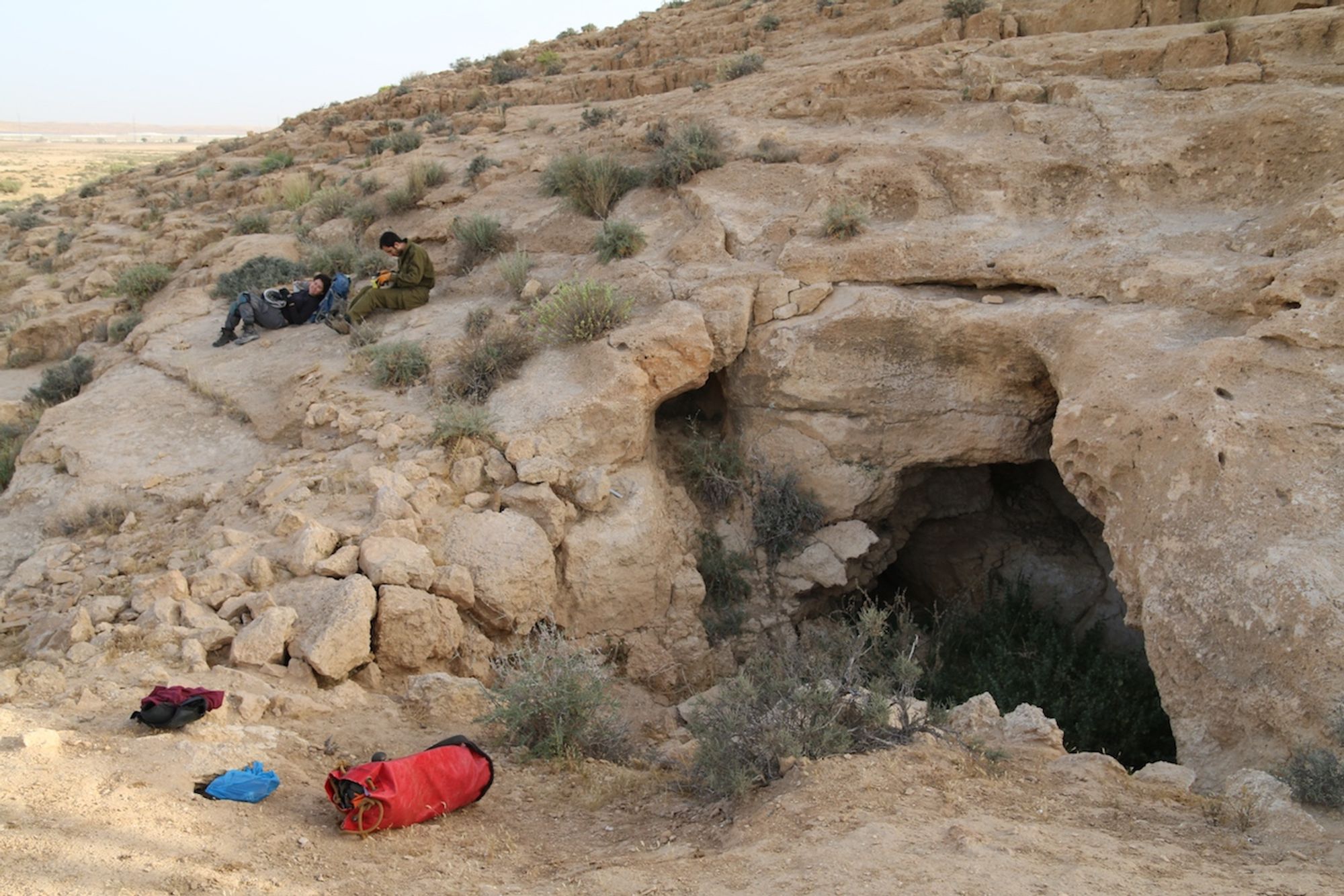
The cave has three openings gaping in the eastern bank of a local channel that drains into the HaBesor dike outlet. The main opening is large and conspicuous from afar, thanks to a spill of soil and stones that were removed from the area inside the opening and thrown in front of it. It seems that the digging was done in order to prepare the place as an improvised water cistern or for the purpose of treasure hunting. Another spill of soil also appears in front of the other openings of the cave, slightly above the main opening.
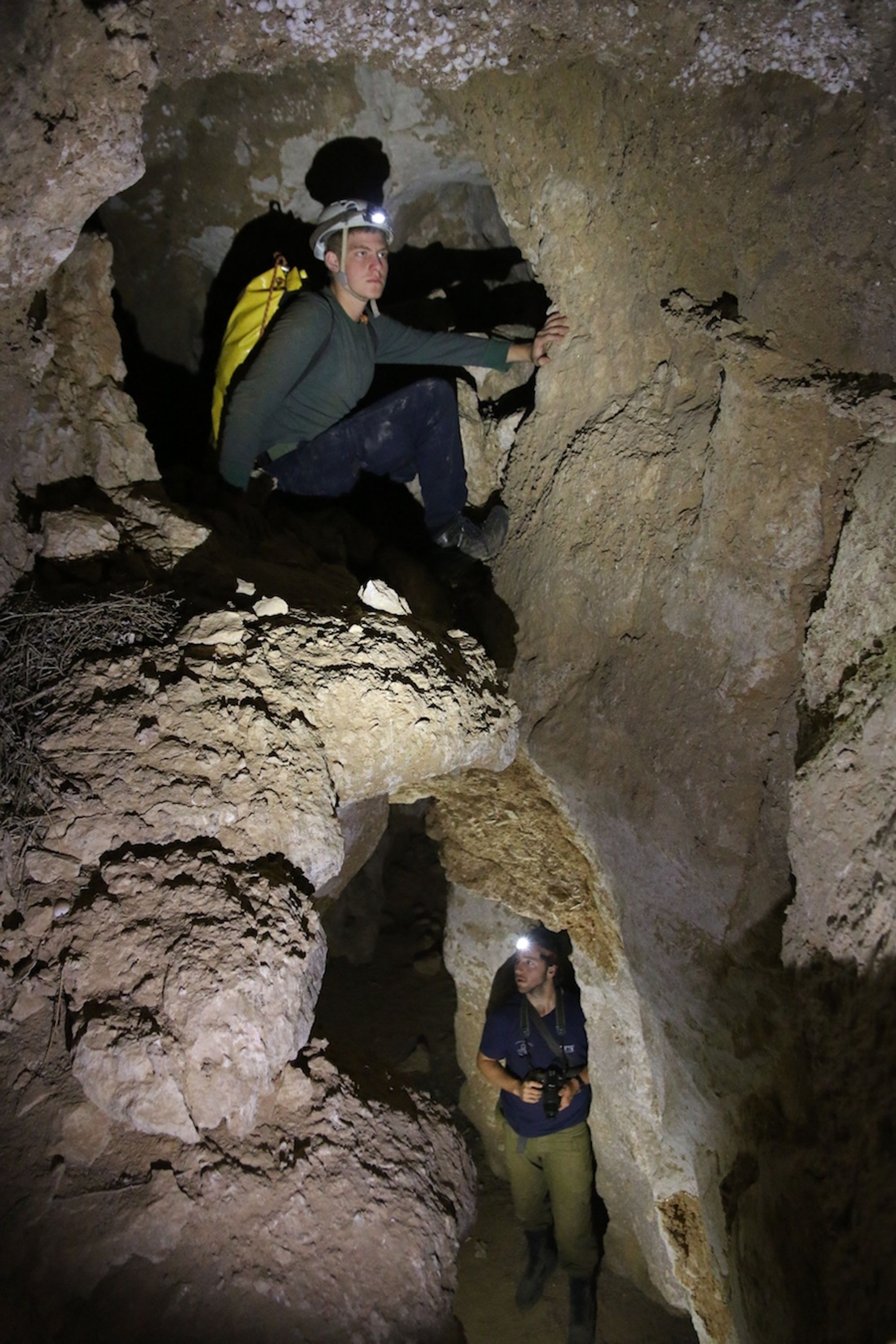
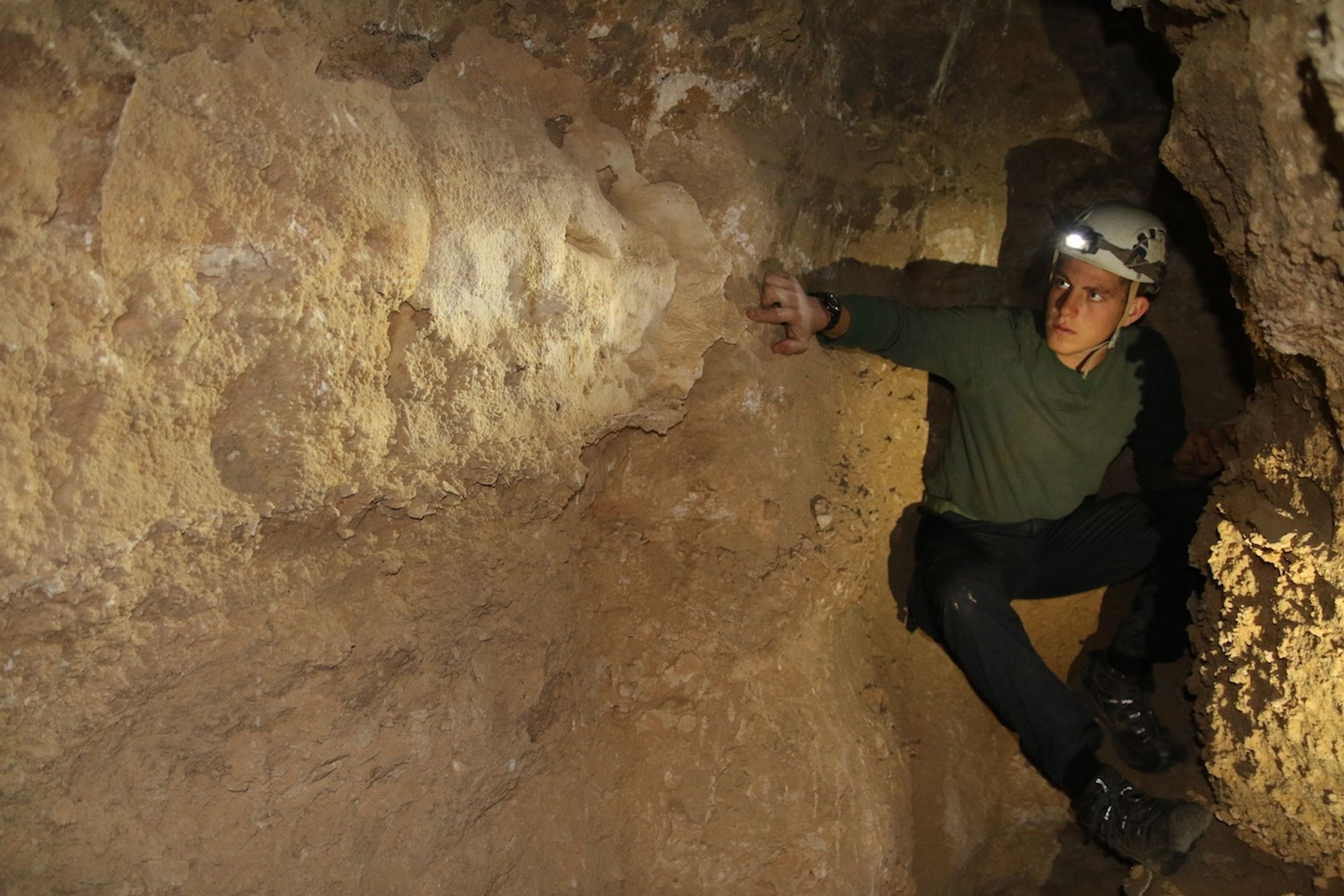
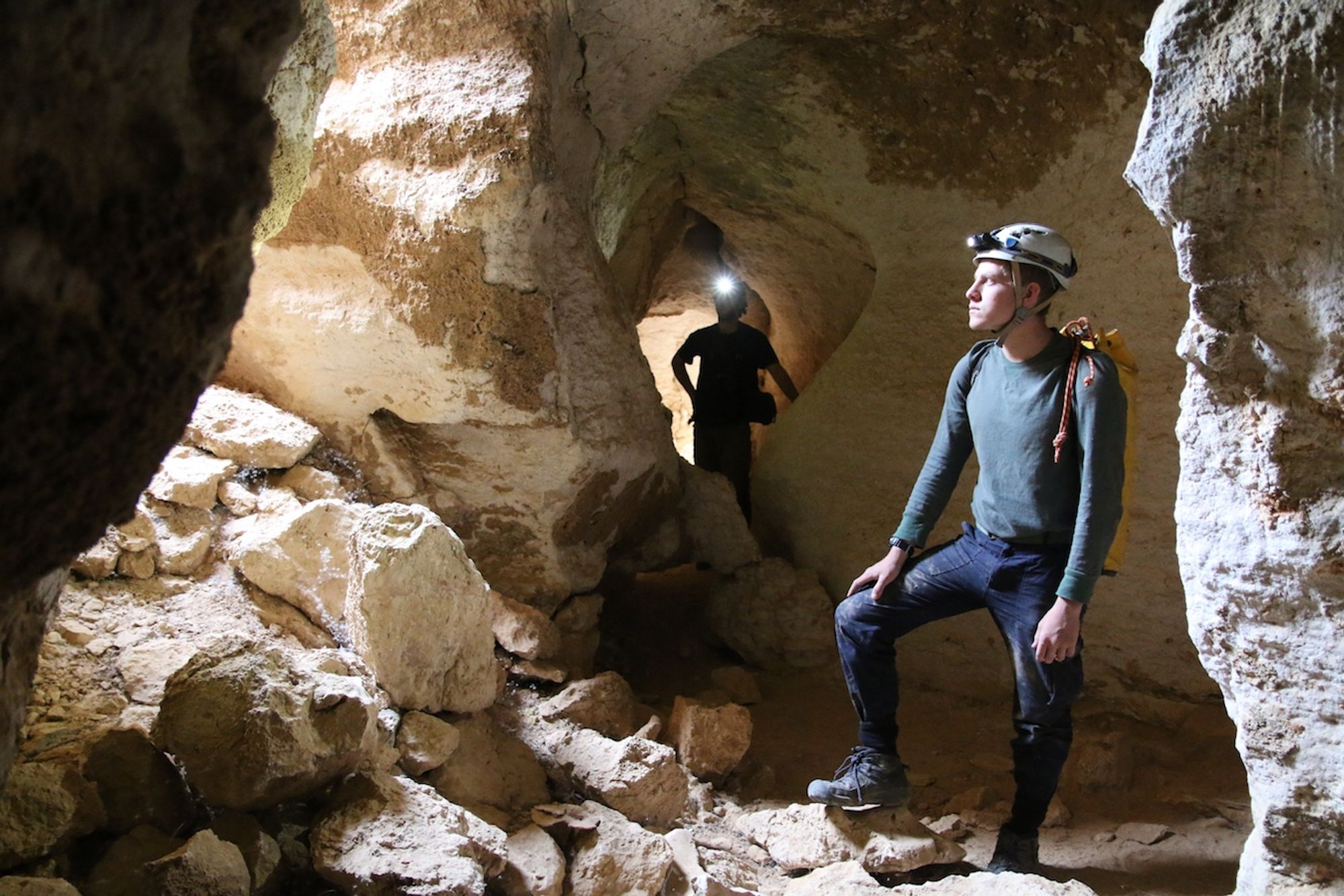
The main opening of the cave leads to a rounded, horizontal, well-lit room. The floor of the room is dug up and a few rocks were pulled out from the base of its walls. From the entrance space a tall corridor with a keyhole-shaped cross-section extends to the north-east. The floor of the corridor is covered by loose gray sediment with a few stones and pigeon and porcupine droppings. Already from the area of the opening, remains of sediment that once filled the space and was later removed from it appear along the corridor. The sediment survived in patches stuck to the walls or in protected niches such as the tops of dissolution domes. The color of the sediment is yellowish to brown and it contains a huge amount of snails of the genus Levantina. At various points the sediment also contains coarse gravel up to 3 cm in size. In considerable parts of the cave the sediment is cemented by crystalline mineral material, which forms crumbling coatings on the walls. In the inner part of the corridor there are a number of rock blocks creating local partitions. Above and beside the rock blocks, at a height of ~2.5 m above the floor, the fill is seen at a uniform level line, which perhaps indicates the original filling of the space up to this height. In this area the walls are also coated with a massive gypsum coating up to 2 cm thick. The color of the gypsum is between white and cream, and it also covers the ceiling of the dissolution domes in this area. Another gypsum coating is found on rock at the bottom of the second opening of the cave, an opening that looks like a vertical chimney in the middle of the corridor. The gypsum coating looks like coin gypsum with developed crystals (up to 1.5 cm) in gray.
In front of the cave opening are scattered fragments of "cave clouds" that were most likely removed from the entrance space during its excavation. In the lower part of the cloud deposits there is crystallization in a hexagon-like form. It is possible that this reflects crystallization on mud cracks and the creation of a "trace fossil" of the cracks between the mud cracks.
Stages of development of the space:
Based on the above, it seems that the different stages in the formation and development of the cave can be summarized as follows:
- Creation of the original space in the confined aquifer of the Shivta Formation. At this stage, while the cave was full of water, cave cloud deposits crystallized in it.
- Draining of the cave of water. During the draining, gravitational flow occurred in the cave, which shaped the corridor into a keyhole-like section.
- Coating of the cave wall by massive gypsum. This stage may also have occurred as stage 2.
- Intersection of the cave space by the surface and exposure of the openings. It is possible that at first the upper openings were exposed, without exposure of the central opening which is lower than them. Such a situation could explain the next stage.
- Filling of the cave by sediment that accumulated to a height of 2.5 m above the floor.
- Removal of the sedimentary fill from the space, perhaps due to incision of the stream and the creation of the main (lower) opening of the cave.
- Accumulation of loose sediment on the floor, including animal excreta.
Notes:
A low presence of cave ticks was observed in the cave.
Samples were collected in the cave of the cave clouds, the massive gypsum coating at the height of the end of the corridor, the coin gypsum coating boulder-sized at the bottom of the central opening, and the wall coating cemented with crystalline mineral cement.
Written by: Boaz Langford
Elevation: 348+