Bir al-Qa'ir, Judean Desert
- Grid ref.
- 175646/094237
- Location
- Central Judean Desert Plateau
- Elevation
- 388 m above sea level
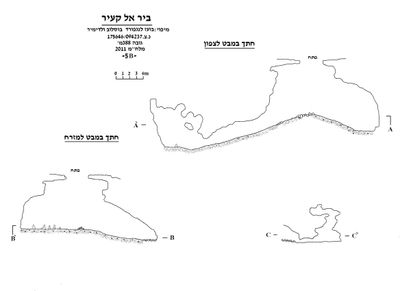 Cave mapView the map (PDF)
Cave description:
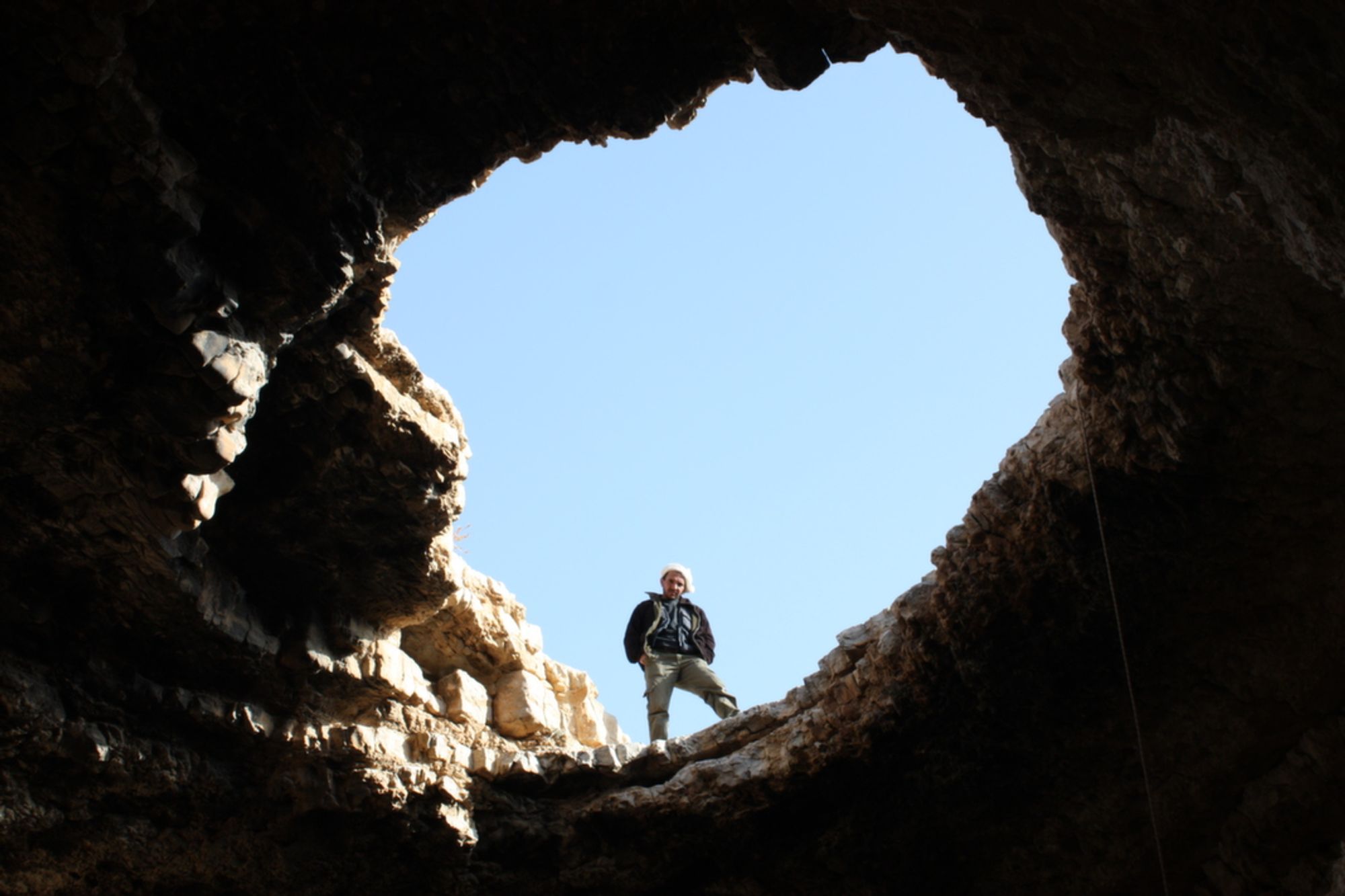
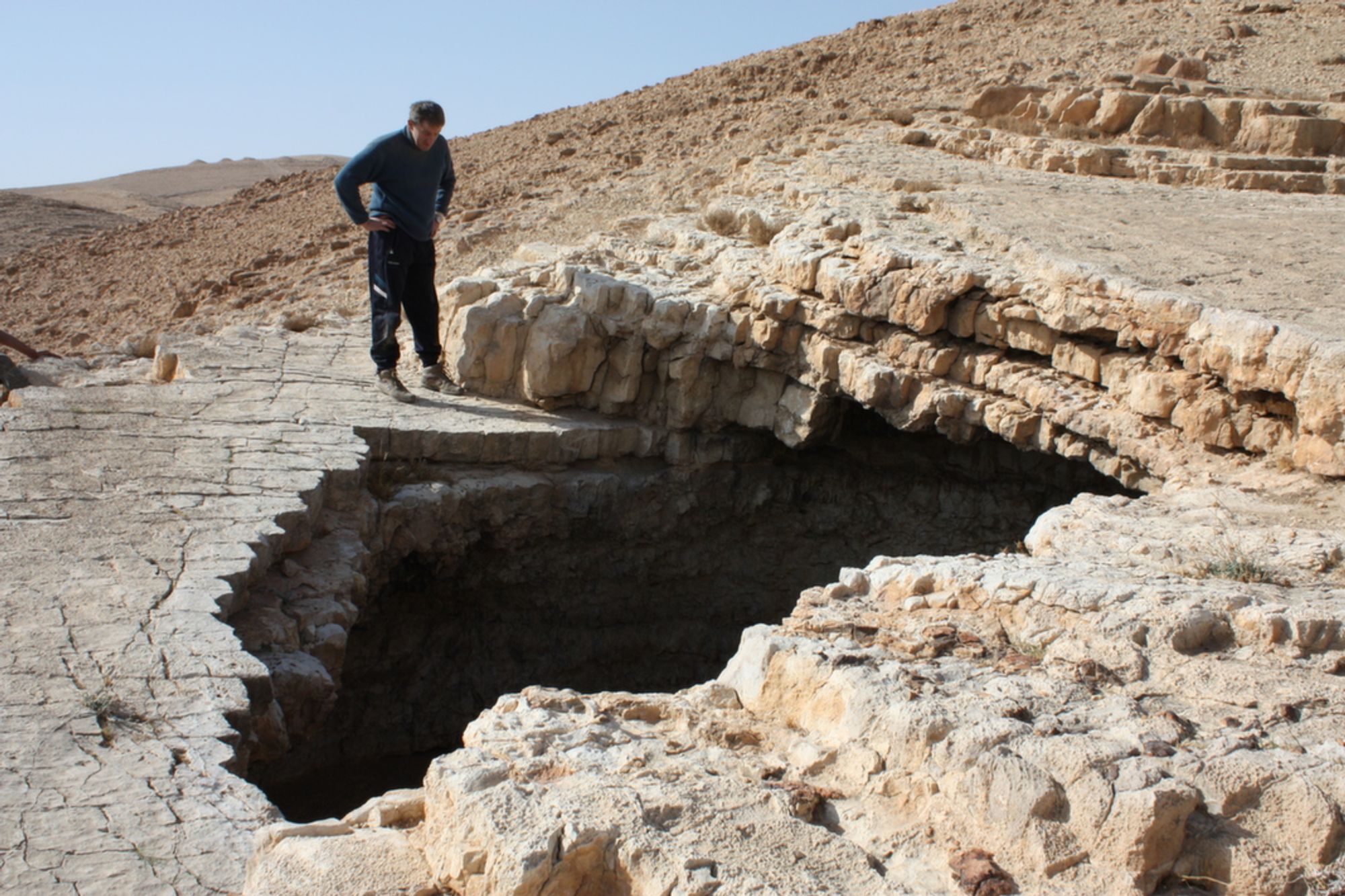
Bir al-Qa'ir is a small vertical pit that developed by phreatic dissolution processes in limestone of Turonian age (Shivta-Netzer Fm.). The cave entrance is exposed at the top of a gentle ridge, about 30 m above the bed of a large channel that empties into Nahal Hever, east of Umm Darag. The entrance dimensions are 4X3.5 m and it opens in the ceiling of the cave space.
The cave space consists of a wide hall, measuring 20X16 m and 8 m high. The floor of the hall is covered with a thick layer of pigeon droppings, from which stalagmites built of this material even protrude. The walls of the hall are vertical, and the rock layers in which the cave developed stand out in them. The layers are thin and gently inclined at azimuth 55 (dip 6.5). A pair of passages extends from the hall space: to the northeast and to the northwest.
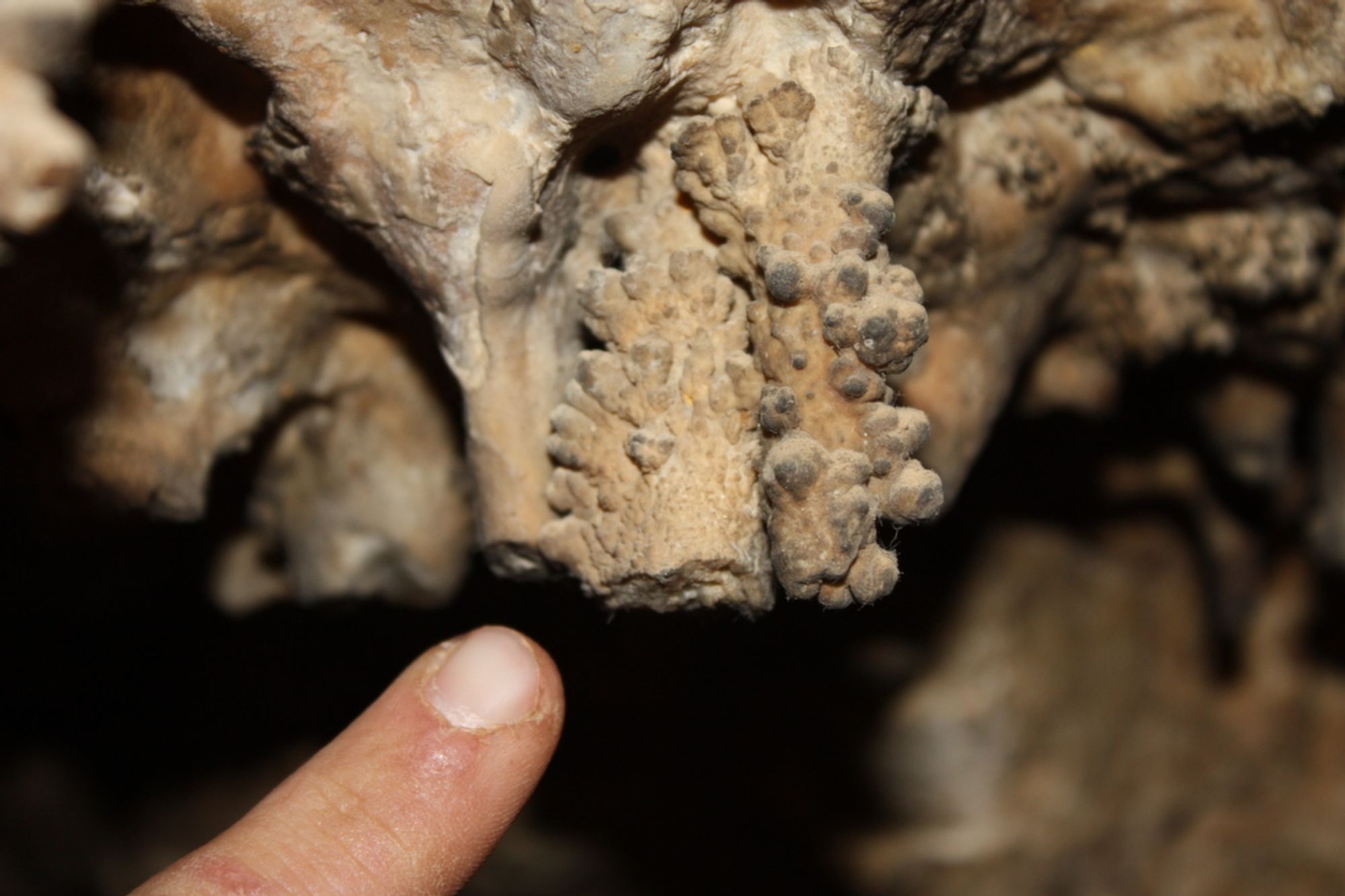
The northeast passage is the more prominent of the two. Its floor slopes in the direction of its development, its ceiling is high and at various points cave deposits appear in it in the form of stalactites, cave coral and elephant ears. At the end of the passage there is a small, arched opening, leading to an oval, high space in whose ceiling there are many dissolution domes and complex rounded spaces. Similar spaces also appear at the end of the northwest passage. This passage is smaller than the previous one and its low entrance opens on the northwest side of the cave hall. From the entrance a low passage continues for about 2 m, almost completely blocked by organic material and pigeon droppings. At the end of the passage there is an elliptical space in whose ceiling a blind chimney opens, extending about 2 m above the height of the ceiling of the space. At the top of this chimney there is a concentration of guano, indicating the presence of bats in this part of the cave.
Archaeological:
- On the floor of the cave hall, near the entrance of the northwest passage, there is a small enclosure (about 2X1) marked on the cave floor by several fieldstones. A single potsherd was found near this enclosure. Additional potsherds may lie beneath the layer of pigeon droppings that covers the entire floor of the cave.
Biological:
- Many pigeons nest in the cave. Muhammad of the Jahalin tribe says that Bedouin, residents of the area, tend to come to the pit to hunt pigeons.
- In the cave space the following were found: 2 individual ravens, a single fox, a single cat. All were found dead and desiccated.
- At the end of the northwest passage many individuals of the Egyptian beetle were observed, males and females.
- At the top of the blind chimney, at the end of the northwest passage, there is a concentration of guano.
In summary:
It appears that the cave space developed, below the water table, within the rock layer of the Shivta Formation. After the cave drained of water, several speleothems were deposited in it. As a result of the draining of the cave and also as a result of weathering processes acting outside it, the cave ceiling collapsed, which was apparently built of a thin rock layer of the Netzer Formation. After the opening was created the cave served as a dwelling place for many animals and also as a "fall trap" for others. It appears that at some stage there was also human activity in the cave.
Access:
- The cave entrance can be reached by a dirt road marked in red extending from the Umm Darag police station eastward.
- The descent into the cave requires the aid of a rope, which can be anchored about 2 m from the cave entrance, around a shallow rock projection.
Equipment:
- A 10 m rope for descending into the cave (the height of the descent is about 8 m).