Tsavoa Cave
- Location
- Kidod Ridge
- Elevation
- 495 m above sea level
Description of the Cave:
General:
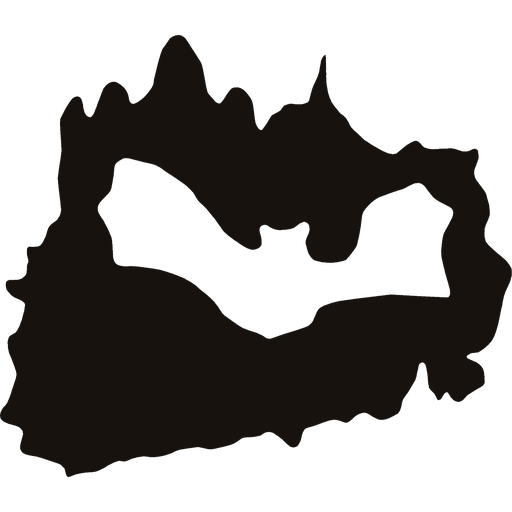
Tsavoa Cave is a giant cave consisting of a series of chambers and passages that developed in a branching, horizontal network-like structure, extending along parallel fracture axes whose general direction is northwest - southeast. In contrast to this type of space, the cave also contains broad chambers with no defined shape that likewise extend along the axes mentioned.
The total length of the cave reaches 600 m. The cave passages are spread through a rock section whose maximum width on the north - south axis is 96 m and on the east - west axis is 108 m. The maximum height of the rock section in which the cave space developed reaches about 18 m (the thickness of the Shivta Formation in this area is 50 m).
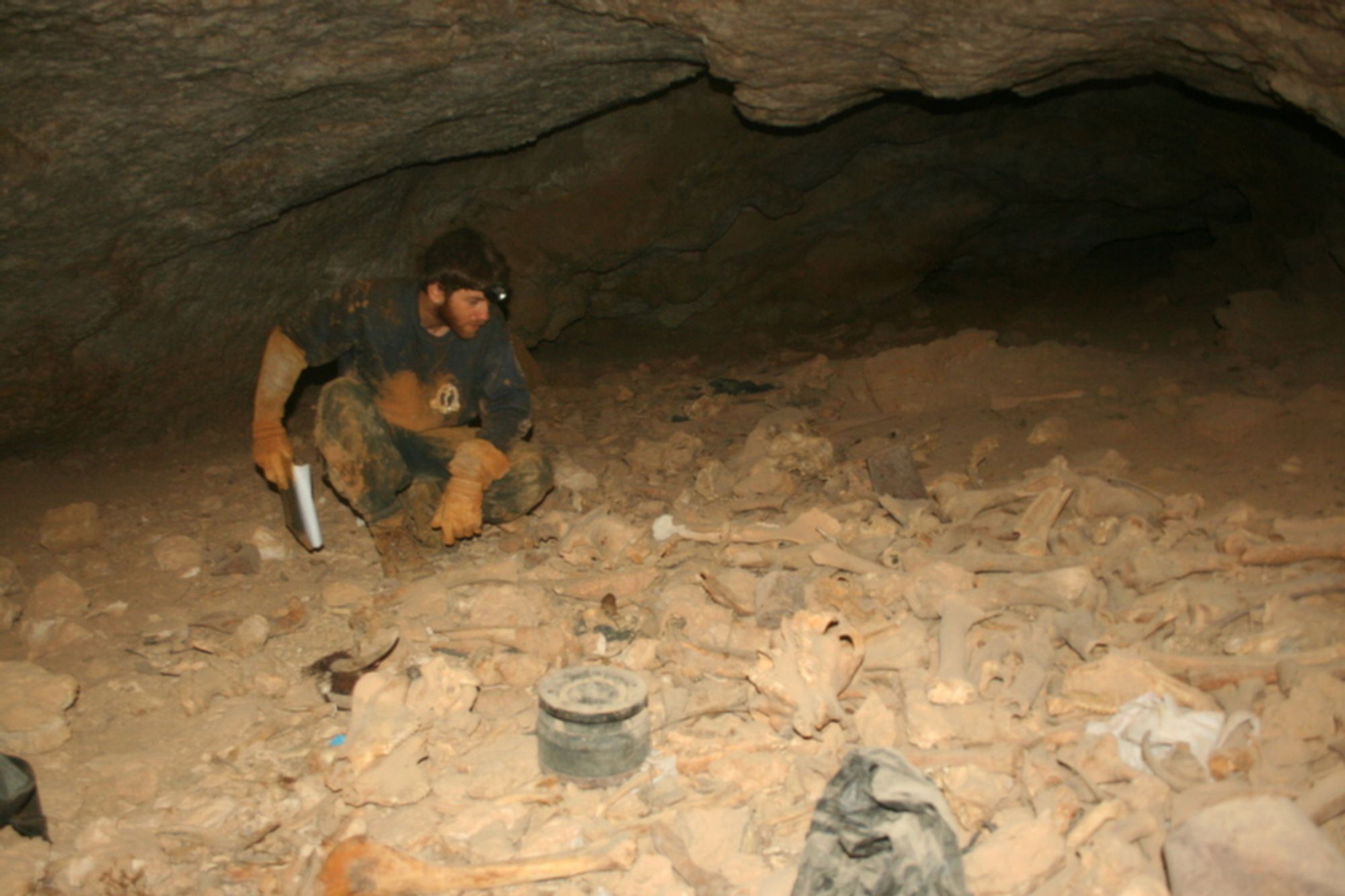
The cave was first exposed in 1977 by the geologist Giora Ilani, who found in it an impressive concentration of animal bones that had been brought there by a hyena that made the cave its den. The presence of the hyena in the cave, as well as the intensity of its activity there, gave the cave its name.
Physical Description:
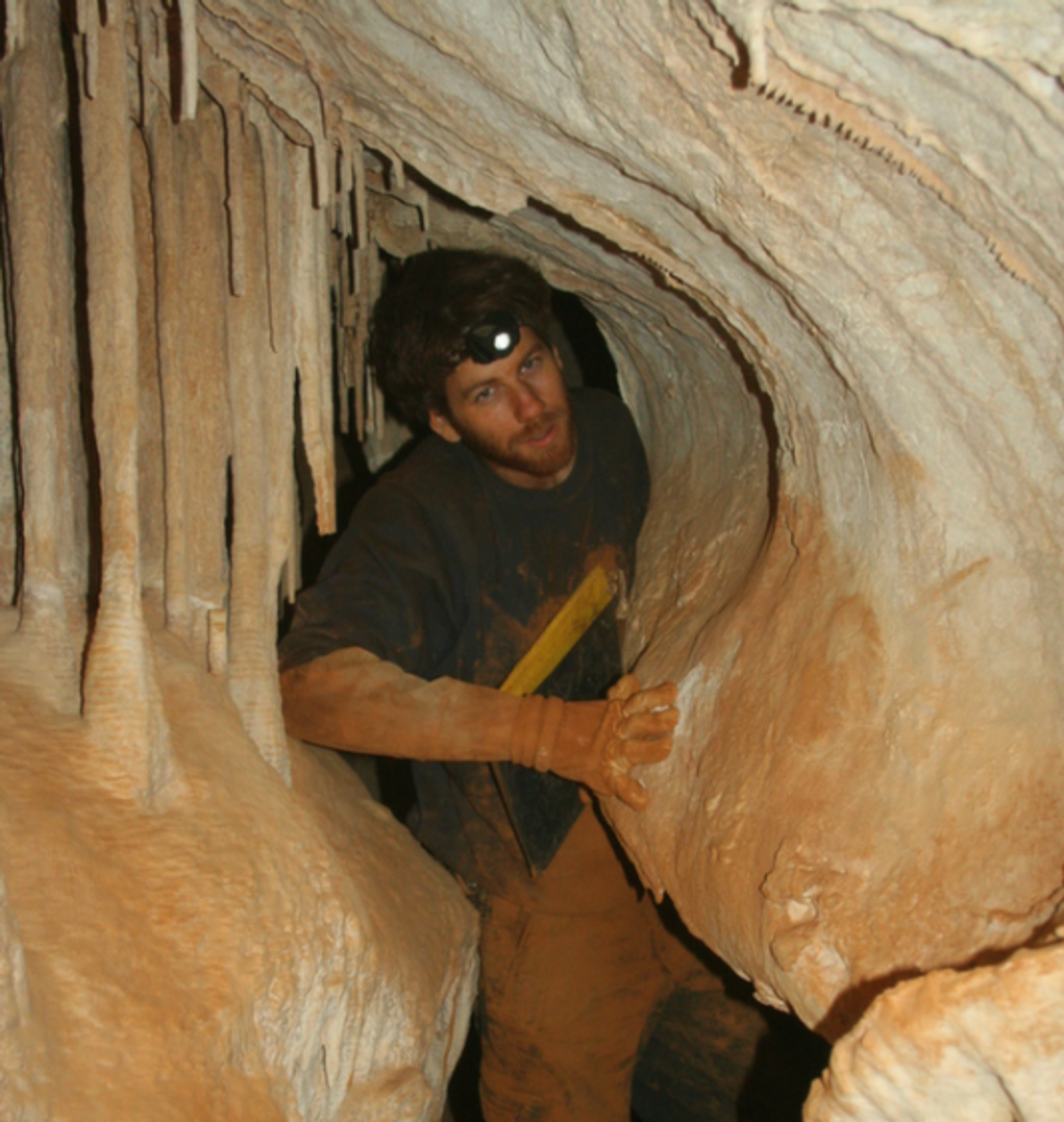
The cave has a small, arched entrance measuring 0.6X1.5 m. The entrance leads to a wide chamber (A) extending along a general NNW - SSE axis, with overall dimensions of about 30X9 m and a typical height of about 2 m. The chamber floor is covered with loose soil, debris and many animal remains, among which concentrations of bones and skulls stand out. In the center of the chamber ceiling a wide, rounded dissolution dome opens, rising from the ceiling surface up to a height of 4.5 m (above ground level). Several passages extend from the chamber and lead to different parts of the cave. One of these passages extends from its northern side for 6 m and leads at its end to another chamber (B), which developed along the same axis as chamber A (chamber B measures 35X10 m, with a typical height of 3.5 m). The passage connecting the chambers looks like a narrow passage with a semicircular cross-section. Its floor is covered with dry, compacted soil and several dissolution domes open in its ceiling. At the junction of the passage with chamber B there is a steep slope (gradient 26), from which soil slides down and fills the connecting passage2.
The floor of chamber B is covered with a thick layer of loose soil and a few collapse boulders. The walls and ceiling of the chamber display a prominent rounded morphology in the form of smoothed walls and blind chimneys extending from the ceiling surface up to a height of 12 meters (above ground level). On the northern side of the chamber there are two short passages extending along a parallel axis: NW-SE - and in them animal bones and plastic debris are scattered, which indicate that the passage connecting the two chambers was open until recent years. On the floor of the northern passage there are speleothems in the form of tiny needles with a transparent, glittering texture (gypsum needles?).
On the southern side of chamber B there is a low, wide passage leading to a passage junction (C). A turn north at junction C leads to an elongated passage parallel in its axis to the two passages mentioned in the north of chamber B. It is about 30 m long and is blocked at its end by a rockfall that makes it difficult to continue along the passage. Blind chimneys also open in the ceiling of this passage. In one of these chimneys, the one closest to junction C, there are speleothems in the form of well-developed salt flowers. From junction C another passage extends to the southwest, in which rockfalls are common. The humidity in this passage is higher than in chamber B. At the end of the passage there is a junction leading to narrow passages which further on split again into additional passages until they become narrow and difficult to pass.
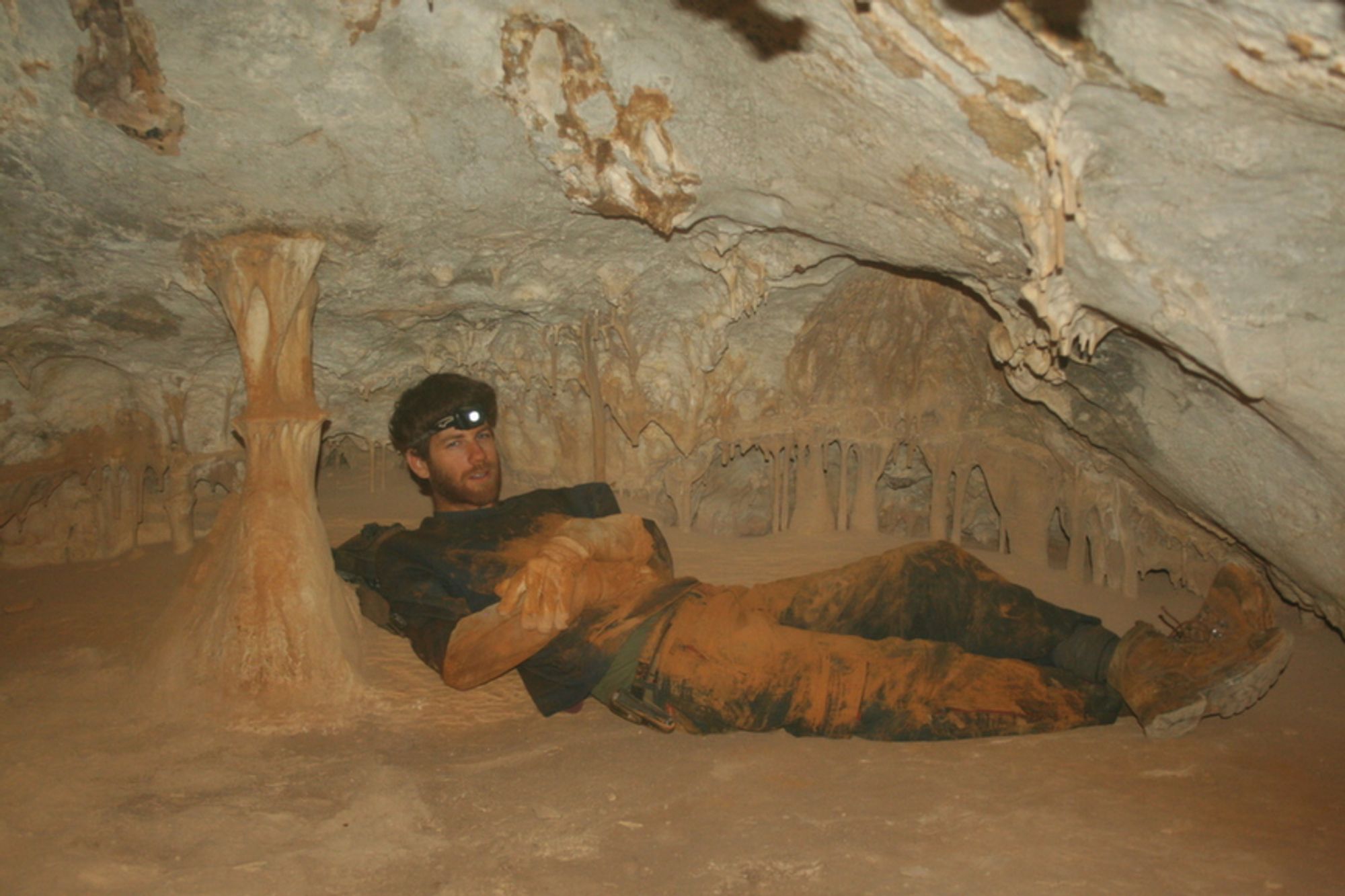
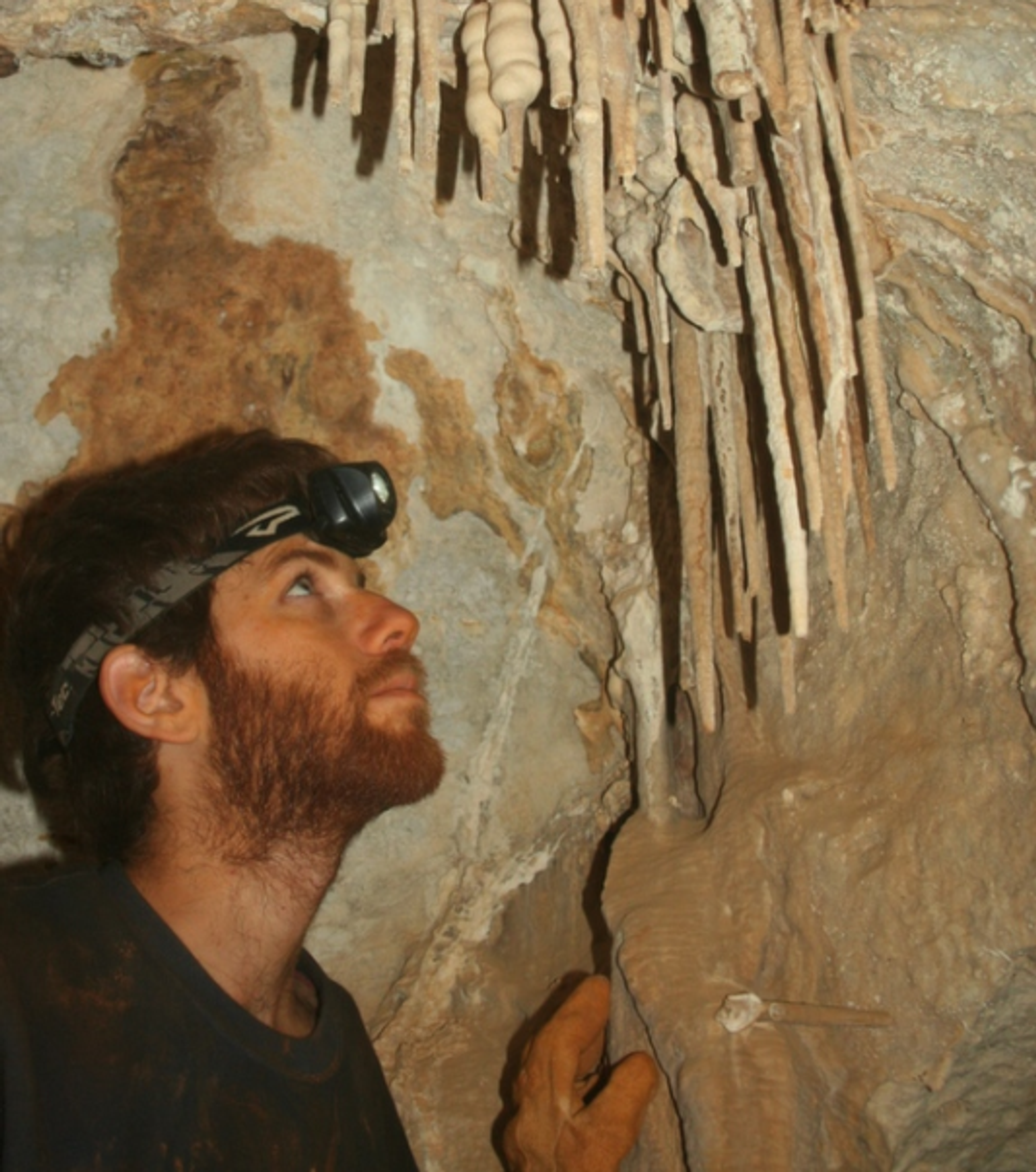
At the southwestern end of chamber A there is a low, wide opening leading to a series of small spaces (D) extending along a general E-W axis and sloping eastward along this axis. These spaces are characterized by a rich concentration of speleothems, among which stalactites, stalagmites, columns and flowstone stand out. On the floor of the western space in this series there are pool deposits, indicating the presence of standing water in this area. During a visit to the cave in February 2011 this area (where the pool deposits appear) was found flooded by a pool of water measuring about 3 X 3 m and about 80 cm deep.
At the end of the series of spaces D, the passage descends in a vertical shaft about 2 meters deep and connects at its bottom to another passage that is parallel to the series of spaces D and similar to it in character, except for the scarcity of cave deposits in this passage.
On the eastern side of this passage it crosses a wide space (F), from whose southeastern side another narrow, low passage extends, which leads at its end, after about 18 m, to the cliff face - entrance II.
On its western side, the passage connects to the SE corner of a wide chamber (chamber E). Passages extend from this chamber in various directions. The passage described crosses chamber E and continues in an ascent to the northwest for about 25 meters (G), and at its end reaches a rounded shaft about 2 meters deep, which forms the end of the passage. Near this shaft there is a well-developed chimney rising to a height of about 20 meters, from which, at various levels, there are short passages with a rounded profile. In the highest of these passages, tree roots can be seen penetrating into the cave space.
Along passage G there are many branches leading to short passages that extend to the northeast or southwest and end after a short distance. In all of these passages, as well as in passage G, the humidity is high, creating, among other things, damp, compacted ground.
On the northern side of chamber E there is a passage junction. A turn east at this junction leads to a wide passage (I) whose ceiling has collapsed in various places. The collapse of the ceiling, which was low to begin with, created blockages that make passage to different areas of the passage difficult. In the center of passage I there is a wide opening leading to a short passage descending south and leading at its end, after about 5 m, to a rounded room with a horizontal floor. The walls of the room are covered with many speleothems. Despite the physical distance of this room from the series of spaces D, it is separated from them by a wall only 6 meters wide, so it seems that the deposition of speleothems in this room may be related to the deposition that took place in the series of spaces D.
From the passage junction in the north of chamber E another passage extends north (H), and after 10 meters it turns sharply east and continues in that direction for another 20 meters. At the point of the turn, a short branch sloping sharply to the southeast joins passage H. This branch is almost completely blocked by a massive collapse of its ceiling. Despite the collapse, or precisely because of it, at this point one can see the development of the space parallel to the dip of the beds in this part of the ridge.
Notes:
- The cave entrance can be reached on foot up the channel in which its entrance is exposed. The channel can be reached from the road connecting Hatrurim Junction and Zafit Junction. About 2 km south of Hatrurim Junction, on the western side of the road, a prominent jujube tree grows. From the jujube tree one can climb up the channel to the cave entrance.
- No bats were observed in the cave, but there are prominent concentrations of guano in it. In August 1988 Gad Shvager reported seeing a single bat of the horseshoe type. The bat was seen in the area of the series of spaces D.
- There is active presence of a hyena in the cave (observed by the Arad rescue unit in January 2011). This activity, as well as the activity of porcupines in the cave, is the cause of the very intensive presence of cave ticks in all the spaces of the cave, even in those most difficult to access.
- Passage through the various parts of the cave is mostly done by crawling. It is advisable to bring protective equipment to reduce exposure to cave ticks.
Written by: Boaz Langford