Sfunim Cave, Carmel
- Location
- Nahal Sfunim (Nahal Matla), western Carmel
- Elevation
- 121+ m (above sea level)
The cave entrance is exposed in the southern bank of Nahal Sfunim (Nahal Matla), about 10 meters above the stream channel. The cave can be reached by a walk of about one kilometer along a red-marked hiking trail, which starts from Highway 4, about one and a half kilometers north of Moshav Magadim. Vehicles can be parked at the start of the trail, outside the boundaries of the banana plantations beside the road.
The entrance:
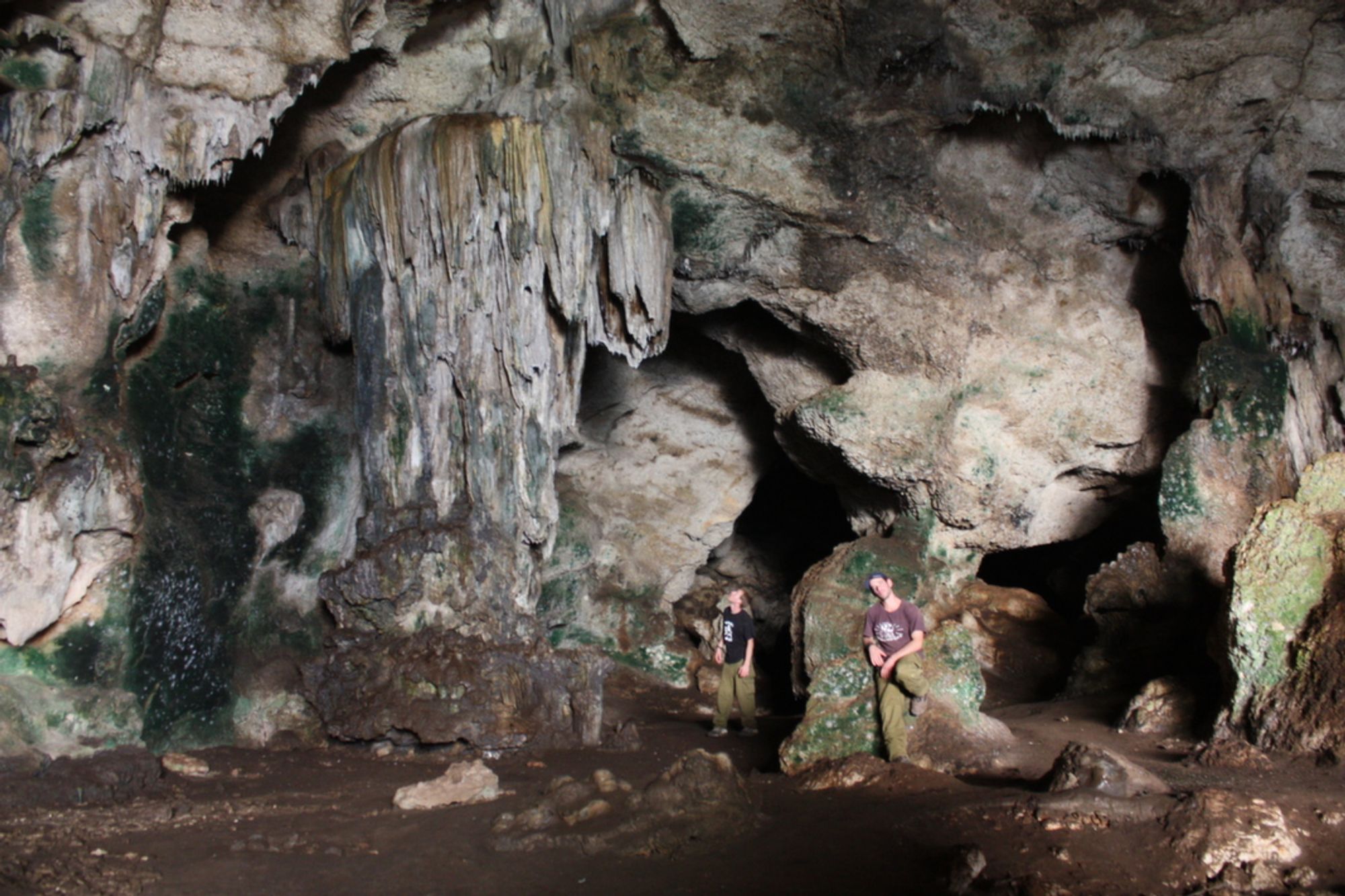
The entrance measures 12.3X3 m and is arched in outline. It is partly blocked by large collapse boulders, which attest to the former extent of the cave ceiling line.
The main space:
The main entrance leads to a large chamber 46 m long and up to 24 meters wide. At a distance of 22 meters from the entrance line there is a speleothem curtain 10 meters long, and facing it stands a huge speleothem column about two meters wide. These two divide the main space into two wings: a front (northern) wing and a rear (southern) wing. The front wing measures 22X23 meters and its height reaches 15.5 m. In its front part, on the east side, there is a low passage leading to the secondary entrance. Signs of the archaeological excavation conducted in the cave are evident on the floor of the space, mainly in the entrance area. In the middle of its eastern wall there is a small gallery, 5X3 m in area, located 2 meters above the floor of the space. On the western side of the chamber, from ceiling height down to the floor, there is a huge rockfall covering about a third of the chamber's area in this part. Between the scree boulders there is a narrow gap (1 meter wide and 30 cm high) leading to an elongated passage that continues in a downward slope to the west. At the end of the passage there is another narrow gap connecting the passage with the western space of the cave (see below).
The rear wing measures 21X24 and its height reaches 9 m. This height was measured to the top of a large dissolution dome, in which a colony of fruit bats (about 30 individuals) was observed. Along the eastern wall of the wing there is a gallery covered with flowstone. The gallery is 5 meters wide and 8.5 m long, and lies 1.6 meters above the chamber floor. Along the southern and western walls of the rear wing a network of passages with an elliptical cross-section and smooth walls has developed. The total length of the passage network reaches 100 m. Their typical width ranges between 1 and 3 meters, and their height does not exceed 1 meter. Vigorous porcupine activity (bones, quills, droppings) was observed in the passages. Porcupine activity is certainly the reason for the presence of the cave tick in this part of the cave.
Geology and morphology:
Sfunim Cave is a phreatic hypogenic cave that developed in limestone rich in marine fossils, of the Muhraqa Member of the Bina Formation. The cave has the morphology of a large chamber with an arched ceiling. At the southern end of the chamber a network of low, narrow passages with an elliptical cross-section develops. In the rear part of the chamber there is a high dissolution dome, which also indicates phreatic morphology.
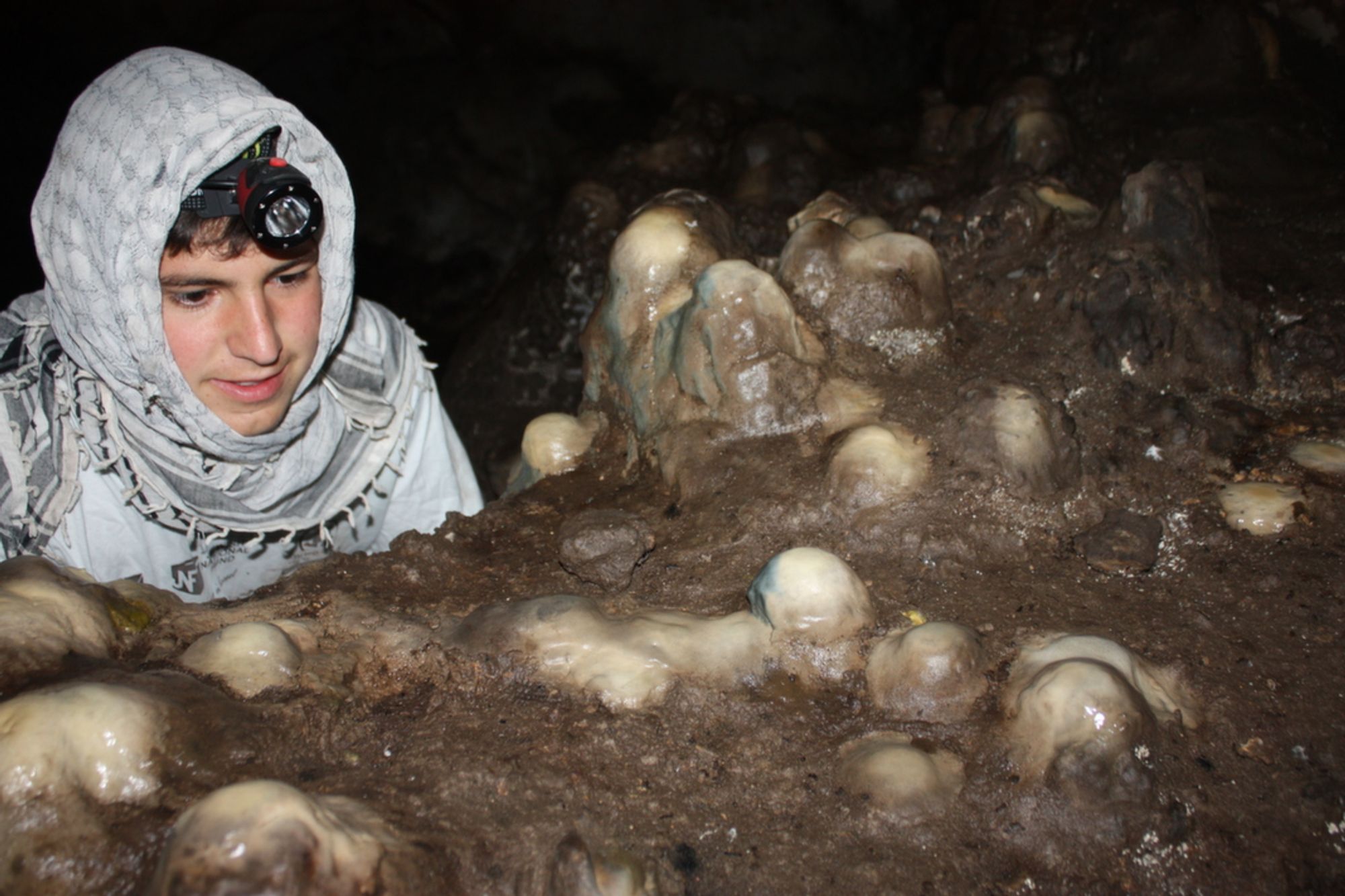
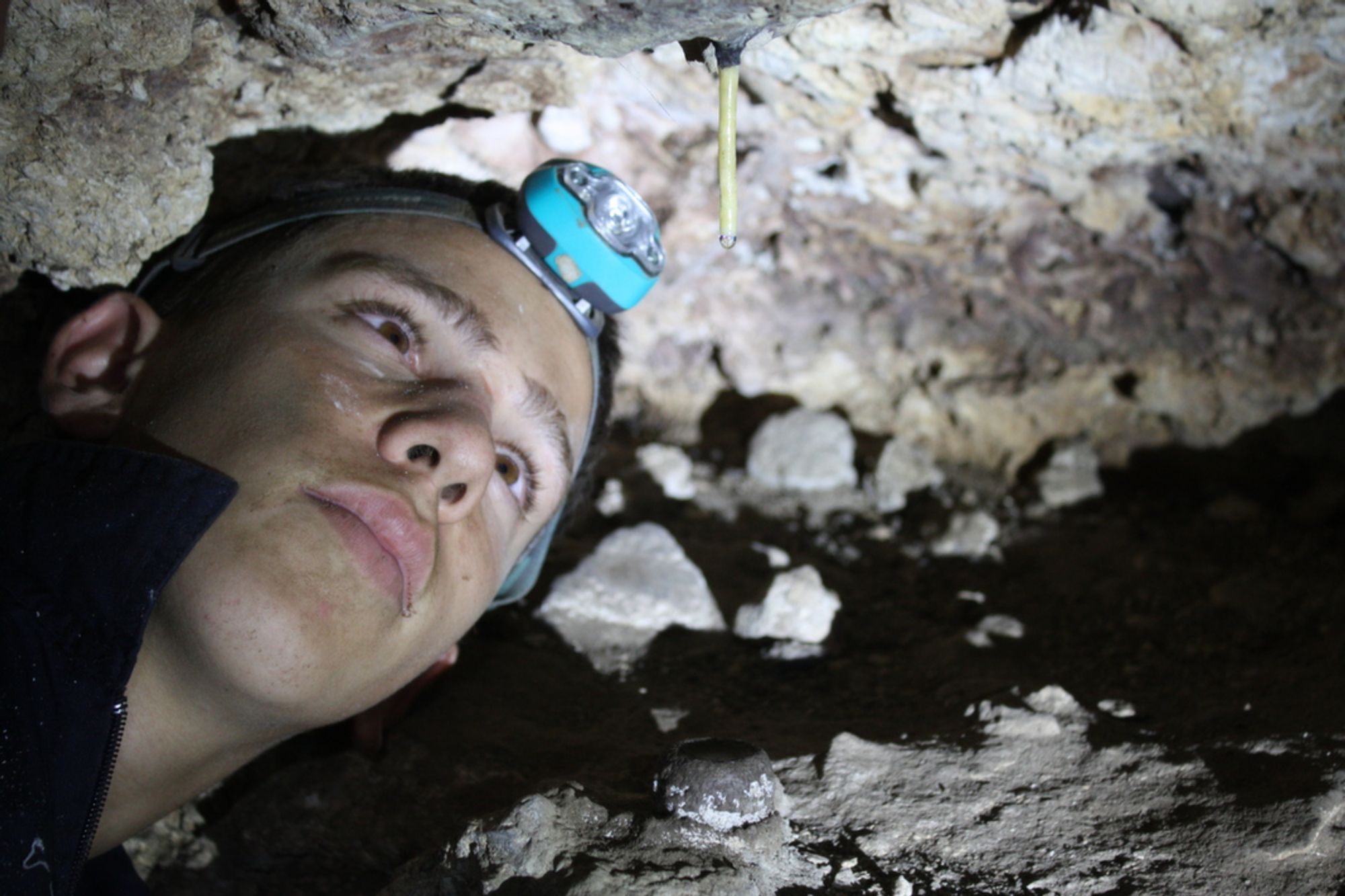
The main space is divided by a speleothem curtain, beside which stands an especially large and impressive speleothem column (its diameter is more than a meter). Another, finer and more beautiful column formed in the high part of the main space, above the huge pile of collapse boulders along the western wall. At several other points in the high ceiling of the space there are several clusters of stalactites. In the rear parts of the space near the low passages there are a few flowstone surfaces. Vadose karst activity still takes place in the cave, and it is muddy and damp.
Animal activity:
In the rear part of the central space there is a high dissolution dome in which a colony of several dozen fruit bats roosts. In the narrow passages at the sides of the space there is porcupine activity (porcupine quills, gnawed animal bones). A relatively small presence of the cave tick is also found in these passages. In all parts of the chamber, mainly in the semi-lit area, many arthropods are present.
In the various parts of the cave there is porcupine activity (quills, droppings, gnawed animal bones, including half of a jaw of a very large herbivore). Single individuals of the lesser horseshoe bat (or one of the small-bodied horseshoe bat species) and several individuals of the greater horseshoe bat were observed. Clusters containing several individuals of moths were observed adhering to the ceiling in several parts of the chamber and the spaces beside it.
Research history, archaeology and human activity:
The cave (that is, the eastern space only) was first reported in 1908 by A. von Mülinen (Mulinen 1908), who noted that the locals used it as a source of phosphatic potassium (originating in guano) for making gunpowder, and for this reason the locals called it Araq al-Barud (that is, the abyss (which in this case is used figuratively for the cave) of gunpowder). In 1941 Moshe Stekelis excavated in the cave, and later the cave was examined again as part of the prehistoric survey of the Carmel carried out by Olami (Olamy 1984: site 87 pp.91-93). The cave was excavated a second time in 1965-70 by Avraham Ronen of the University of Haifa, and the finds were published in a detailed report (Ronen 1970). In the summer of 2013 research in the cave was renewed with a limited excavation in the entrance area, in order to study anew the Upper Paleolithic layers in the cave. The project is led by Ron Shimelmitz of the University of Haifa and Andrew Kandel of the German Max Planck Institute. The area they excavated was covered with a black nylon sheet, which can be clearly seen below the drip line, in the eastern part of the entrance.
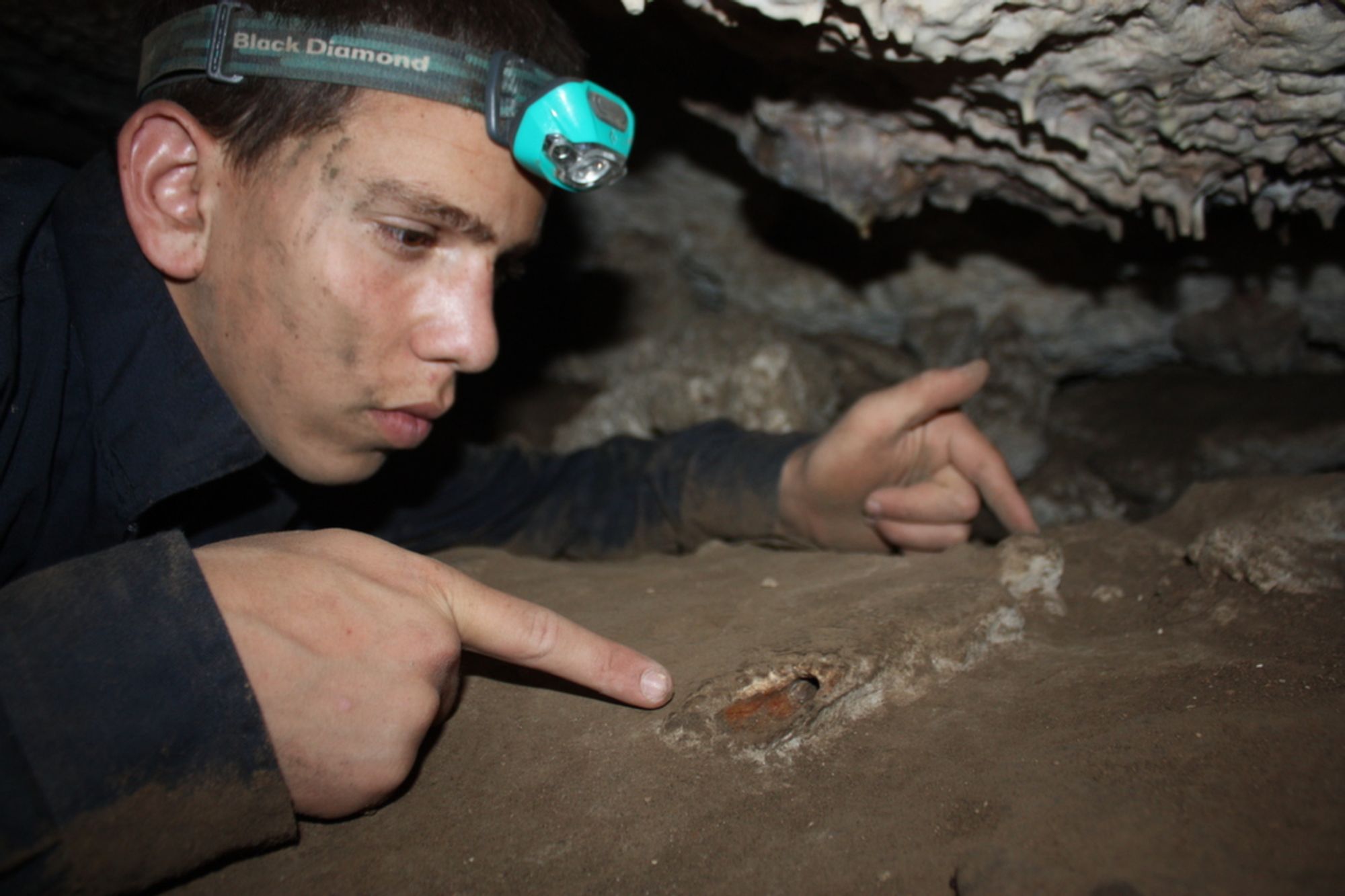
The archaeological finds in the cave (in the main, eastern space) include the following periods: Middle Paleolithic, Upper Paleolithic, Epipaleolithic (Geometric Kebaran), and are characterized by finds of knapped flint items and remains of animal bones. Today very few flint items and a few pottery sherds can be found on the floor of the space. An elongated bone (human?) cemented in flowstone was found by us between the speleothem curtain in the center of the chamber and the entrance to the system of low passages on its western side.
One of the old maps of the cave (Mount Carmel survey, Menachem Marcus) indicates that in the innermost part of the main chamber there is a stone basin hewn in the bedrock. During the re-mapping of the cave (M. Ullman, B. Langford, S. Avni, Y. Polansky, D. Ben-Tov) no evidence of the existence of such an element was identified at the spot.
Written by: Boaz Langford
Total length: 206 m