Pitriya Cliff - Cave 10
- Grid ref.
- 172822/117402
- Location
- Nahal Tekoa
- Elevation
- 522 m above sea level
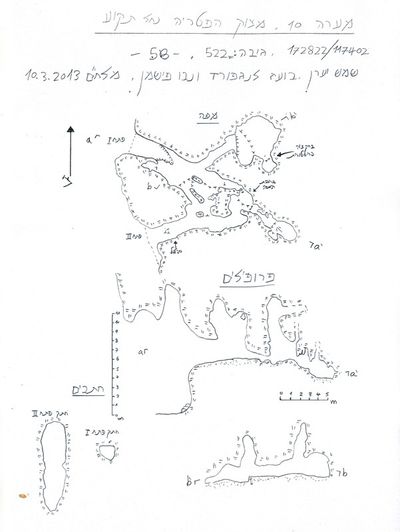 Cave mapView the map (PDF)
General:
Cave 10 in the Pitriya Cliff is a medium-sized cave (cumulative length 63 m and cumulative height 10 m) consisting mainly of a branching network of passages. Throughout the cave there are rounded dissolution marks, blind chimneys, and dissolution domes, indicating that the cave formed by phreatic-hypogene dissolution processes that acted in Turonian limestone (Shivta Fm.).
The cave was discovered in 1984 during a cave survey carried out by the youth club of the ICRC, led by Amos Frumkin (Frumkin 1986), and appears in that survey as Cave number 10 or, according to the marking of its openings, Z1+Z2. The cave was examined again in February 2013 by Shemesh Yaran, Boaz Langford, and Nevo Fishbein, who carried out a full map of the cave.
Description of the Cave:
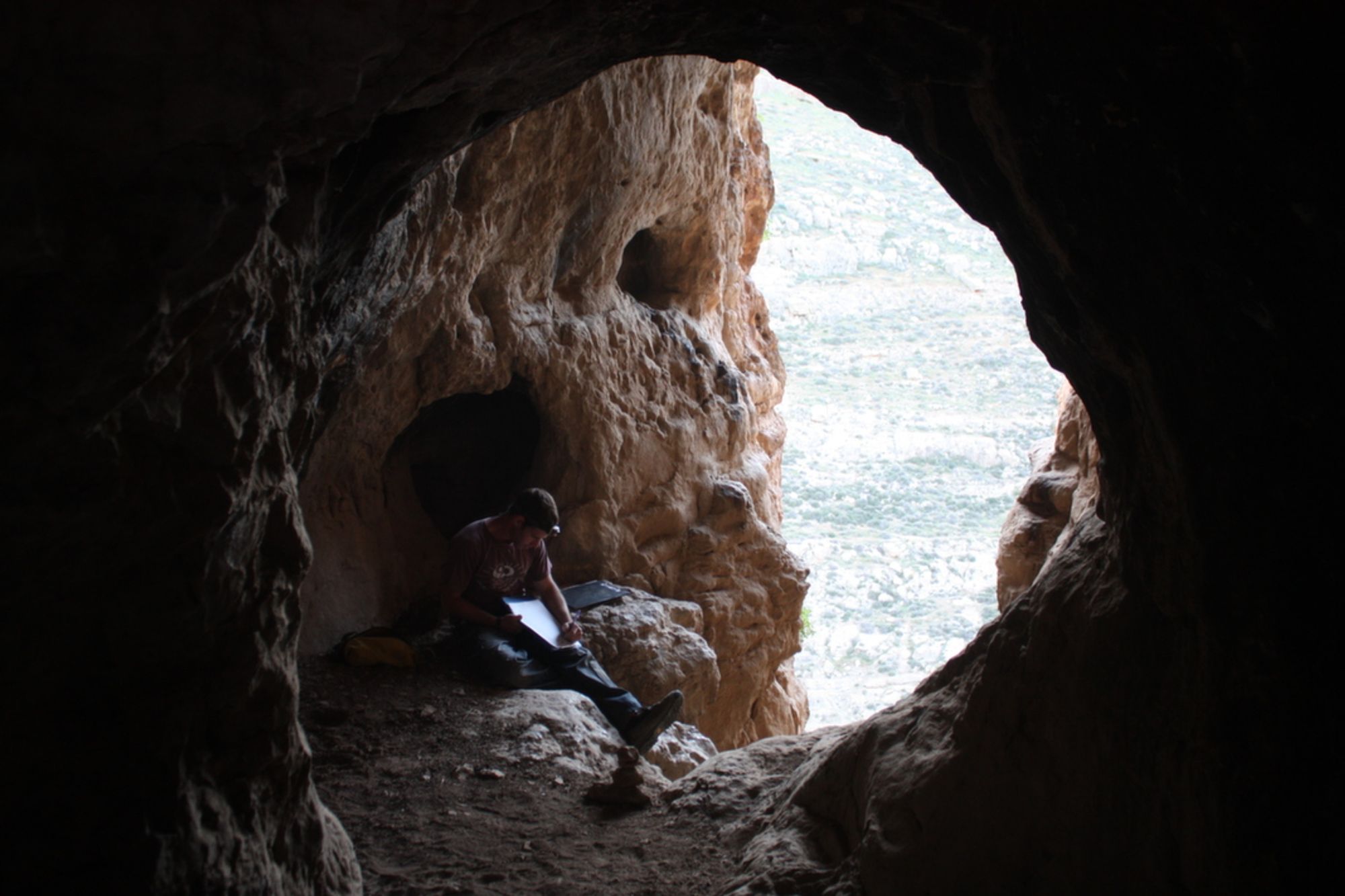
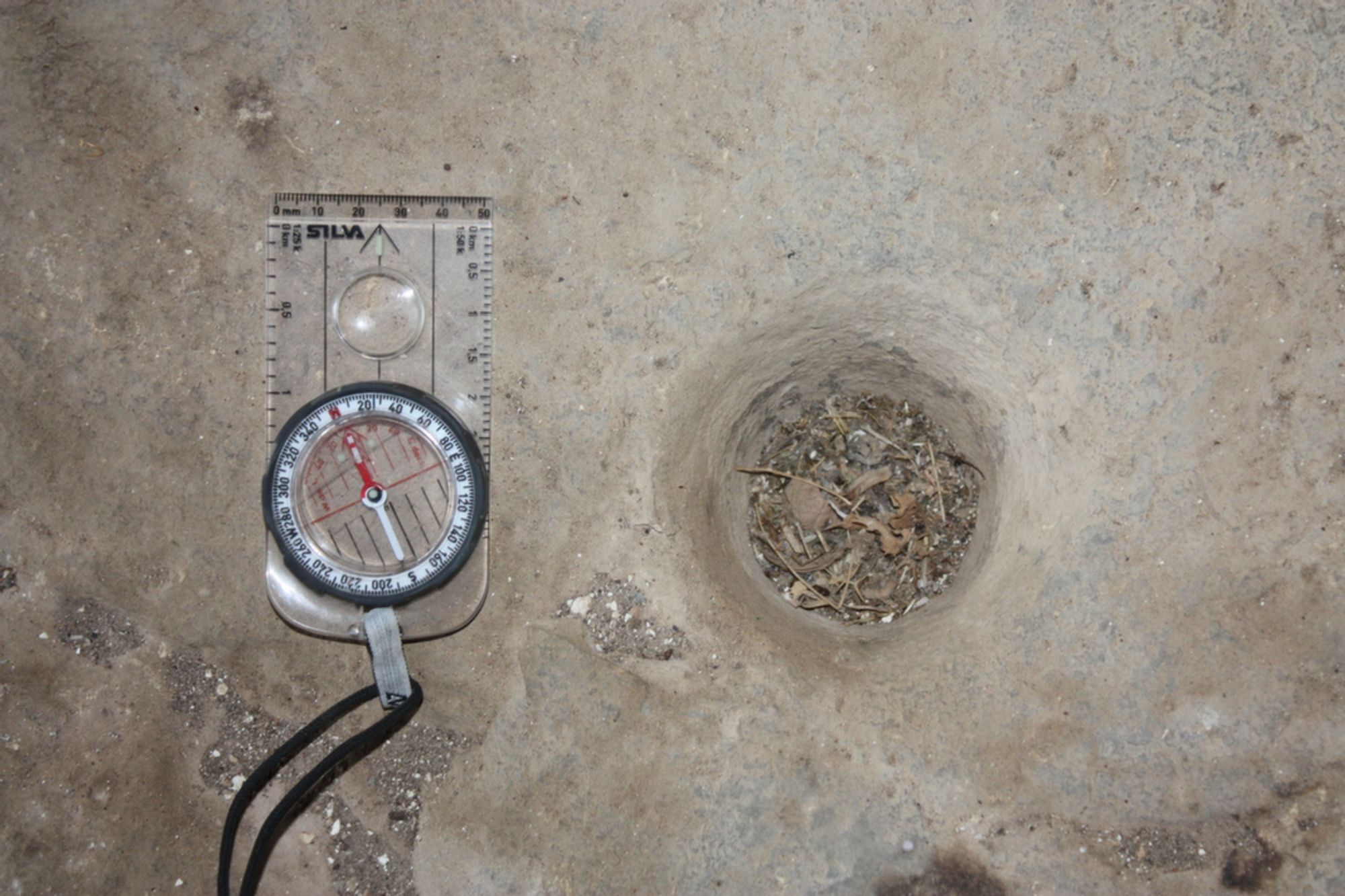
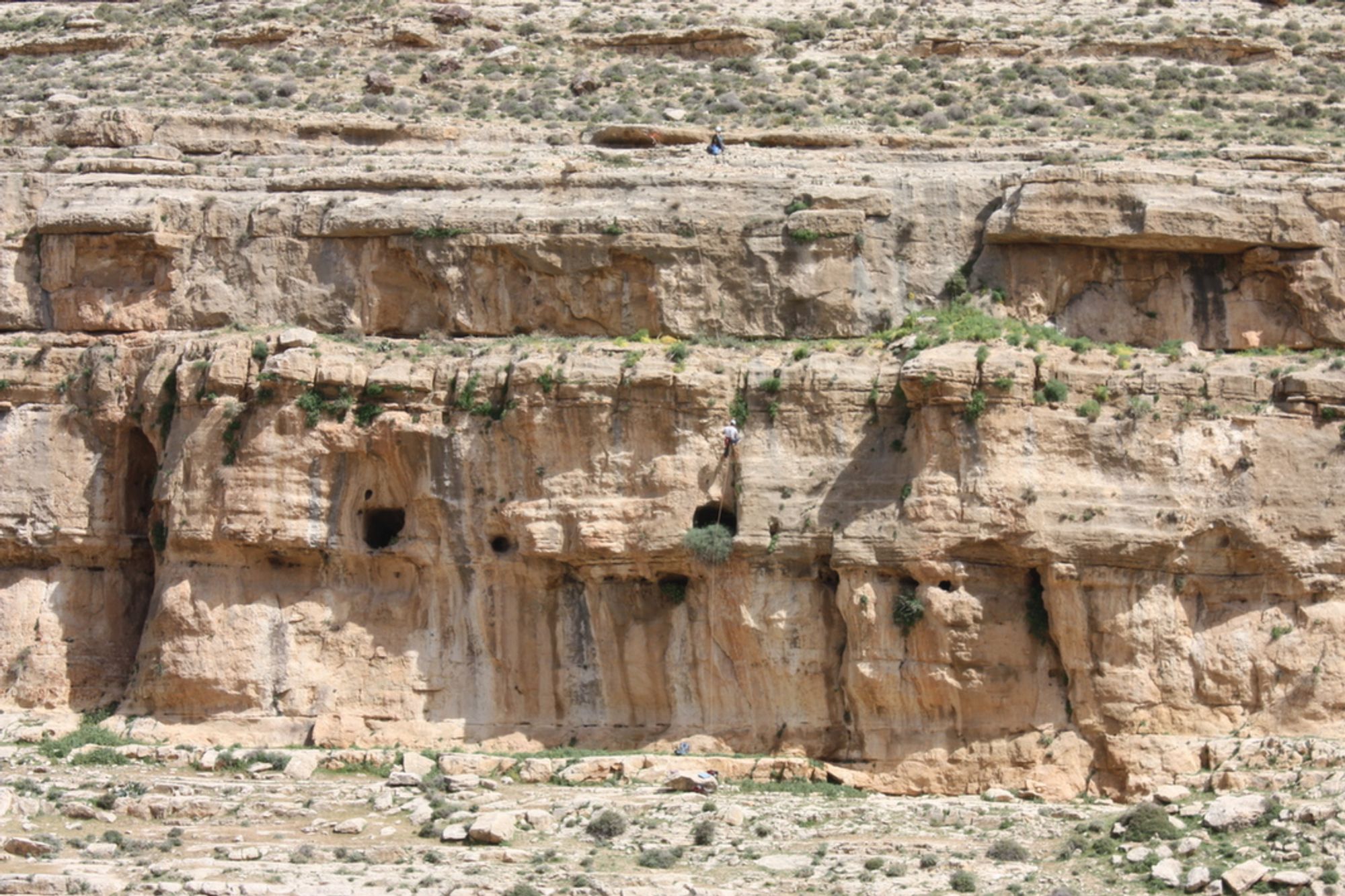
The cave has two openings about 10 m apart. The main opening is the northern opening of the cave, which looks like a large elliptical slit (9.7X2.2 m) facing northwest. The level of the cave passages is in the upper part of the opening, about 6 m above the base of the cliff. At this point there is a kind of lit "balcony" overlooking the stream bed. The floor of the balcony on its northern side consists of exposed bedrock, and on its northern side, adjacent to the cave wall, a shallow conical cupmark is carved (its diameter is about 6 cm and its depth similar). The cave opening leads to a wide (2.5X3 m), semi-lit space that is the most central junction in the cave. On the northern side of the space there is a narrow opening leading west to a short corridor that after 5 m joins a rounded room that forms the northern limit of the cave. The room measures 5X5 m and its typical height is about 2 m. The room floor is horizontal and covered with loose soil and a few rocks, among which very few pottery sherds are scattered. The room ceiling is uneven, mainly because of the many dissolution domes opening in it (the highest of them reaches up to 5 m above the room floor). Few cave deposits, some of them active, coat part of the dissolution domes. On the southern side of the room there is a low niche at whose opening a light-colored, crumbling breccia was laid down, containing countless bones of small animals, mainly rodents.
On the eastern and southern sides of the entrance space there are small openings leading to the southern passage of the cave. This passage runs parallel to the entrance space, to the south of it, and on its western side it connects with the secondary opening of the cave. The opening measures 1.7X1.55 and its general shape is rounded. On the inner side of this opening too a shallow cupmark is carved, similar in its characteristics to the one carved in the balcony at the top of the main opening. On its eastern side the passage turns north and connects to a rounded room. In the room ceiling there is a blind chimney rising up to 7 m above the room floor. The walls of the room and of the chimney are completely covered with calcitic cave deposits, which also coat the walls of a narrow opening on the eastern side of the room. East of the opening a sloping corridor extends, descending and connecting, after about 3 m, to another room that also has a high blind chimney in which calcitic cave deposits were laid down.
Notes:
- The Pitriya Cliff can be reached on foot from the settlement of Nokdim, which lies above the eastern bank of the stream. From the top of the stream bank one can proceed north and descend to the foot of the cliff along a steep ridge on which a comfortable trail runs (marked with a blue trail marking). From the middle of the ridge one can proceed along the foot of the cliff to the cave opening. Entering the cave requires a climb of about 6 m from the base of the cliff to the level of the cave passages.
- During the visit, several arthropods were observed in the cave, including: a Mediterranean recluse spider, a moth, and beetles of the darkling beetle family. No bats were observed during the visit, but small guano clusters were found.
For more information:
A. Frumkin 1986, The Formation of the Caves of Nahal Tekoa, Nikrot Tzurim 13, pp. 33-41.
Written by: Boaz Langford