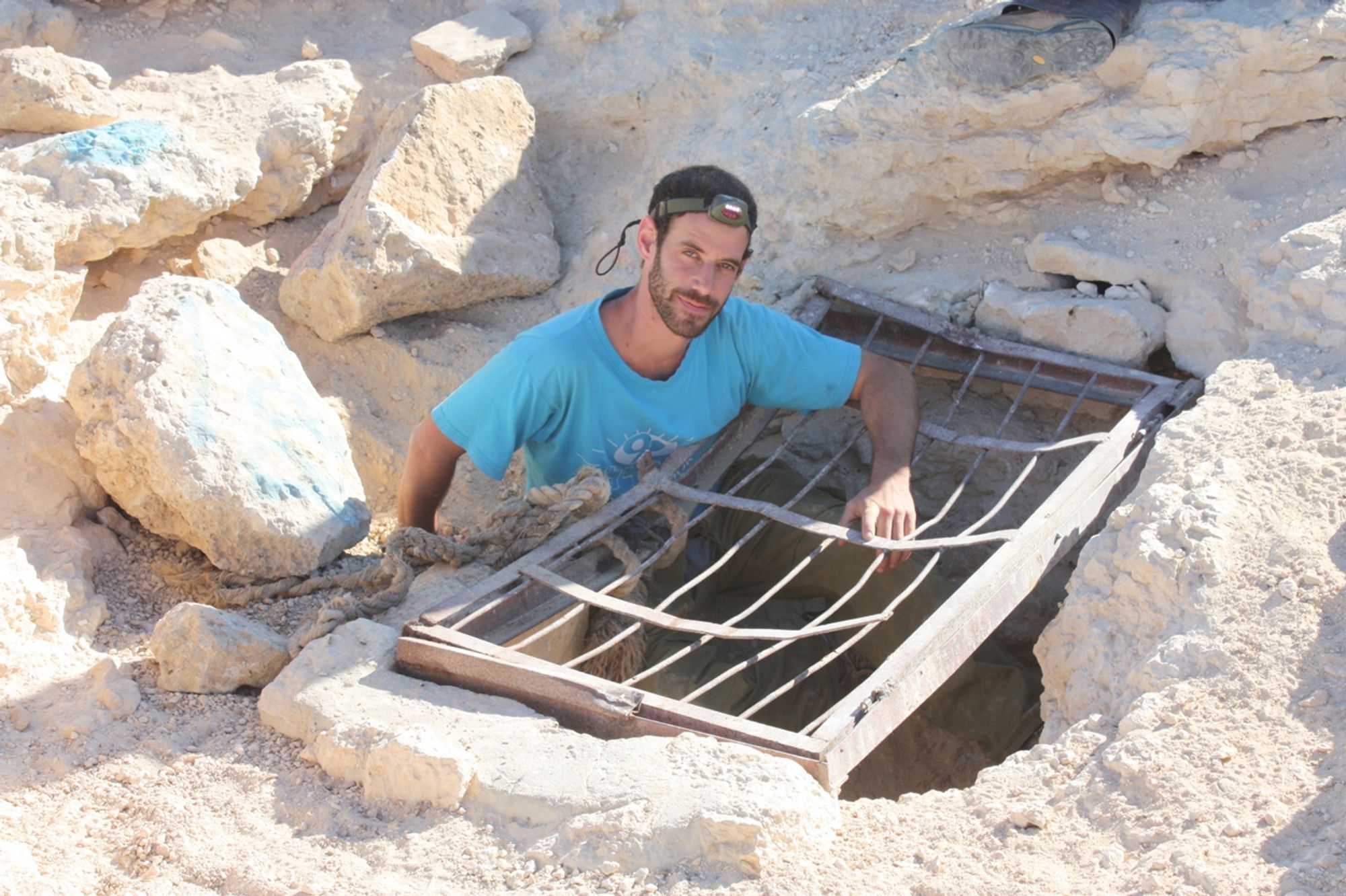
Mitzpe Ramon Cave, the Negev
- Grid ref.
- 129882/003061
- Elevation
- 845 m above sea level
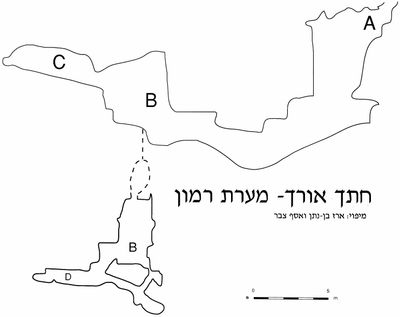 Cave mapView the map (PDF)
General:
Mitzpe Ramon Cave is a medium-sized cave (total length 75 m) consisting of an elongated corridor and several sub-spaces. The cave was formed in limestone and dolomite of Cenomanian age, with its entrance opening at the base of the Avnon Formation and most of the space formed in the Zafit Formation. The rounded profile of the cave spaces, as well as rounded dissolution domes and hollows, indicate that the cave was formed as a hypogenic cave in the phreatic zone. Dry cave deposits, scattered throughout the cave, represent a vadose stage later than the draining of the cave.
The location of the cave appears in the landscape survey by Menachem Marcus, 'Ramat HaNegev: Landscape Survey and Hiking Routes'. The cave was surveyed and mapped by the ICRC (Erez Ben Natan and Asaf Tzabar) in 1999.
Cave description:
The cave entrance opens on a local spur separating a pair of open channels that eventually drain into upper Nahal Hava. The entrance measures 1X1 m and its general shape is rounded. From the entrance a wide vertical chimney extends (about 7 m deep), leading to the northern side of a tall corridor. The corridor continues in a descent to the southeast, semi-lit, and becomes dark only from its center. The floor of the corridor is covered with stones, a little gray sediment and a great deal of pigeon droppings. From the center of the corridor its floor slopes upward toward its inner part. At the height of the end wall of the corridor, about 1.5 m above its immediate floor, there is a rounded opening leading to an oval room (C), which forms the end of this branch of the cave. Another room (D), narrower than the previous one, extends parallel to it but on a lower level, also branching off from the end of the main corridor.
Notes:
- Access to the cave is possible on foot from the western edge of the town of Mitzpe Ramon.
- The cave entrance is blocked by an iron grate. A narrow gap between the grate and the wall of the entrance allows squeezing into the cave. The descent to the cave requires the help of a 10 m utility rope.
- No bats were seen in the cave and no guano was observed.
Written by: Boaz Langford
Region: Negev Hills