Hon al-Watwat Cave, Binyamin
- Grid ref.
- 1883/1520
- Location
- Eastern Binyamin
- Elevation
- 57 m above sea level
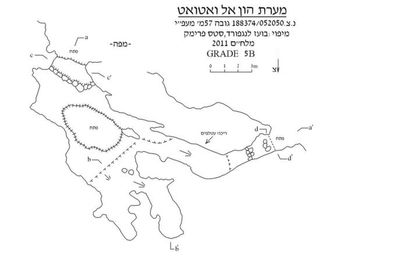 Cave mapView the map (PDF)
Description of the cave:
General:
Hon al-Watwat Cave is a medium-sized cave (total length 40 m) that developed by phreatic dissolution processes in limestone of Turonian age (Shivta Fm.). The cave consists mainly of a number of small spaces (a wide room and a number of short passages) that developed in bedded limestone dipping at about 24.5º in a north-north-west – south-south-east direction.
The cave was discovered by Vladimir Boslov, Boaz Langford and Stas Primak in 2011 during a search for Amal al-Watwat Cave. The feverish search and the chance discovery of another, not small, cave gave the cave its name.
The entrance and its surroundings:
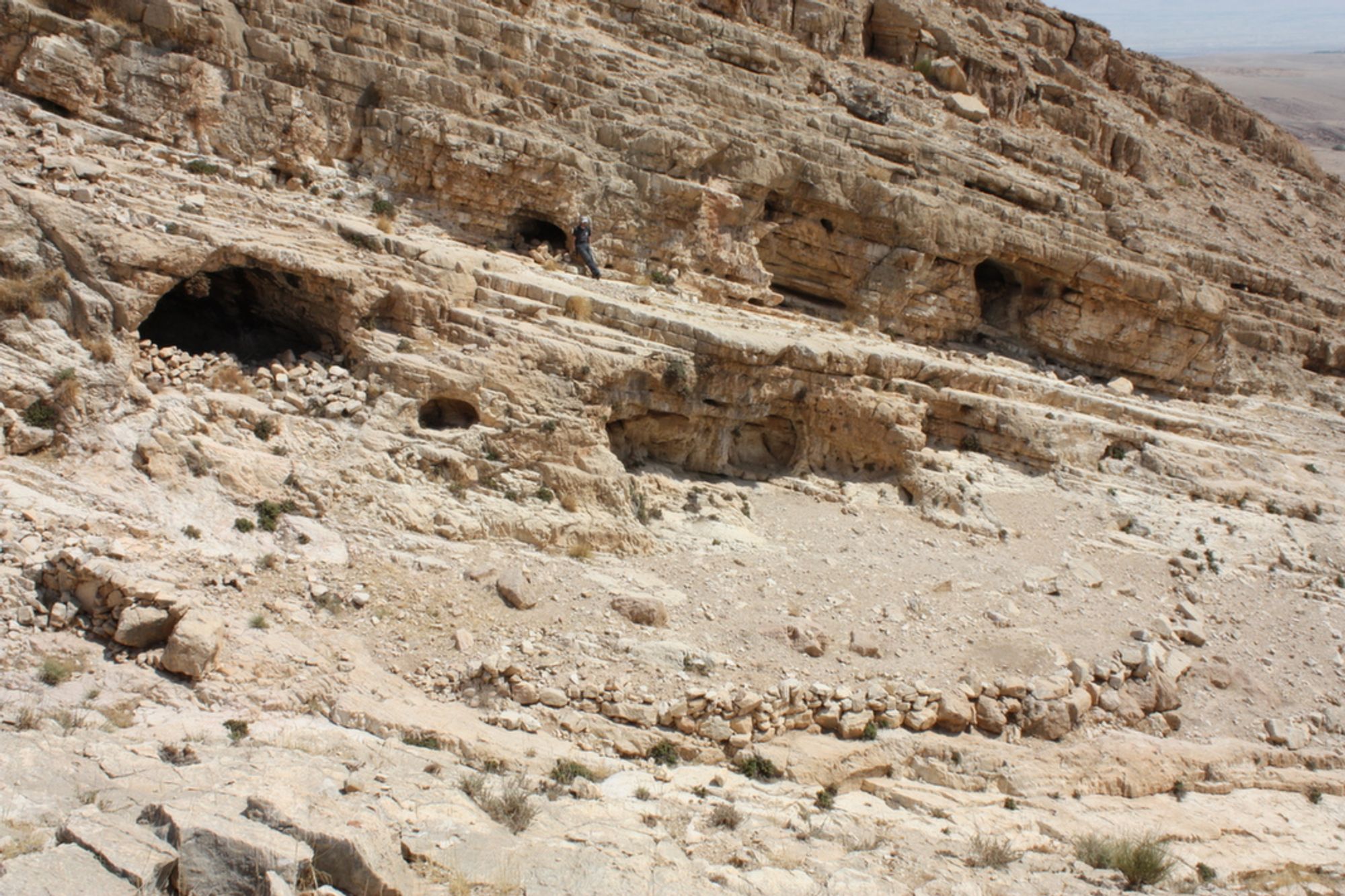
The cave has two horizontal entrances that open at the bottom of a rock step in the slope of the northern bank of Wadi a-Nubiris. The cave entrances are about 14 m from each other. The dimensions of the eastern entrance are 2.8X1.8 m and its general shape is rounded. The western entrance is smaller, its dimensions are 1.4X0.9 m and its shape is square. This entrance is blocked by a poor, collapsed fieldstone wall. In front of the entrance, below another rock step, there is a wide terrace bounded by a low fieldstone wall. Entrances of small spaces opening in the vicinity of the cave and the terrace are also blocked by poor walls. A small structure, built of fieldstones, stands opposite and close to the cave entrance on the bank of a small gully draining into the bed of Wadi a-Nubiris from the north.
The cave space:
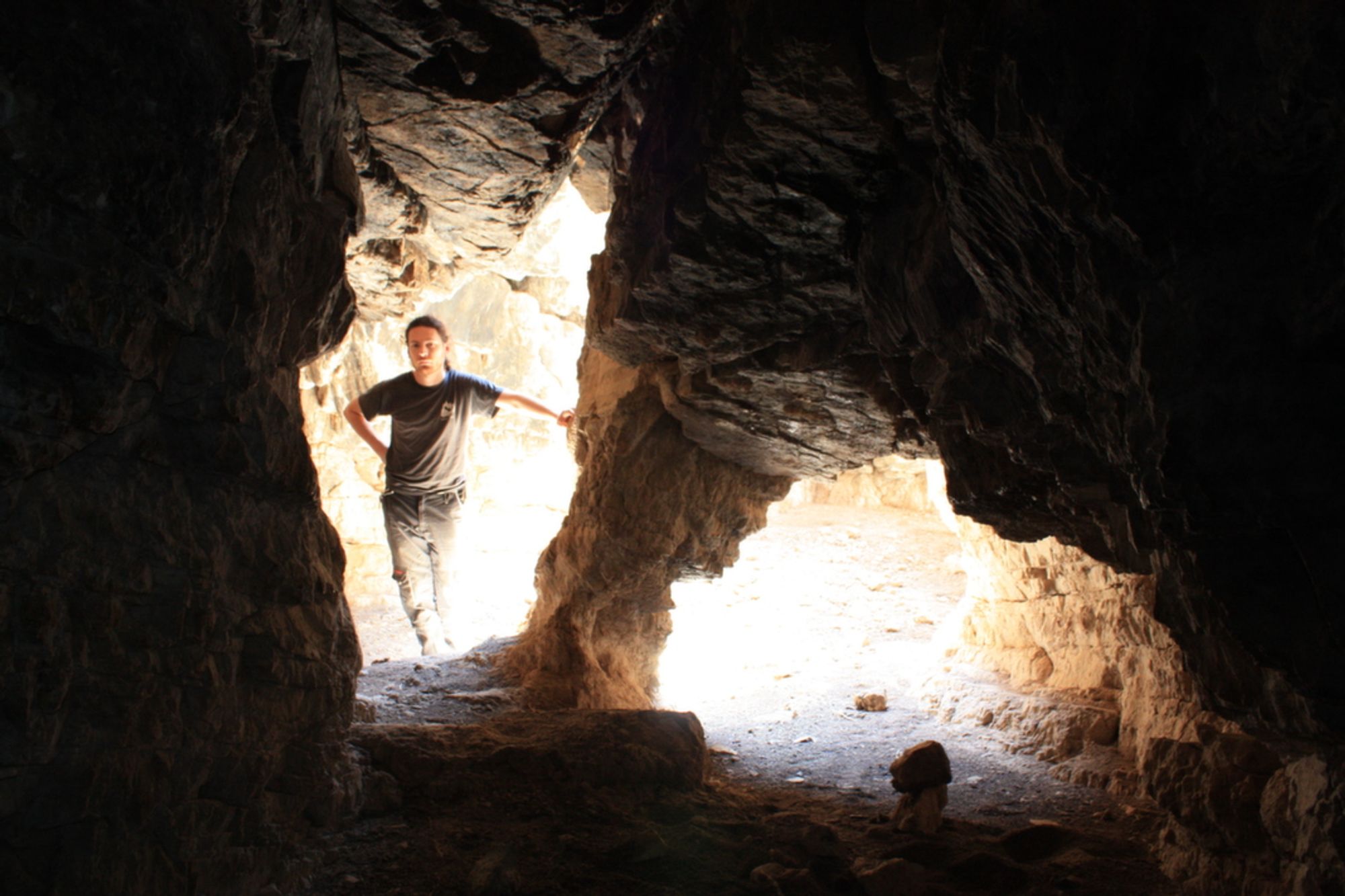
The western entrance of the cave leads north to a spacious, lit room, its dimensions 7X4 m and its height varying. Following the dip of the rock layers in which the cave developed, the room space is located slightly above the level of the entrance. A step built on the inner side of the entrance, overcoming this slope, also creates a leveled floor in the room space. In the center of the room ceiling there is a large elliptical opening (4.5X2.5 m) that lights the room space and its immediate surroundings. From the northern side of the room extend a pair of short, low passages leading northwest, dipping in accordance with the rock layers in which the cave developed. On the western side of the room there is a natural rock pillar and beyond it a horizontal passage extends west. The passage dimensions are 1.5X1.5 m, its floor is covered with a layer of guano and in its ceiling a crack opens along which a tiny space developed, extending to a height of about 3.5 m above the passage floor. About 7 m west of the rock pillar the passage turns southwest and ends after another 5 m, where the western entrance of the cave opens.
Notes:
- Wadi a-Nubiris canyon can be reached by 4X4 vehicle, driving on a dirt road descending from the quarry north of Kochav HaShahar to the Wadi Auja pass. From the rim of the stream canyon one can descend on foot to the cave entrance.
- Very few potsherds were found in the cave space.
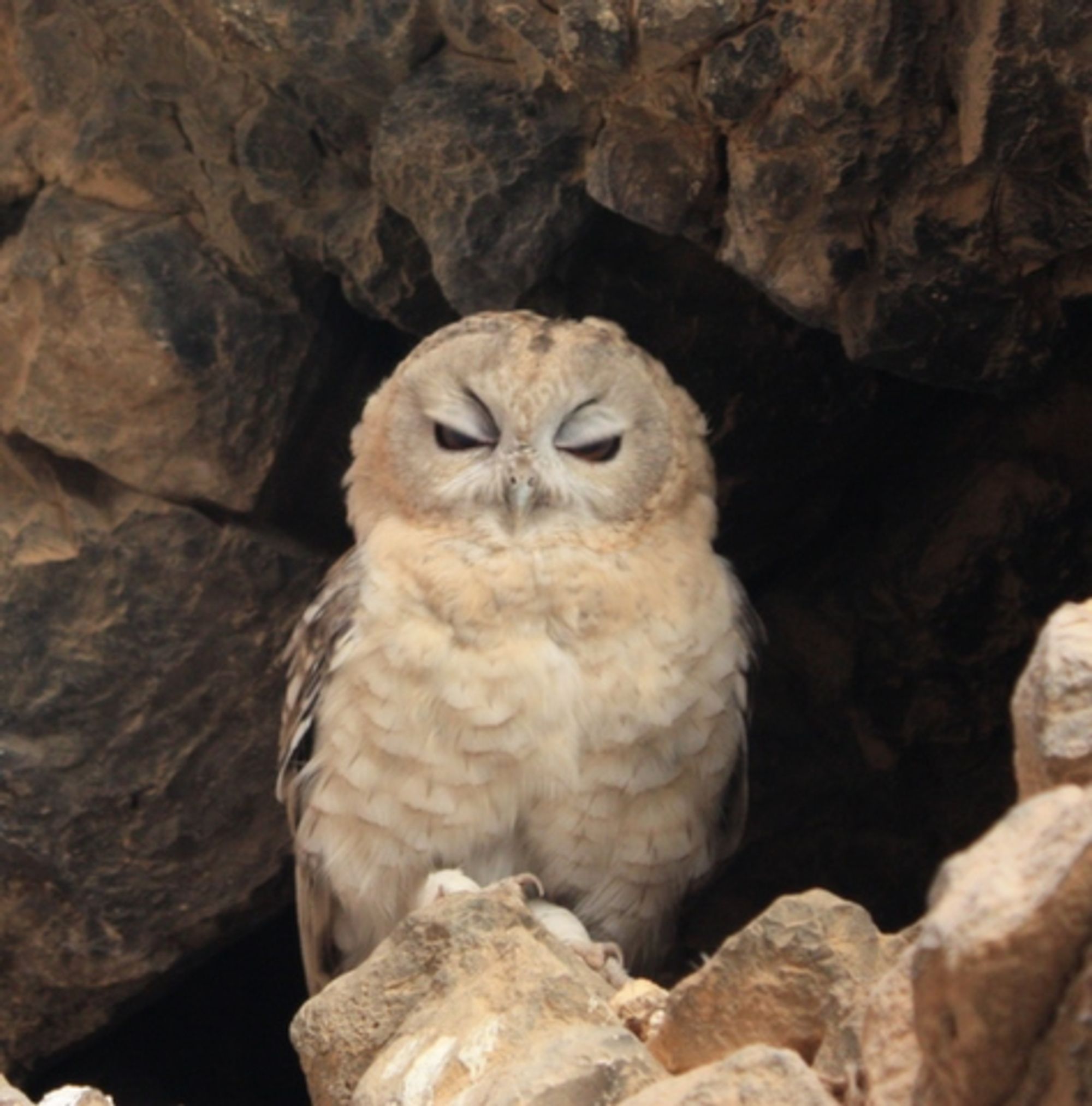
- During the visit to the cave about 50 individuals of the greater mouse-tailed bat species were seen in it. Also seen in the cave was a single individual of a nocturnal raptor of the little owl species, which had settled below the opening in the room ceiling. Near the western entrance of the cave a snake shed about 80 cm long was found.
Written by: Boaz Langford