El Kuliya 6 Cave
- Location
- South of the village of Yabrud
- Elevation
- approx. 635 m above sea level
Description of the Cave:
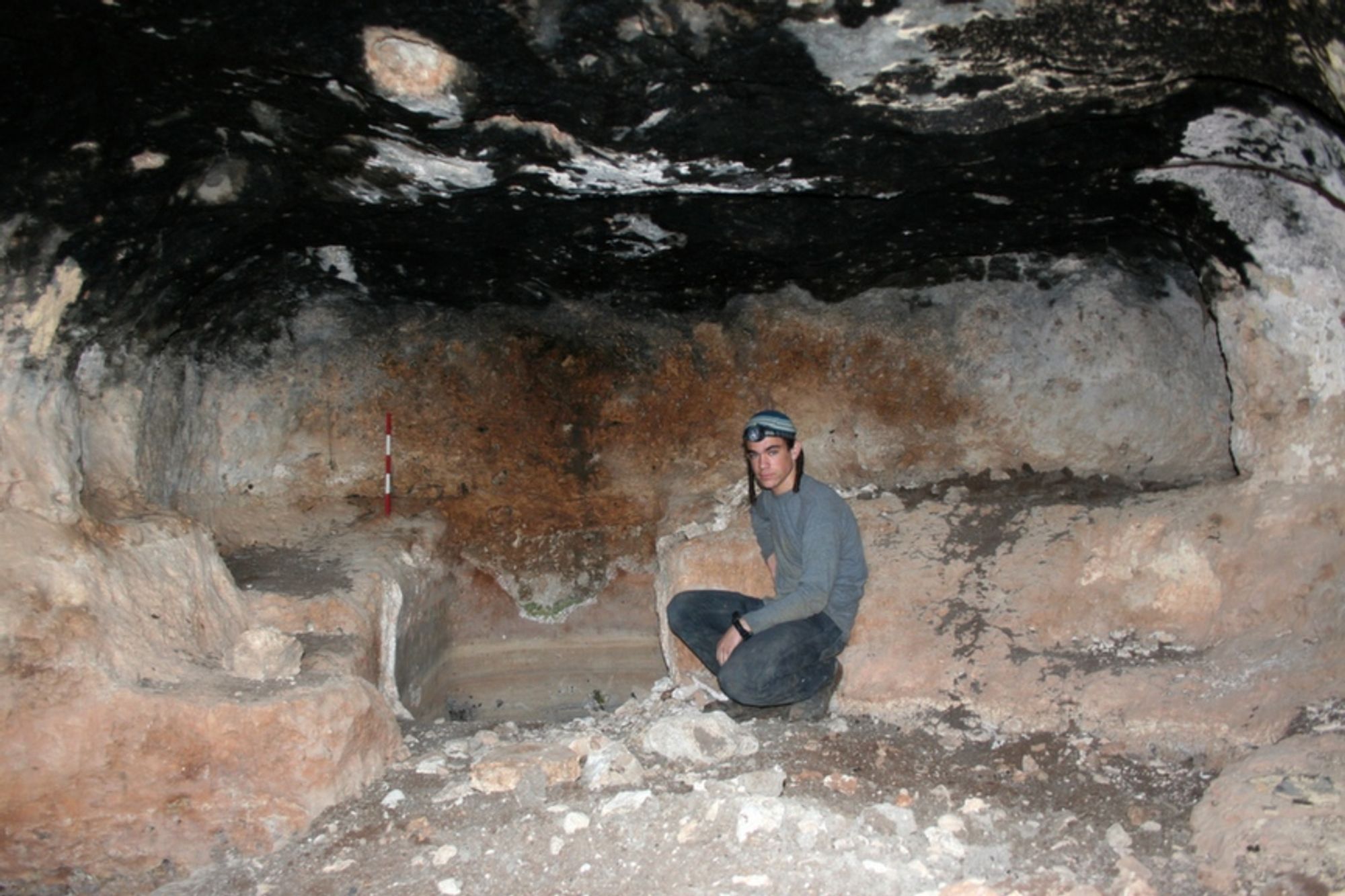
El Kuliya 6 Cave is a small cave consisting of a rectangular space measuring 3.5X6.5 m with a typical height of 1.6 m.
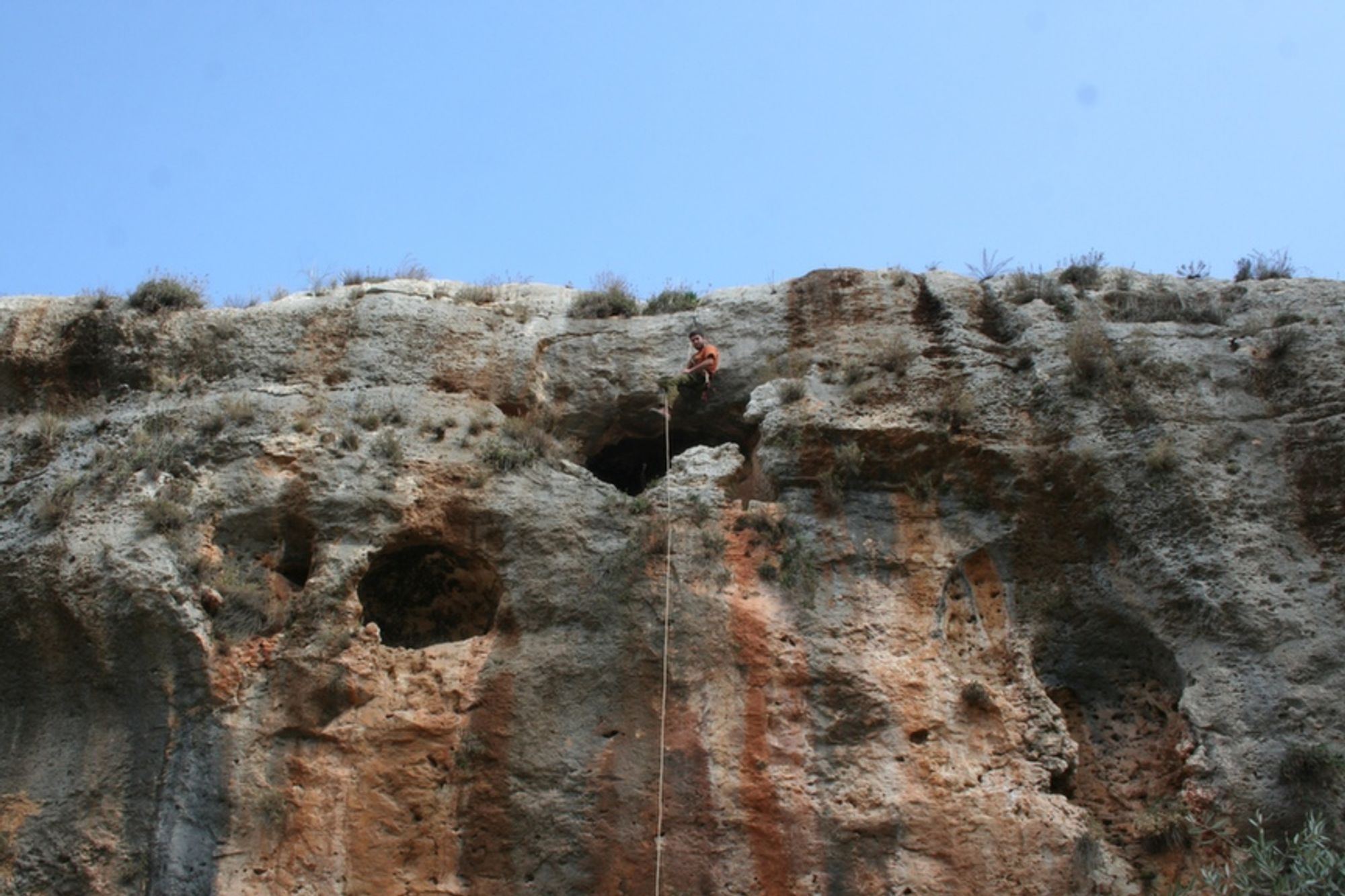
The cave opening is suspended in the upper part of a cliff, about 12 m above its base (close to Cave no. 1, to the east). Its walls and the upper part of the opening are rock-cut and form a rectangular shape, whereas the bottom of the opening is not rock-cut, and natural rock protrusions rise from it, between which a rectangular pattern is carved. On the inner side of the opening there is a pile of large ashlar stones that formerly blocked the cave opening (evidence of the blocking of the opening was given by Yoel Elitzur, who saw it so in the 1980s - see below). It can be assumed that the rectangular pattern carved at the bottom of the cave opening was intended to create a stable base for the stone wall.
On the inner side of the opening there is an area that looks like a kind of vestibule to the cave space. In the floor of that area, close to the opening, a shallow basin was cut, from which a drainage channel extends out of the cave opening. In the walls and ceiling of the vestibule, shelves, niches, and rock bridges are carved.1
On the northern side of the vestibule there is a low step descending to the central part of the cave. This step is accompanied by a slope of the cave ceiling toward its center - parallel to the descent of the floor. The center of the cave is a low area enclosed between the vestibule area, to the south, and a raised rock bench, to the north. The floor of this area is covered with dark soil and a little gravel and pottery sherds. On the eastern side of this area, parallel to the eastern wall and close to the rock bench that bounds this area on the north, there is a low, elongated step, on whose eastern side a wide niche was cut, protruding into the cave wall. The walls around the niche are covered with a thin gray plaster, whereas the ceiling is covered with a coarse plaster composed of yellowish clays and thin twigs.
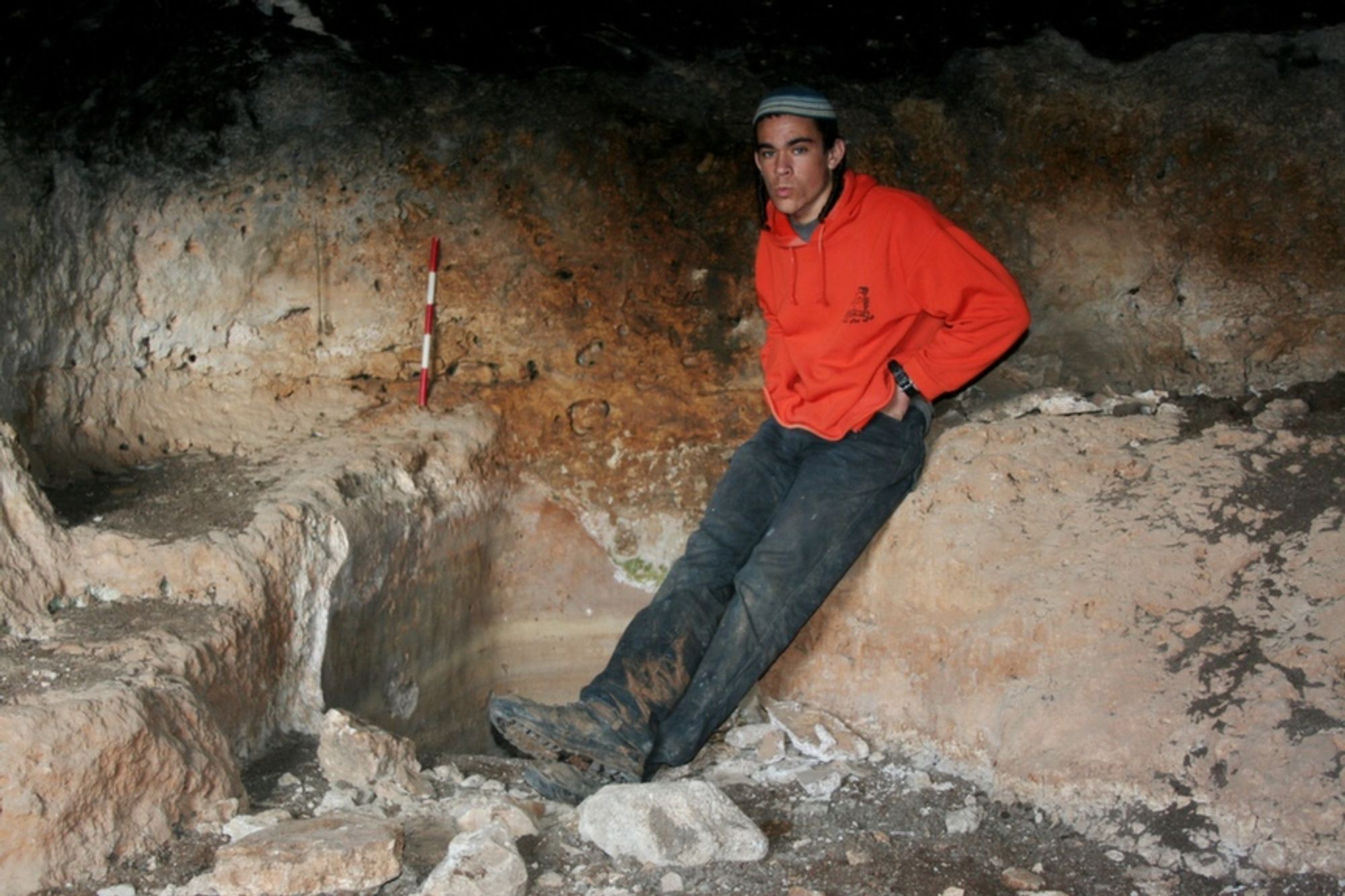
On the western side of the center of the cave, adjacent to the western wall, an unplastered pit is cut, measuring 1X1 m and about 1.4 m deep. On the southern side of the pit a deep step is cut through which one can descend to the bottom of the pit (this step perhaps hints at its use), and north of it an elongated shelf is cut, extending from the rim of the pit northward. On this shelf, close to the rim of the pit, a small, shallow cupmark is cut.
North of the center of the cave there is a rock-cut step about 0.5 m high, which forms a raised rock bench 1.7 m long and as wide as the entire width of the cave. This bench is divided into several levels and steps at various points, and in its center a water cistern is cut, plastered with three different layers of plaster. The cistern measures 1X1 m, its depth is 1.4 m, its rim is at the level of the floor of the center of the cave, and its bottom is covered with soil (the original depth may be greater by 0.1 to 0.2 m than its present depth). Close to the eastern rim of the water cistern there is a shallow cupmark cut into the rock bench.
It can be seen that this cave was cut on the basis of a karstic void that existed at the site before the quarrying, and that the quarrying only enlarged and shaped an existing void.
This can be concluded from:
1. The direction of the long axis of the room, which is identical to the long axis of the other caves of the stream.
2. Karstic niches and dissolution domes found in the walls and ceiling of the cave.
3. The cave walls that are not rock-cut have the meandering shape typical of the passages that make up most of the caves in the stream.
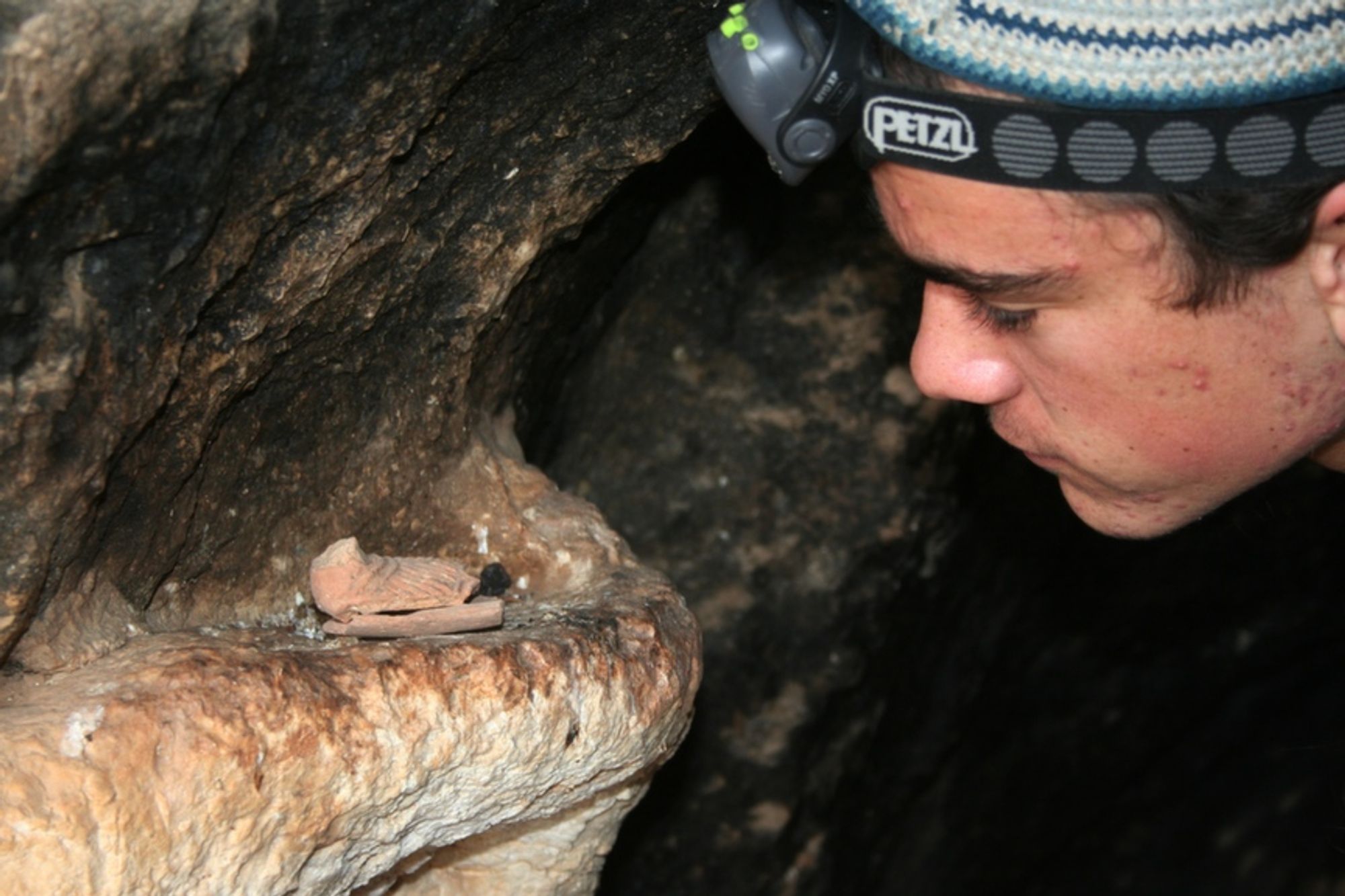
* Many pottery sherds are scattered throughout the cave space, as well as a few fragments of glass vessels. At the bottom of the plastered pit a fragment of a pottery lamp from the Umayyad/Abbasid period was found.