El Amud Cave
- Grid ref.
- 161305/184154
- Location
- South of Beit Lid
- Elevation
- m above sea level
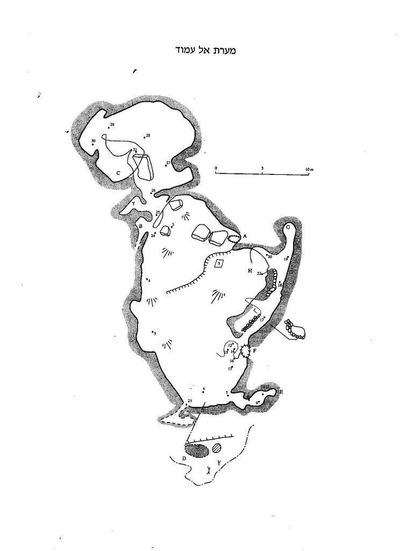 Cave mapView the map (PDF)
Description of the cave:
El Amud Cave consists mainly of a large chamber; the chamber is 30 m long, 14 m wide and up to 13 m high. The chamber floor is covered with collapse rocks and fill material forming a slope inclined south at an angle of 50 degrees. Several passages branch off from the chamber in different directions.
The cave is entered through a vertical shaft about 4 m deep. It is advisable to use a rope both in the shaft and in the cave to prevent slipping and falling, and one must move with great care. From the bottom of the shaft one must move close to the right wall, counterclockwise, down to the bottom of the chamber. Anyone who does not do so will meet an impassable drop about 5 m high. The northern part of the chamber has a relatively gentle slope, and boulders that apparently fell from the ceiling are scattered in it.
9 m west of the entrance, a low opening about one meter wide opens in the chamber wall, leading to the northwest wing of the cave. In this wing one descends at an average slope of 30 degrees through a system of spaces 1.5 meters high and a few meters wide, to space C. Many signs of collapse are evident, including of whole rock layers that once formed the ceiling. The rock layers in area B are horizontal, and in the wide section after it they dip 4 degrees at azimuth 240. In this wing, not all the passages and cracks between the rock blocks have yet been examined. In this part of the cave there are few travertine deposits.
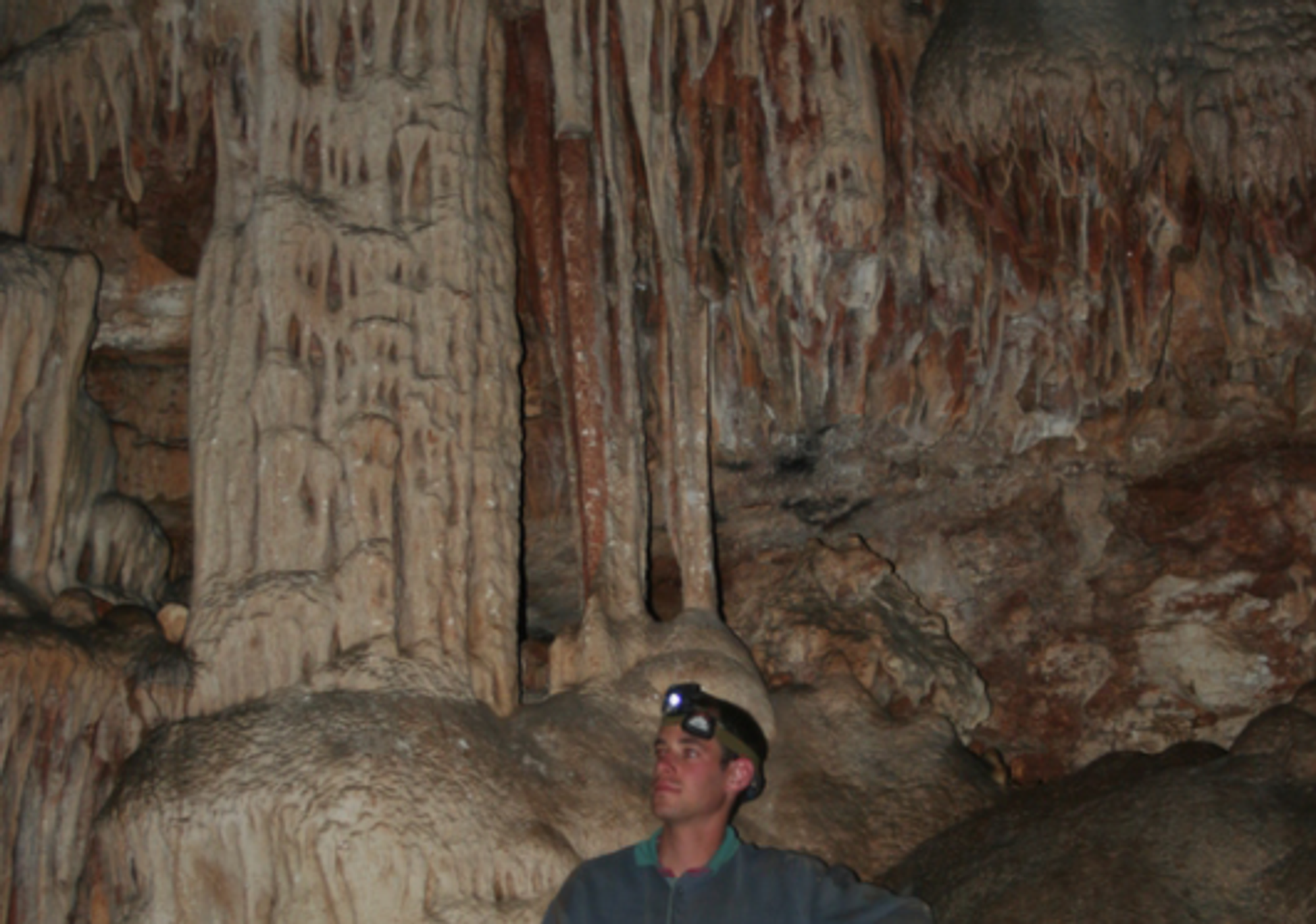
Let us return to the main chamber. Its ceiling is less sloping than its floor, and therefore the chamber becomes higher toward the south. In its southern part travertine deposits become very numerous on the chamber wall and ceiling. Common types are conical stalactites, elephant ears, pagodas and stalagmites.
From the lowest point of the chamber a narrow passage continues east, at a slope similar to that of the chamber. It is 10 m long, up to the deepest point in the cave, E. On its floor there is stone scree. In the wall there is a breccia of broken macaroni stalactites and calcareous mud. In this section, as in the whole lower part of the cave, there is active water dripping.
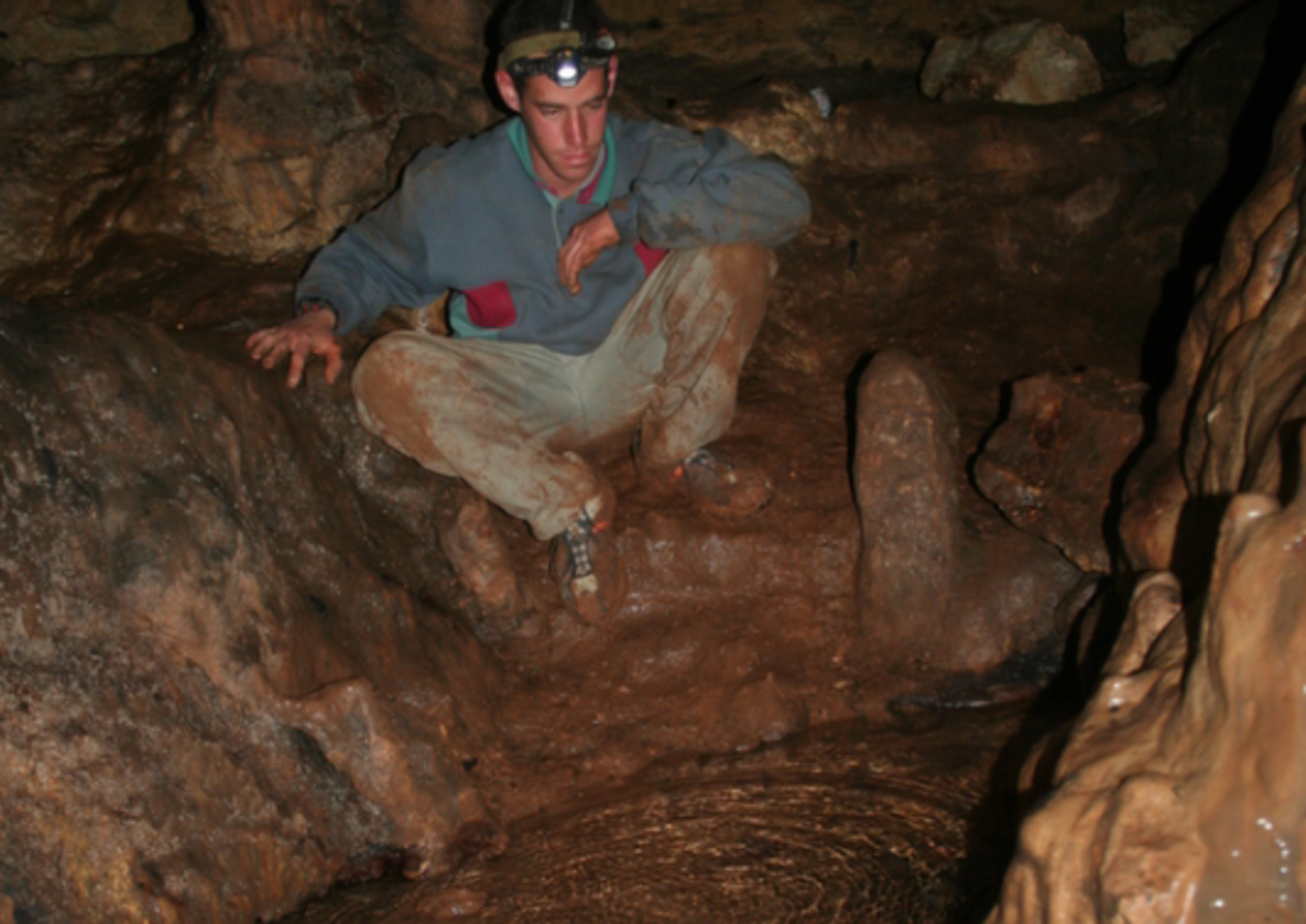
At a higher level, above the aforementioned passage, is the "Stalactite Bend", a wide horizontal passage about 10 m wide that connects two points in the chamber wall and leaves a rock "column" 2 m in diameter between it and the chamber. In the "Stalactite Bend" there is an abundance of travertine deposits. Especially prominent are pool deposits and the small water pools that deposit them. (The dimensions of the largest pool are 0.5x1 m). There is also a stalagnate here (a stalagmite that joined its stalactite).
From the eastern end of the Stalactite Bend one can descend by a shaft to the lower level F, or crawl northeast in a narrow horizontal passage 14 m long to G. The right wall of the passage is made of collapse rocks, the left of host rock. Near its end one can climb between collapse rocks back to the main chamber at point H.
No clear signs of dissolution were found in the cave. The dominant morphology is that of collapse. It can be assumed that the cave began to develop as a chamber of karstic origin, whose dimensions were larger than those of the present chamber. The chamber underwent many collapses, as well as the penetration of weathering products from the direction of the present opening. As a result a large weathering-debris cone formed that blocked part of the ancient chamber. The passages branching off from the present chamber are nothing but spaces that remained above the debris cone, while their surroundings were completely filled with debris.
The cave is in limestone of the Be'ana Formation of Turonian age. The rock is medium-bedded to massive. The bedding planes and the large area of the chamber ceiling caused the extensive collapse.
A few insectivorous bats were seen in flight in the cave. On its floor, white fungi were found that developed on organic matter that entered the cave from the opening.
Access to the cave:
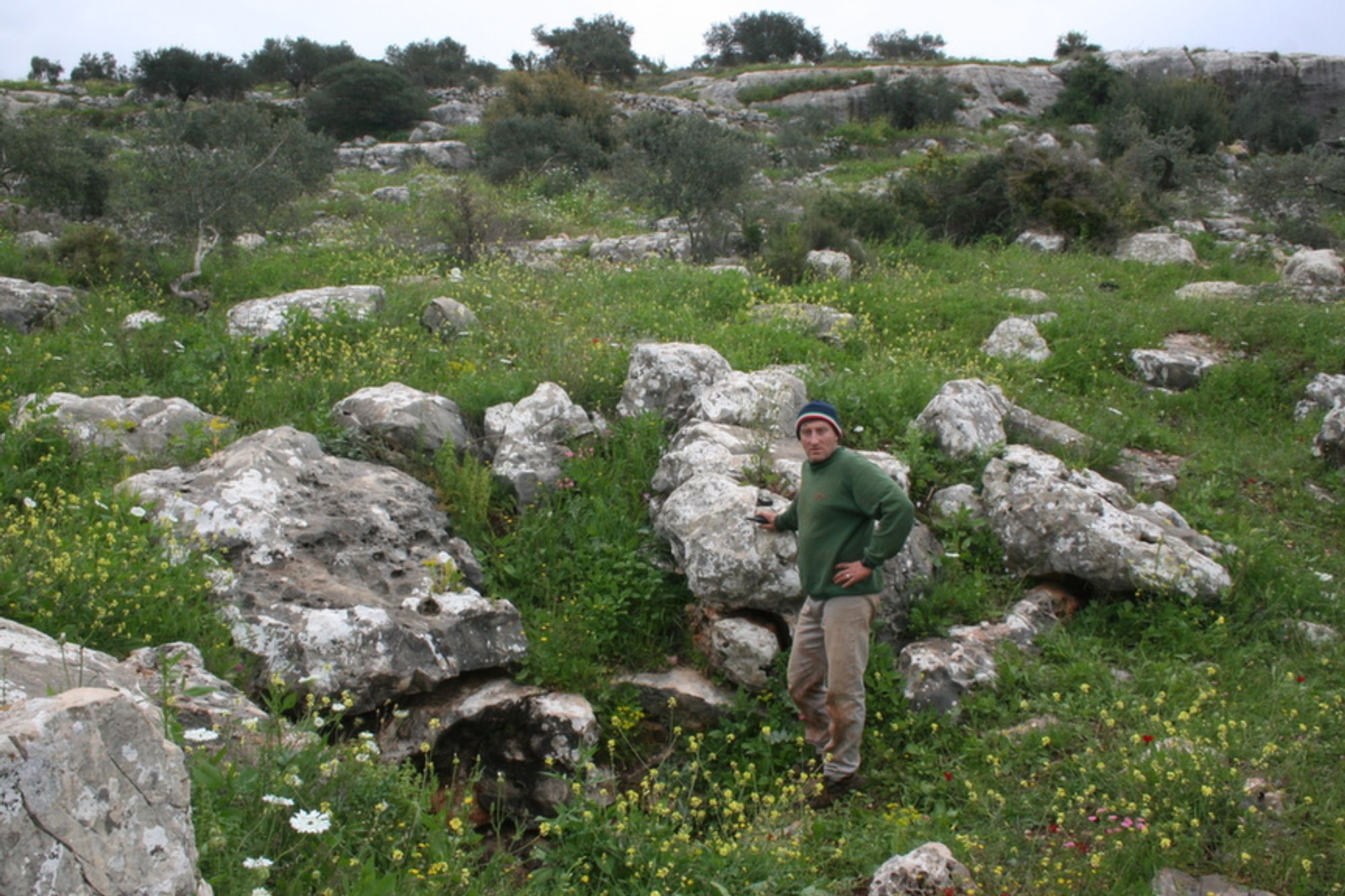
The cave opening is in the middle of an olive grove, west of a low rock cliff and south of the road connecting Beit Lid and Kafr Kur. The opening can be found with the help of a stone fence located across the road, opposite the cave opening.
* Bats were observed in the cave - species not identified.
* During the visit to the cave, 2 barn owls were found spending the daylight hours inside the cave near the opening.
Equipment:
- The visit to the cave does not require special equipment.