Shechania Cave
- Grid ref.
- 179590/275945
- Location
- Ramat Shtula
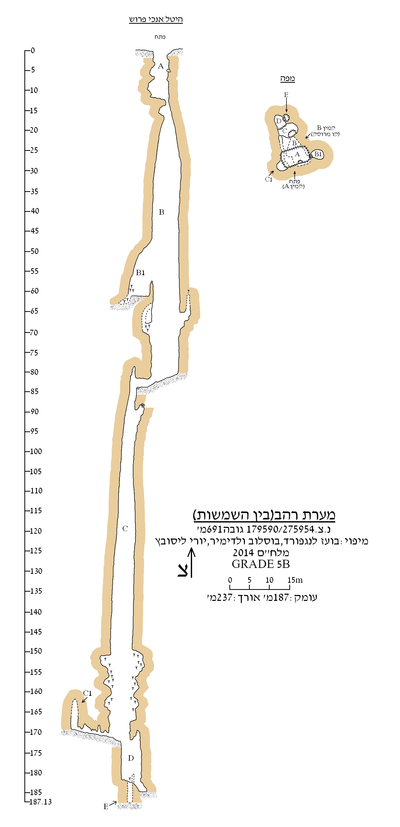 Cave mapView the map (PDF)
Description of the cave:
Rahav Cave is a developed karst pit that formed in limestone of Turonian age (Bina and Yanuach formations). Most of the pit's spaces are three vertical chimneys plunging to a depth of 188 m below the surface - the deepest point in the caves of Israel.
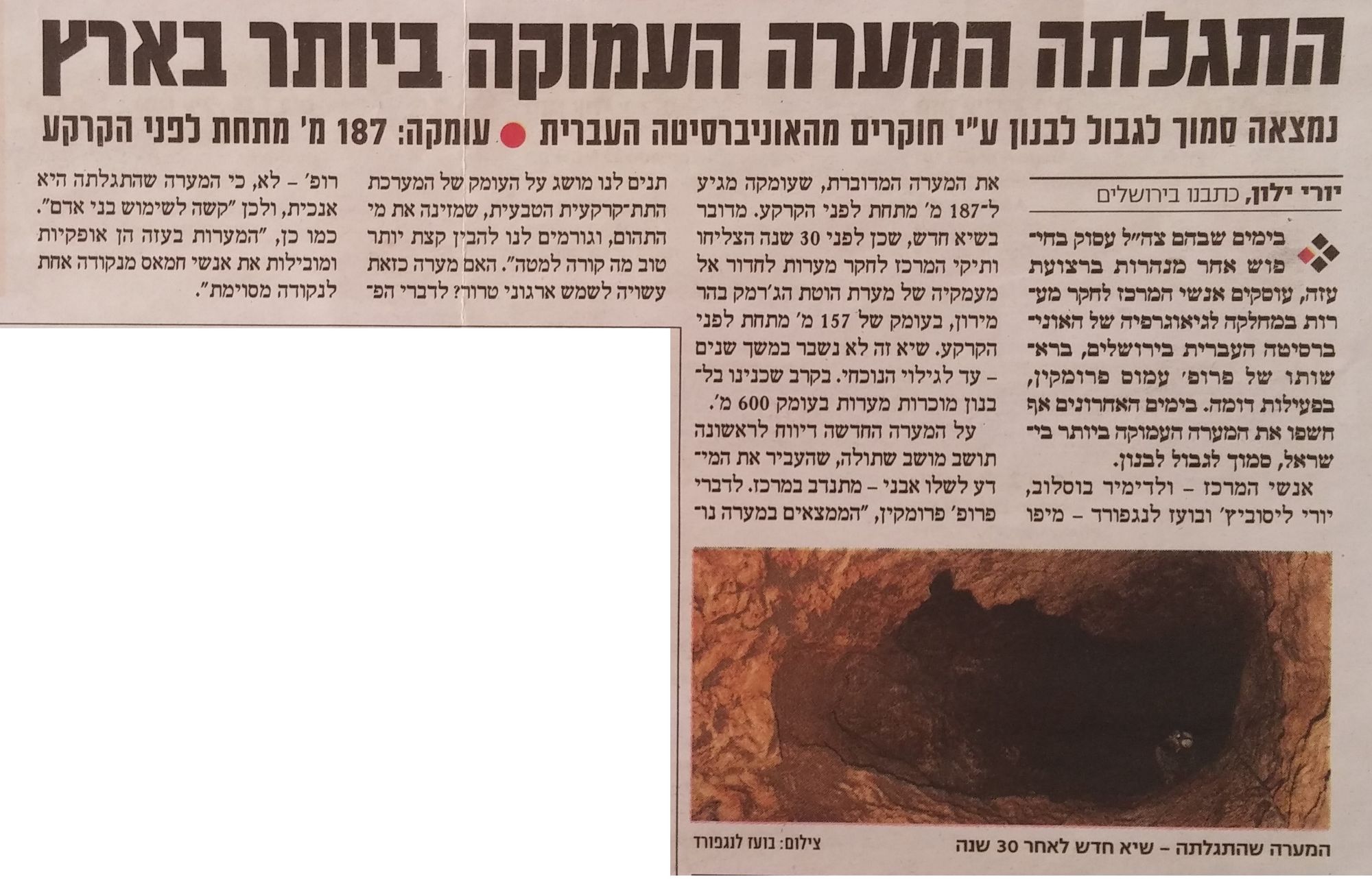
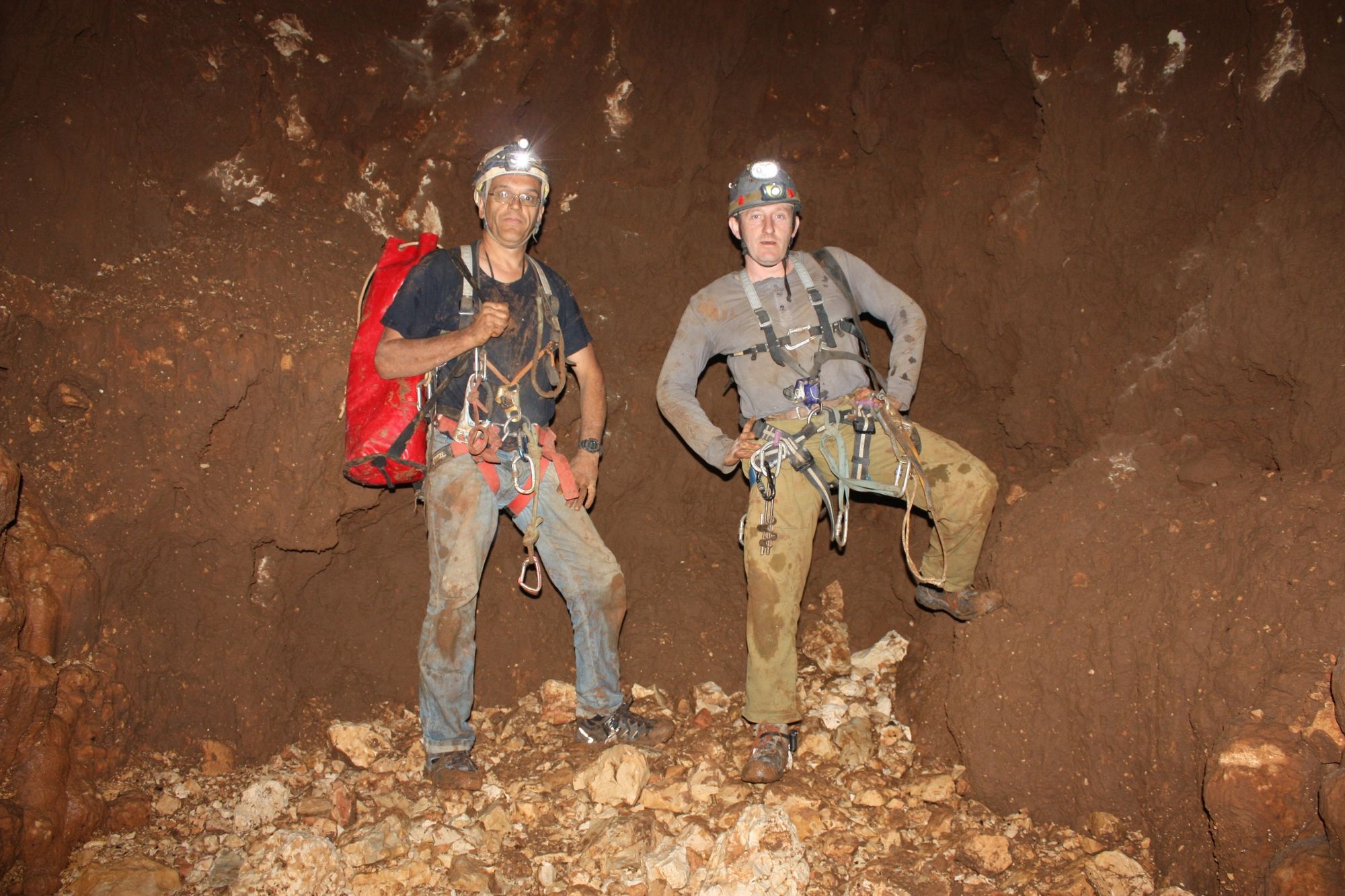
A report about the cave was submitted to the ICRC in early July 2014 by Hanoch Kalil HaHoresh of Moshav Shtula. Following the report, the cave was examined by Shalev Avni, who advanced to a depth of 80 m and reported that there is further continuation. A few days after the initial visit, an ICRC team (Vladimir Buslov, Yuri Lisovitz, Boaz Langford) returned to the cave and advanced in it, mapping and checking branches along the way, to a depth of 187 m. Thirty-eight years after the first cave explorers descended to the bottom of the Jarmaq Hoteh (depth 157 m), the depth record in the caves of Israel was set anew.
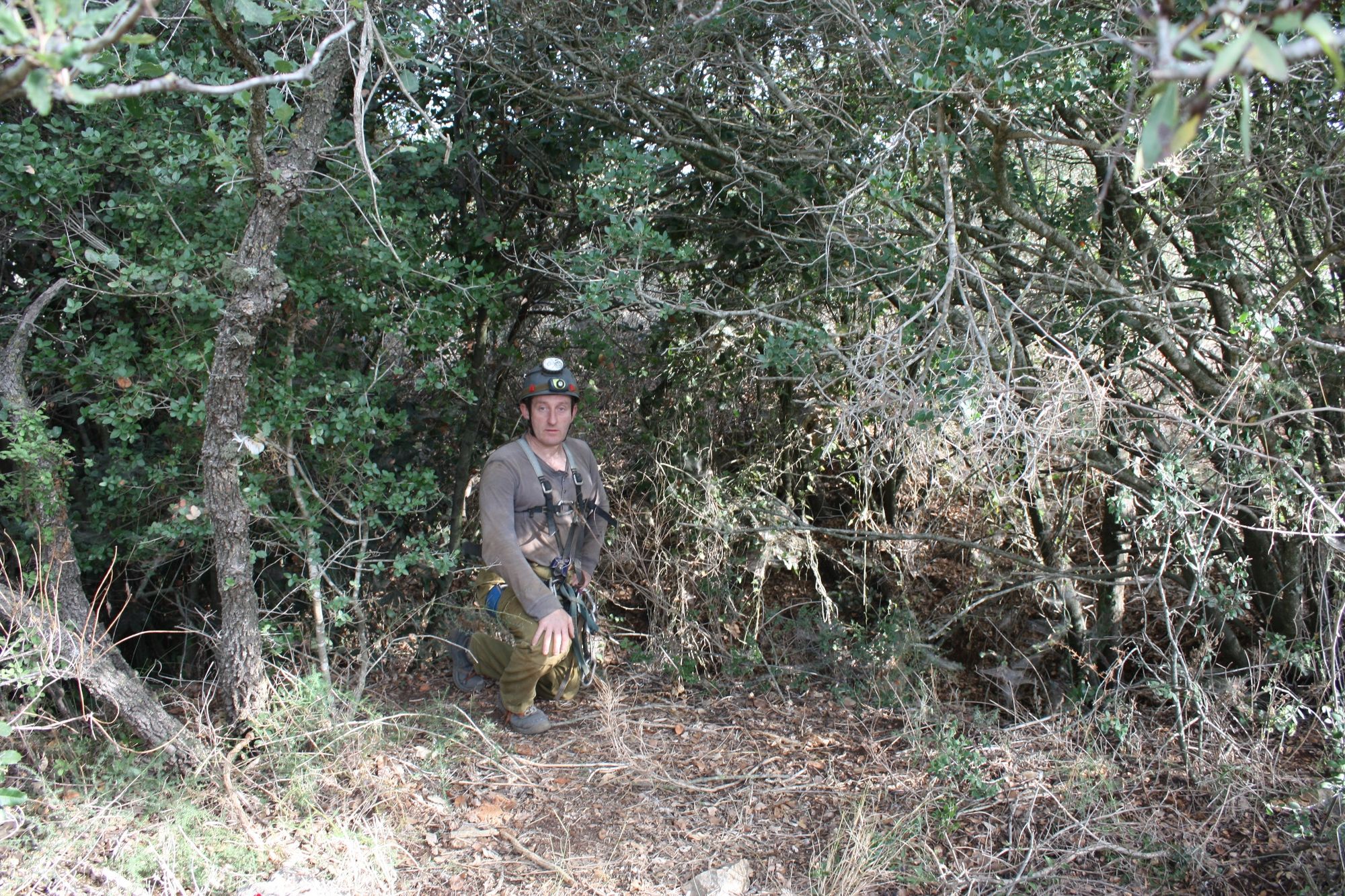
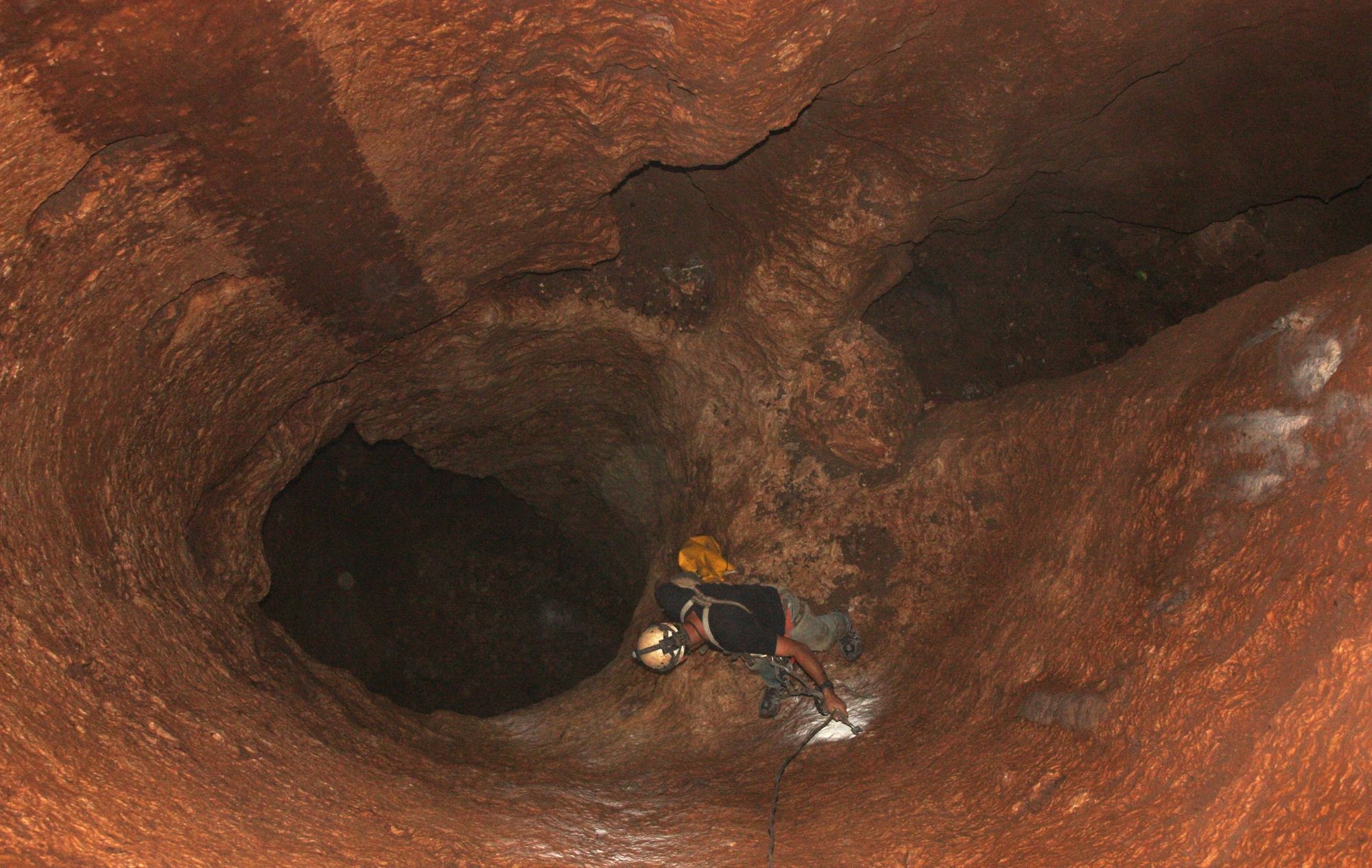
Rahav Cave has a large rectangular entrance (3.7X6.6 m). The entrance opens in a gently rolling area on the western side of Mount Rahav. Around the entrance grows a dense cover of Mediterranean woodland, disturbed at a few points by logging or as a result of cattle grazing. The area of the cave entrance is also covered by dense vegetation, which makes it hard to identify the entrance and to enter it. From the entrance a wide, lit vertical space extends to a depth of 12 m (space A). The floor of the space consists of collapse rocks covered with soil and leaves. On the eastern side of the floor there is a vertical opening leading to the top of a huge chimney that plunges to a depth of 80 m below the entrance (space B). As it descends the chimney widens, and at its center it looks like a rounded pipe measuring 5X3.5 m. The first change in the structure of the chimney occurs 25 m above its floor, where there is a shallow saddle beyond which a secondary chimney continues, parallel to and adjoining the space of the main chimney. At the end of the parallel chimney there is a gallery of speleothems containing: stalactites, stalagmites, flowstone, elephant ears, and cave corals. From this point to the bottom of the chimney, additional chimneys join it, which alters its rounded shape. In the area where the chimneys join there are impressive galleries of cave deposits.
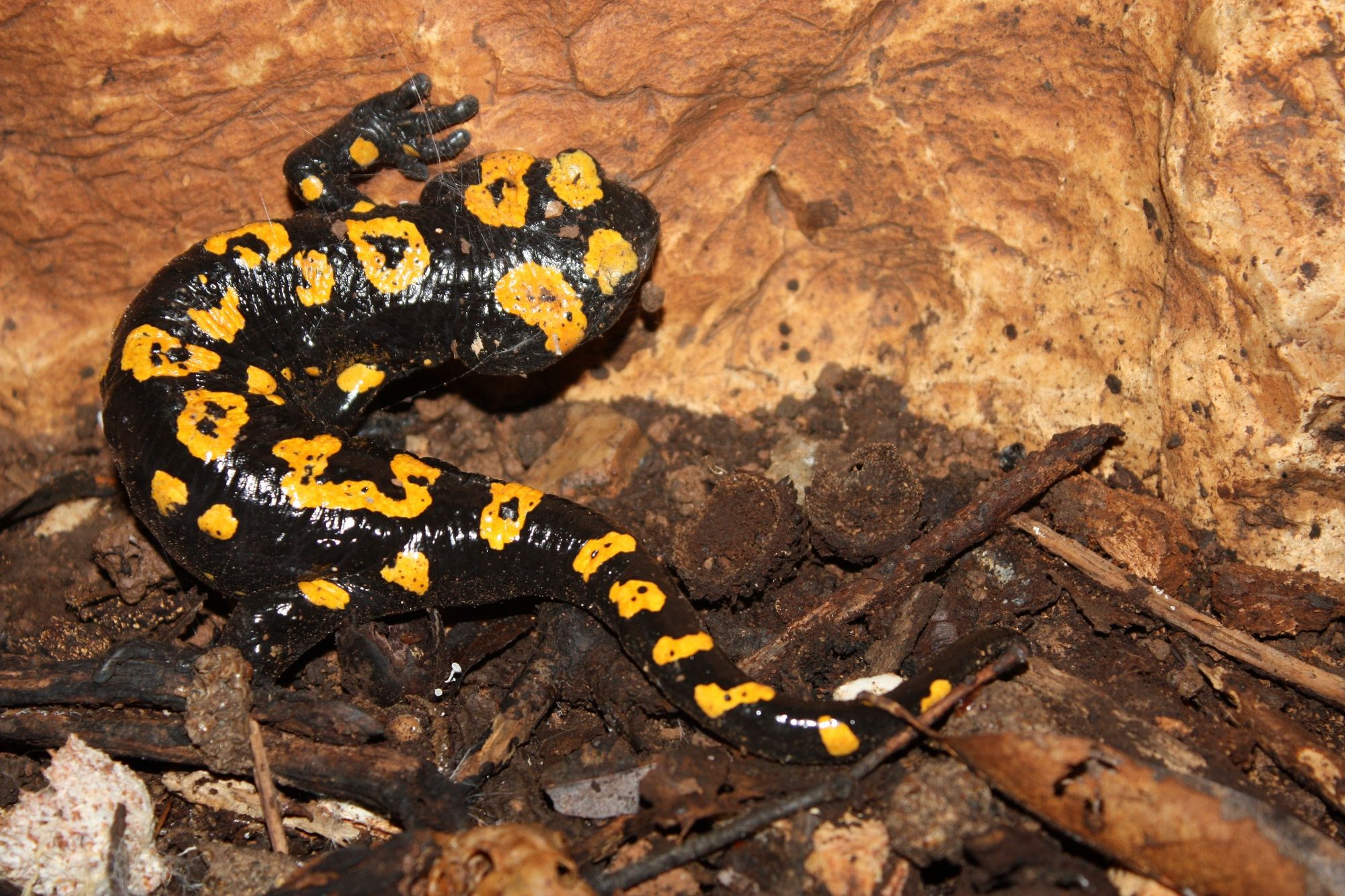
The floor of the chimney consists of a gentle slope dipping northward. The slope is completely covered with many stones and a little organic material (tree branches, bones), which provides an energy source for a few arthropods. In this area two adult salamanders were also observed, which apparently use the cave as a natural habitat. The depth of the point where the salamanders were found, and the fact that they were alive and alert, do not allow the assumption that they arrived there by an accidental fall.
At the end of the floor slope, chimney B connects to the upper part of another chimney, the longest of the cave's chimneys (chimney C). The connection point looks like a triangular window beyond which chimney C continues in a narrow vertical space with an elliptical profile. A pile of stones resting on a ledge, below the point where the chimneys connect, is a dangerous obstacle for visitors, who may inadvertently knock the stones onto one another.
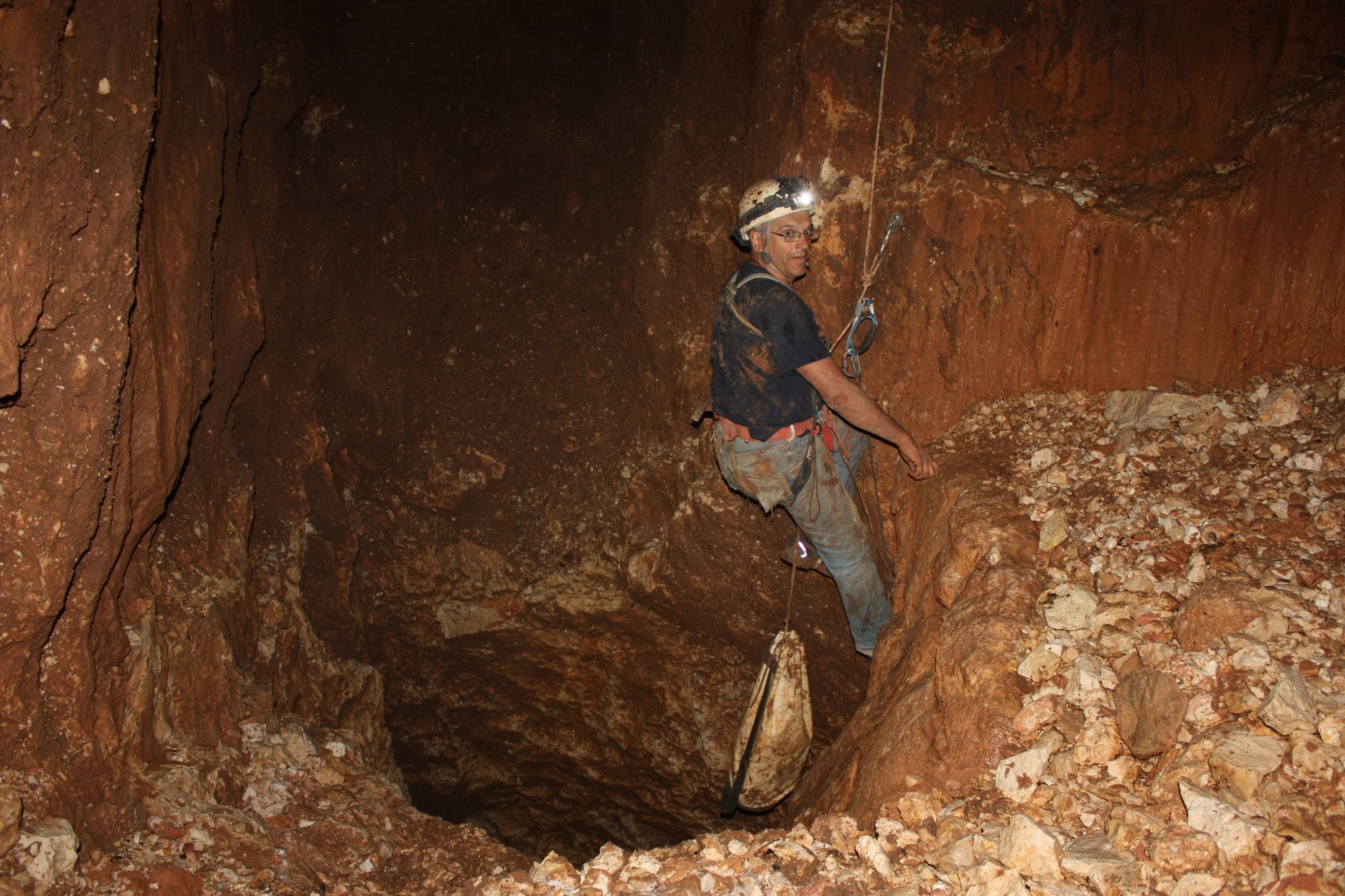
A few meters after the connection point, many chert nodules appear in the cave walls, which perhaps indicates a transition from the Bina Formation to the Yanuach Formation. Shortly after the nodules appear, the space widens, as a secondary chimney joins the central space. From this point chimney C continues with characteristics reminiscent of its predecessor: its general shape is rounded, and its walls are "polished" and lack cave deposits. About 20 m above its floor, several secondary chimneys join the chimney, which alter its rounded shape. Cave deposits, among which impressive flowstone stands out, appear in the area where the chimneys join.
The floor of the chimney consists of a gentle slope dipping northward. At the top of the slope, on the southern side of the floor, there is a low horizontal opening leading to a narrow passage that continues south. After 7 m the passage connects to the bottom of a rounded chimney that runs parallel to the wall of the main chimney.
At the bottom of the slope chimney C connects to a wide vertical space (space D), which is one of the lowest of the cave's chimneys. The chimney is 11 m deep, measures 5.5X2.8 m, and its general shape is rectangular. The floor of the chimney slopes to the north; its upper part consists of flowstone partly covered with stones, and its lower part is covered with stones and a little mud. On the northeastern side of the floor of space D there is a low saddle (about 2.5 m) beyond which a chimney continues (space E) leading to the deepest point in the cave. The profile of the chimney is rounded, it measures 1.5X2 m, and its depth, from the saddle to its floor, is 8 m. The floor of the chimney is horizontal and completely covered with dark mud, in which shallow depressions formed by water dripping from the ceiling can be seen. Difficulty breathing and a burning sensation in the throat and eyes, which occur in this part of the cave, result from the low oxygen, which worsens with the descent to depth. According to a measurement in July 2014, the oxygen level at the floor was 16.7% and the temperature was 19 degrees.
Notes:
- Passage through all parts of the cave requires rappelling and climbing equipment. The structure of the cave is complex, and the descent to the floor requires knowledge and experience.
- It is likely that the oxygen level and the temperature in the cave vary according to the seasons. The low oxygen is not noticeable in most parts of the cave, except in its deepest parts (spaces D and E).
- Although no bats were observed in the cave, some guano can be seen in it. Guano concentrations appear along the whole cave down to the floor of chimney C, about 165 m below ground level. The scarcity of bats may result from the entrance being covered by a thicket of vegetation, and from the low oxygen.
- Few arthropods were observed in the cave: a millipede of the genus Brachydesmus, an unidentified millipede, mosquitoes, springtails, moths. The flying arthropods were observed mainly on the cave walls, while the rest were observed on and around organic material that entered from the surface (among other things acorns that had sprouted and grown to a height of 10 cm!). Animal bones were also observed: a turtle shell and a scatter of unidentified bones.
Elevation: 691 m above sea level