Bikta Cave, Sedom
- Grid ref.
- 1872/0536
- Elevation
- minus 232 m
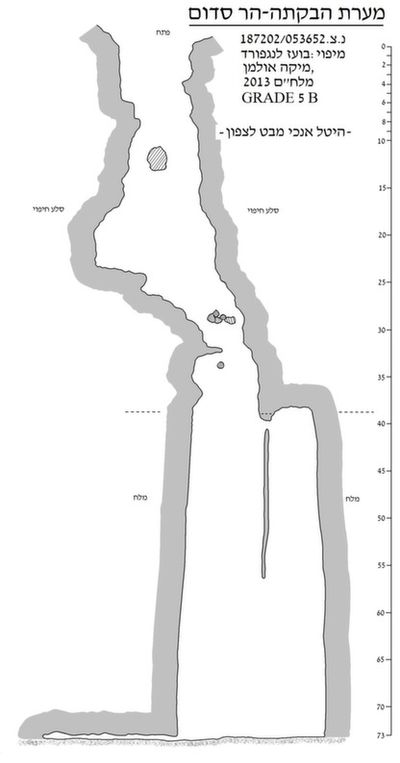 Cave mapView the map (PDF)
General:
Bikta Cave is a medium-sized cave that formed in cover rocks and salt of Pliocene and Pleistocene age (Sedom Formation and Lashon Formation). The total length of the cave is 138 m and its maximum depth reaches 73 m.
The cave was discovered in December 2012 and mapped in February 2013.
Description of the cave:
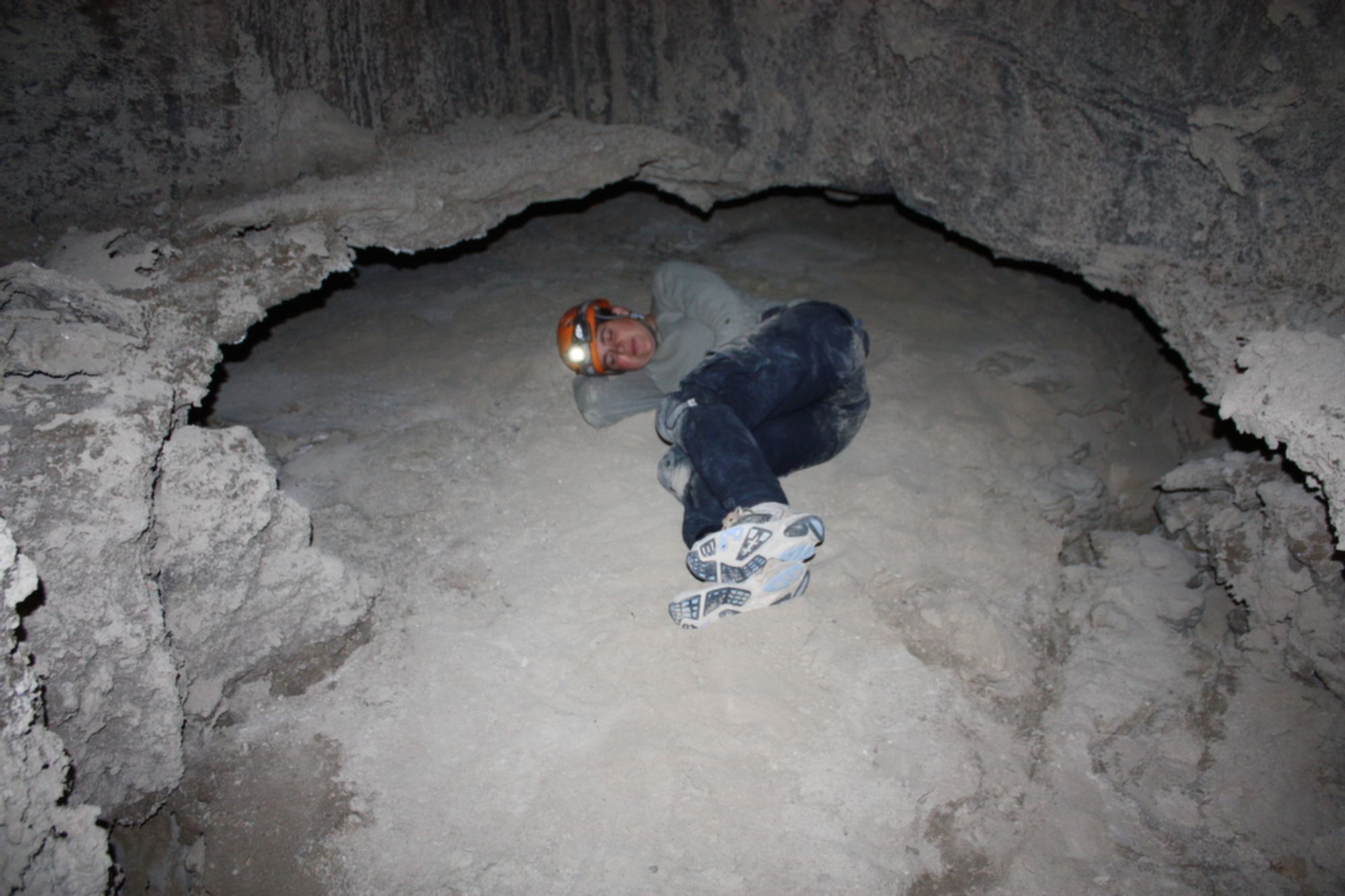
The cave has a small entrance (measuring 3.5X0.6 m) that looks like an elongated, narrow slit. From the cave entrance a vertical shaft extends, cut in crumbling cover rock. The shape of the shaft is a narrow crack, partly obstructed by collapse boulders stuck in the crack space. 25 m below the entrance the vertical crack is blocked by a local floor level, which continues in a stepped descent of about 6.5 m toward azimuth 60. From the end of the stepped section the cave continues in a narrow vertical shaft that after 9 m crosses the contact line between the cover rock layers and the salt layers (38.9 m below the cave entrance). After the transition to the salt layers the cave space widens and continues as a pair of parallel chimneys separated from each other by a narrow partition. The floor of the chimneys (34 m below the transition to the salt rock) looks like a pair of rounded rooms between which, beneath the partition separating the chimneys, there is a large collapse boulder. On the northeast side of the floor of the main chimney there is a stream terrace rising to a height of 0.9 m above the floor level. It seems that it was formed by the incision of the chimney floor by the flood waters that visit the cave. On the south side of the cave floor space there is a wide, low opening leading to a low chamber (measuring 9X6 m and 0.6 m high) in the middle of which stands a wide rock pillar. The chamber floor is horizontal and covered with soft sediment, partly covered with fine salt hairs. A stalactite and a stalagmite, each as thick as a drop, stand in the northern part of the chamber, very close to its entrance. It seems that the stalagmite and the stalactite were connected in the past, and it is possible that their separation occurred as a result of tectonic movement.
Notes:
- Visiting the cave requires the use of a rope and rappelling and climbing equipment. An 80 m rope allows access to the cave floor. The rope can be anchored to bolts, which can be placed near the entrance. It is recommended to bring rope protectors to prevent its friction along the descent route.
- During the visit to the cave, 3 bats of the small yaznuv species were observed in it.
Written by: Boaz Langford
Region: Mount Sedom