Ashalim Cave, Negev
- Grid ref.
- 1249/0392
- Location
- Near Kibbutz Ashalim
- Elevation
- 373 m above sea level
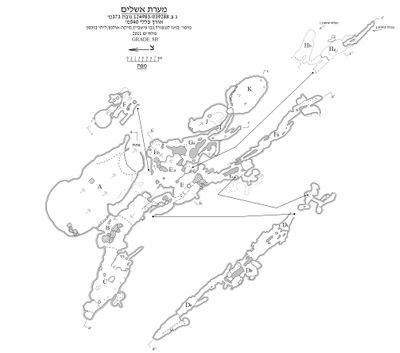 Cave mapView the map (PDF)
General:
Ashalim Cave is a giant cave composed mainly of a network of elongated, branching passages and several large chambers that developed by phreatic-hypogenic dissolution in Turonian limestone (Shivta Fm.). The total length of the cave reaches 540 m and its depth 31 m. The cave spaces developed along a main northwest-southeast axis, extending over several levels, horizontal or sloping, which are connected to one another by many vertical shafts.
An archaeological survey and excavation was carried out in the cave by the expedition of Rudolph Cohen, who worked at the site in 1970. Since then several attempts were made to map the cave (Yehuda Ziv - '73, an ICRC team led by Azriel Raikin - '82, an ICRC team led by Shmulik Avidan - '07), and it was fully mapped only in December 2012 by the ICRC team (Boaz Langford, Mika Ullman, Nevo Fishbein, Lihi Buchman).
Description of the Cave:
The Cave Entrance and Entrance Space:
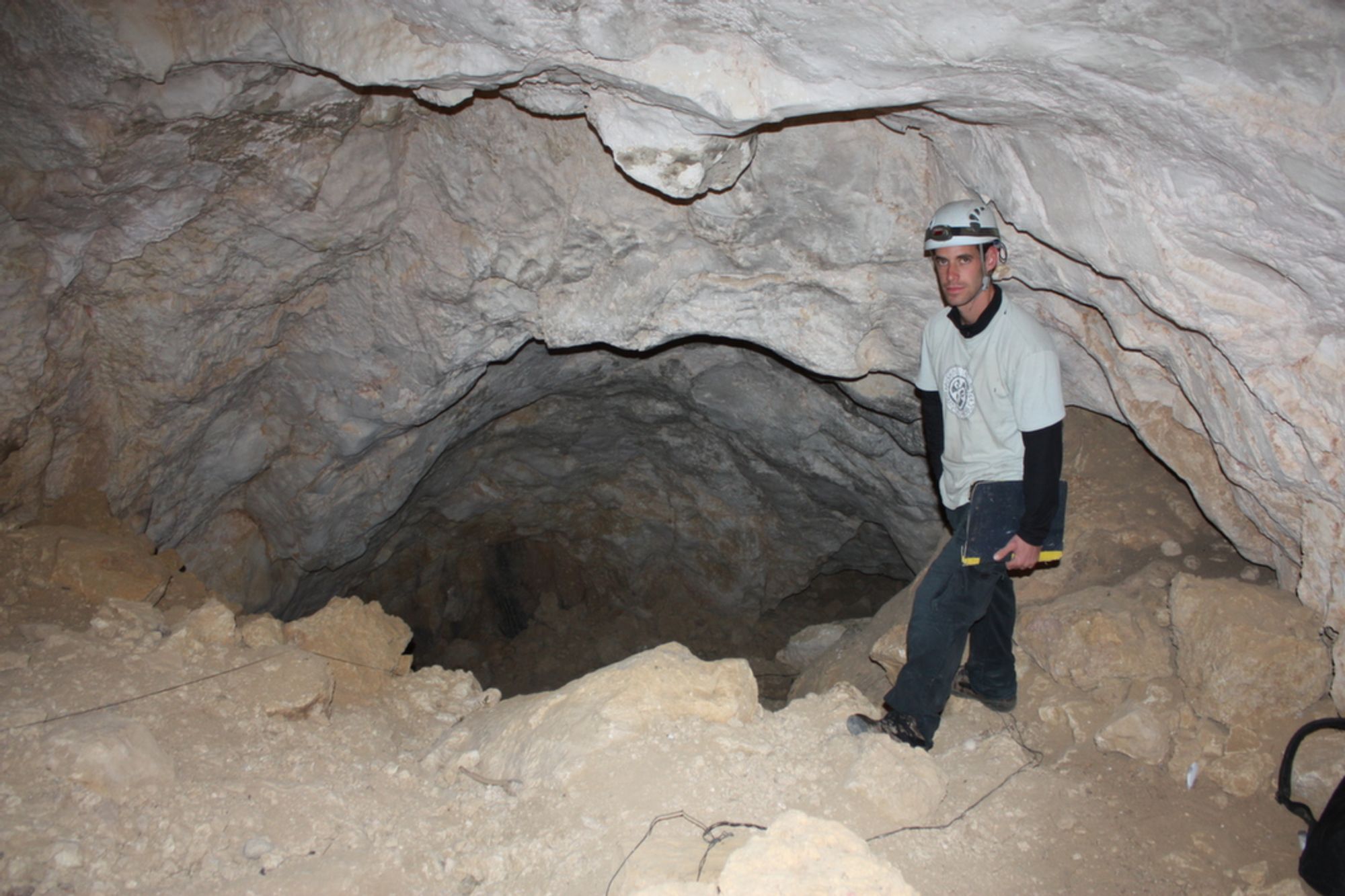
The cave has a large entrance opening in an exposed area, at the bottom of a gentle slope, on the bank of a small channel that descends north and joins, at its end, the huge channel of Nahal Besor. The cave entrance looks like a wide vertical depression, a kind of conical doline whose center is narrower than its edges. At the bottom of the doline a narrow vertical opening (1.2X5 m) opens, leading to the southern end of a large chamber that extends northwest (chamber A). The chamber measures 24X11 m and its height reaches 4.5 m. The chamber floor slopes from the entrance area toward its inner part, and is covered with small collapse stones and a little light-colored soil. At various points, water-flow marks are visible on the chamber floor, certainly entering through the chamber entrance. It seems that the water flow drains toward the innermost end of the chamber, where there is a limited area in which the chamber floor is level, and on it marks of standing water are visible (mud flakes, a level line on the adjacent wall). The chamber ceiling also slopes parallel to its floor. The ceiling structure is rounded/domed, and a "phreatic morphology" is prominent in it, in the form of domes and shallow dissolution pockets.
In the inner part of the chamber, on its western side, there is a wide opening (4.8X1.8 m) leading southwest to an elongated space (B) that is partly blocked by a pile of large collapse boulders. On the floor of the opening connecting the entrance chamber to space B, a massive terrace is built, extending across the full width of the opening and rising to a height of 1.8 m.
The Stalactite Chamber (Chamber C) and Its Surroundings:
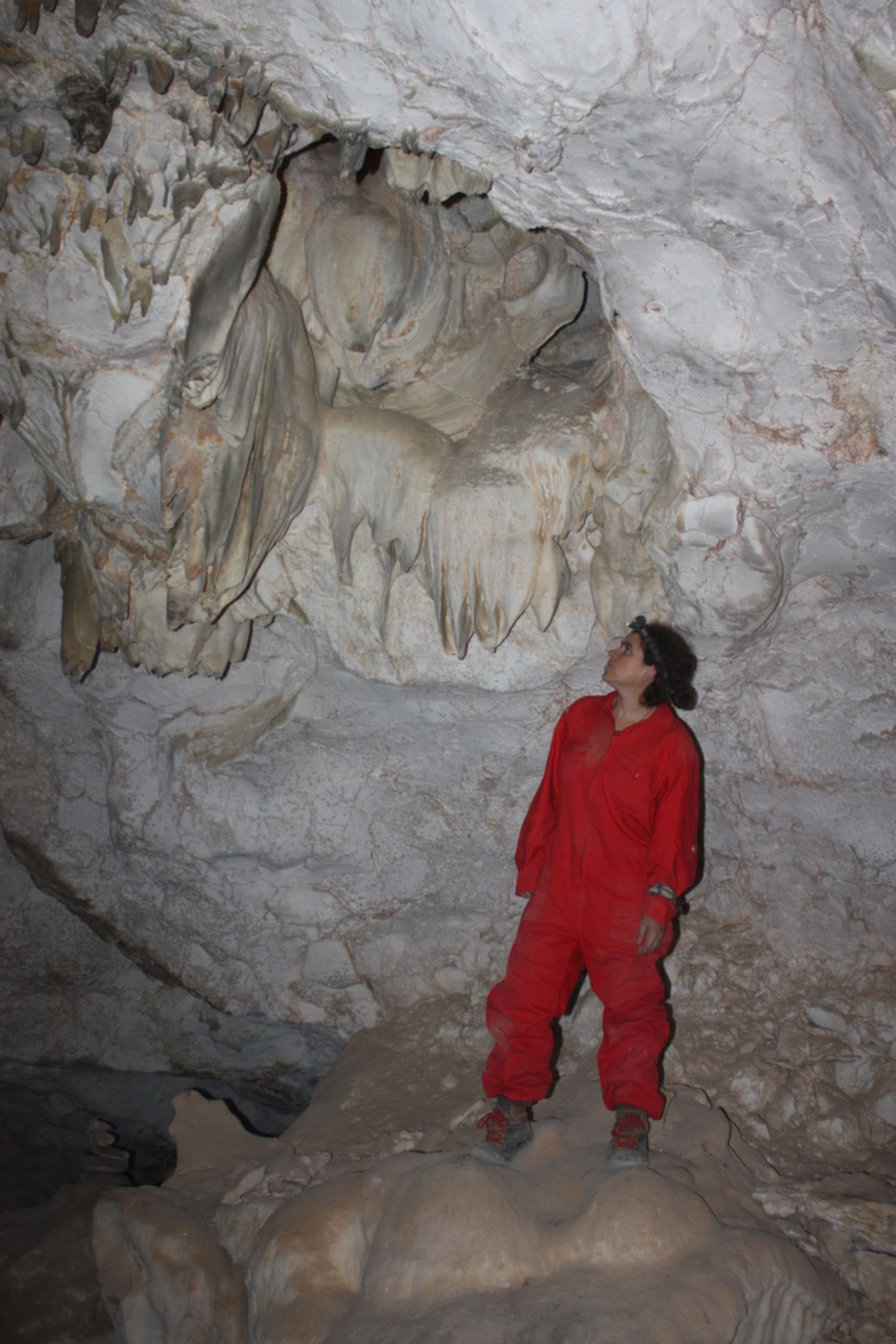
Space B is in fact the center of a wide passage that extends along an axis parallel to the entrance chamber. A turn from space B to the northwest leads, through a low passage, to an elongated chamber (14X5.5, height about 4 m - chamber C) in which many speleothems were deposited: flowstone, pagodas, and elephant ears, and a few conical speleothems (stalagmites, stalactites). The chamber floor is completely covered with large collapse boulders, between which wide openings open, leading to several vertical shafts that connect the various levels of the cave. In the ceiling and walls of the chamber, well-developed dissolution domes open, some of them covered with cave deposits. On the northern side of the chamber there is a rounded space separated from the center of the chamber by a wide, low opening. On the western side of the center of the chamber there is a tiny opening between a curtain of speleothems. This opening leads to a small room that is almost completely blocked by many cave deposits.
The Lower Passage:
The lower level of the cave can be reached through the shafts descending from the floor of the Stalactite Chamber (chamber C), or through a shaft at the end of the corridor extending south from space B. These shafts connect to an elongated passage that forms the main part of the lower level of the cave (the length of the passage from end to end reaches 110 m). The section of the passage to which the shafts descending from space C connect is built of a central space (Db) that is divided and interrupted by many rock partitions that create sub-spaces, of various sizes, "trapped" within the boundaries of the central space of the passage. North of this complex space the passage continues as a simple space (Da) with a rounded or elliptical profile. The passage floor is horizontal and covered with abundant guano. On the passage walls there are many salt/gypsum flowers. On the northern side of this part of the passage (Da) there is a tiny opening (0.4X0.4 m) leading to the northernmost part of the passage. This part consists of an elongated, low space in whose ceiling center there is a deep crack that forms a raised corner. It seems that this raised corner is favored by the insectivorous bats that roost in the cave, judging by the urine deposits, grease stains and concentration of guano found there.
South of the complex part of the passage, a vertical shaft descending from the corridor that extends from space B southward connects to it. In this part the passage continues as a high space (Dc) that connects on its southern side to chamber E. In the ceiling of chamber E another passage runs, crossing the chamber parallel to the lower passage, which extends from chamber E southward. In the floor of the lower passage, a little south of chamber E, there is a rounded shaft (Fa) leading to several small spaces that developed beneath and west of the passage. South of the shaft the passage continues as a simple space (Fb) with a rounded or elliptical profile. Well-developed salt/gypsum flowers were deposited densely on the passage walls. Similar to the structure of the passage on its northern side, on its southern side too it ends in a tiny opening leading to an elongated, low space with a high crack in its ceiling, which forms a favored place for the bats that live in the cave.
Chamber E and Its Immediate Surroundings:
Chamber E is a large space that developed in the center of the cave. The chamber measures 18X8 m and its height varies according to its different areas. The chamber floor slopes from its eastern, higher side to its western, lower side. On its western side the chamber floor is covered with enormous collapse boulders, between which there are narrow passages that allow a glimpse into the depth of the space and an understanding of the original height of the chamber. In this area of the chamber a few potsherds are scattered, as well as animal and human bones (a femur of a young child was found1). The western part of the chamber is separated from its central part (Ea) by the collapse boulders, which almost touch the chamber ceiling. East of the collapse boulders the central part of chamber E can be seen. The floor of this part is horizontal and covered with soil and a few collapse boulders. The ceiling of the central part of the chamber is higher than on its western side and slopes east. The eastern part of chamber E (Eb) consists of a high space that slopes west. The ceiling of the space is made of a high chimney completely covered with many cave deposits.
North of the central part of chamber E there is a wide corridor (F) that descends north and connects at its end to several rounded spaces that developed beneath the floor of the entrance chamber. Interestingly, on the floor of these spaces there are signs of standing water that may be seeping from the chamber above. In corners and niches on the sides of the corridor there are enormous concentrations of snail shells, mainly of the species 'wrinkled-mouth Levantina', which is common in this region of the Negev. It is reasonable to assume that the origin of the shells is the activity of rodents in the cave2.
Southeast of the Cave:
South of the central and eastern parts of chamber E, a branching, two-level network of passages extends (upper level: Ga+Gb, lower level: Ha+Hb), composed of wide, low passages characterized by a horizontal floor and a rounded profile. The floor of the passages is covered with a very thin layer of soil and guano. On the western side of the passage network, in the part near the center of chamber E, there is a vertical crack leading to the lower level of the passage network, to a spacious space measuring 8X3 m and with a typical height of 3 m - space Ha. The floor of the space is horizontal and covered with a thick layer of dry dark soil mixed with abundant guano. Many potsherds and a few animal bones were found throughout the space. From the northern side of the space a low passage extends north, connecting after about 5 m to the center of chamber E.
On the southeastern side of the upper level of the passage network, one of the passages of the network connects to a narrow space that developed between large collapse boulders (space I). At the junction between the passage network and space I there is a narrow passage, in which a complete mace with a wooden handle and a metal head was found3. On the eastern side of space I, between the collapse boulders that bound it, there is a narrow vertical opening leading to the floor of a large chamber (chamber J). Chamber J is elliptical in shape, measures 10X4.5 m and its height reaches 1.8 m. The chamber floor is completely covered with large collapse boulders that form a coarse talus sloping from the southern side to the northern side of the chamber. On the southern side of the chamber there is a vertical shaft rising about 5 m above their floor. At its top the shaft connects to another chamber (K), larger and more impressive than chamber J. Chamber K measures 12X7 m and its height reaches 3.5 m. The chamber floor is also covered with large collapse boulders, between which one can descend and connect to narrow spaces that were "trapped" at the edges of the original chamber that preceded the collapse. Signs of bedrock collapse are evident in the chamber ceiling, which looks like a wide dome with bat grease stains on it. The humidity of the air in this area of the cave (chambers J+K) is high relative to the other parts of the cave.
Notes:
- The cave entrance can be reached with a high-clearance vehicle, even without 4X4, on a dirt road that extends from an abandoned quarry south of the road leading to Kibbutz Ashalim.
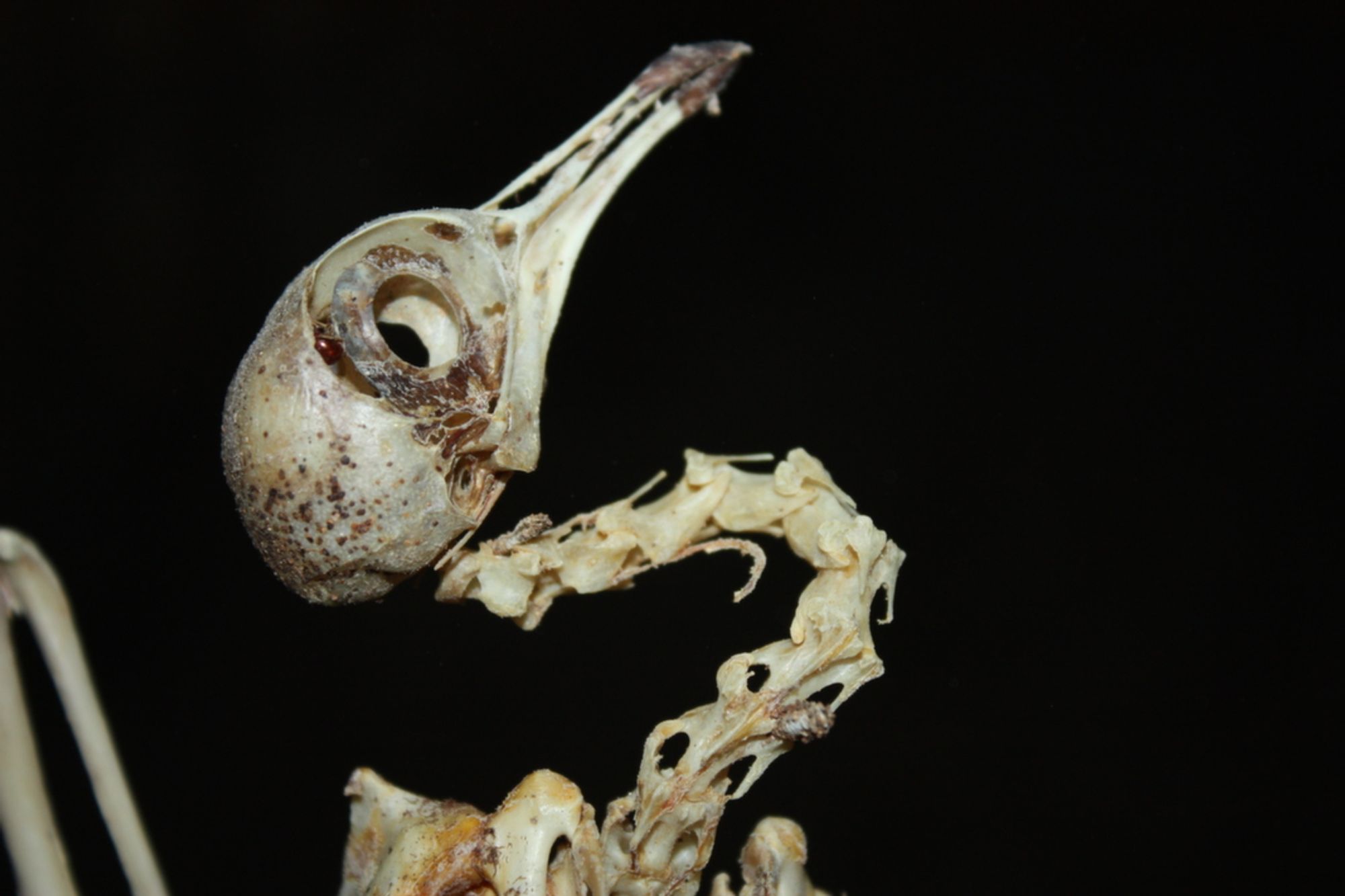
- During the visit to the cave (December 2012) no bats were seen in it. However, in all the different parts of the cave there are signs of the presence of bats: grease stains on the cave walls, concentrations of guano and urine deposits. On the southern side of the lower passage (Fb) the skeleton of a bat of the free-tailed bat type was collected.
On 16.7.74 several dozen mouse-tailed bats were seen in the cave - Mikin, ICRC archive.
On 9.3.95 a Negev mouse-tailed bat, a female with a fetus, and a long-eared bat were captured at the cave entrance - Mikin, ICRC archive.
On 25.5.88 a Negev mouse-tailed bat was observed in the cave - Beni Shalmon, ICRC archive. - On 16.7.74 several dozen mouse-tailed bats were seen in the cave - Mikin, ICRC archive.
- On 9.3.95 a Negev mouse-tailed bat, a female with a fetus, and a long-eared bat were captured at the cave entrance - Mikin, ICRC archive.
- On 25.5.88 a Negev mouse-tailed bat was observed in the cave - Beni Shalmon, ICRC archive.
- During the visit to the cave (December 2012) no presence of the cave tick was seen in it. In past years ticks were found in the cave, and some of them were even identified as infected with cave fever.
1 This may be part of a complete skeleton found in the cave in '73 by an expedition headed by Yehuda Ziv (Anan Shiyon, according to Galili from Sde Boker - oral information).
2 On the floor of chamber K, one of the spaces farthest from the cave entrance, a rodent "nest" is visible, located beneath a large rock.
3 In the upper part of the wooden shaft that makes up the handle of the mace, two rough notches were carved. The mace head was found threaded on the wooden shaft. The shape of the mace head is pear-like, a shape reminiscent of the mace heads from the Cave of the Treasure in Nahal Mishmar. On the broad side of the mace head there is local gnawing that slightly damages its integrity.
Written by: Boaz Langford