Bika Monument Cave
- Grid ref.
- 193692/162428
- Location
- Southern Bika
- Elevation
- 184 m below sea level
 Cave mapView the map (PDF)
Description of the cave:
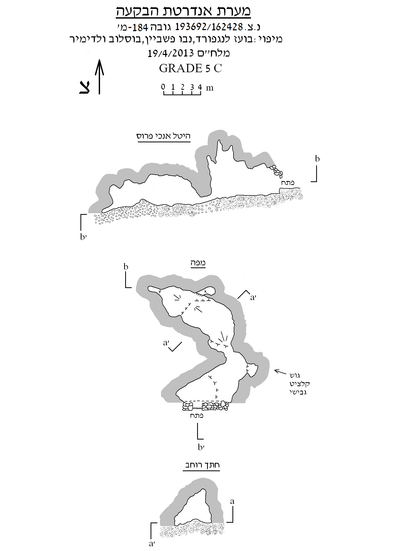
Bika Monument Cave is a small cave consisting of a pair of rooms formed by phreatic dissolution processes. The cave's cumulative length is 23.5 m and its total height reaches 7.6 m. A report about the cave was posted on the website 'Amud Anan'. In April 2013 the cave was examined and mapped by Vladimir Buslov, Boaz Langford and Nevo Fishbein.
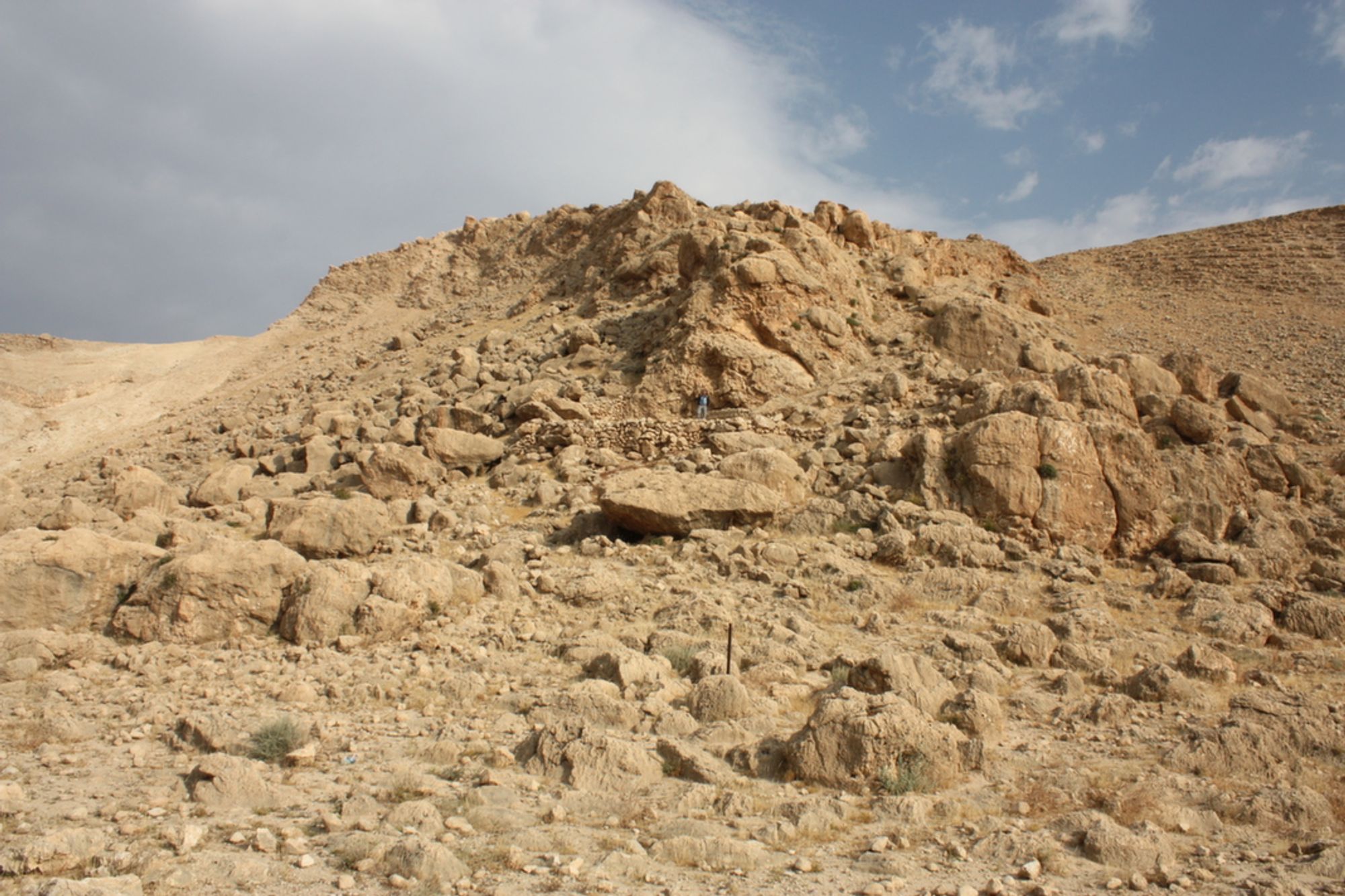
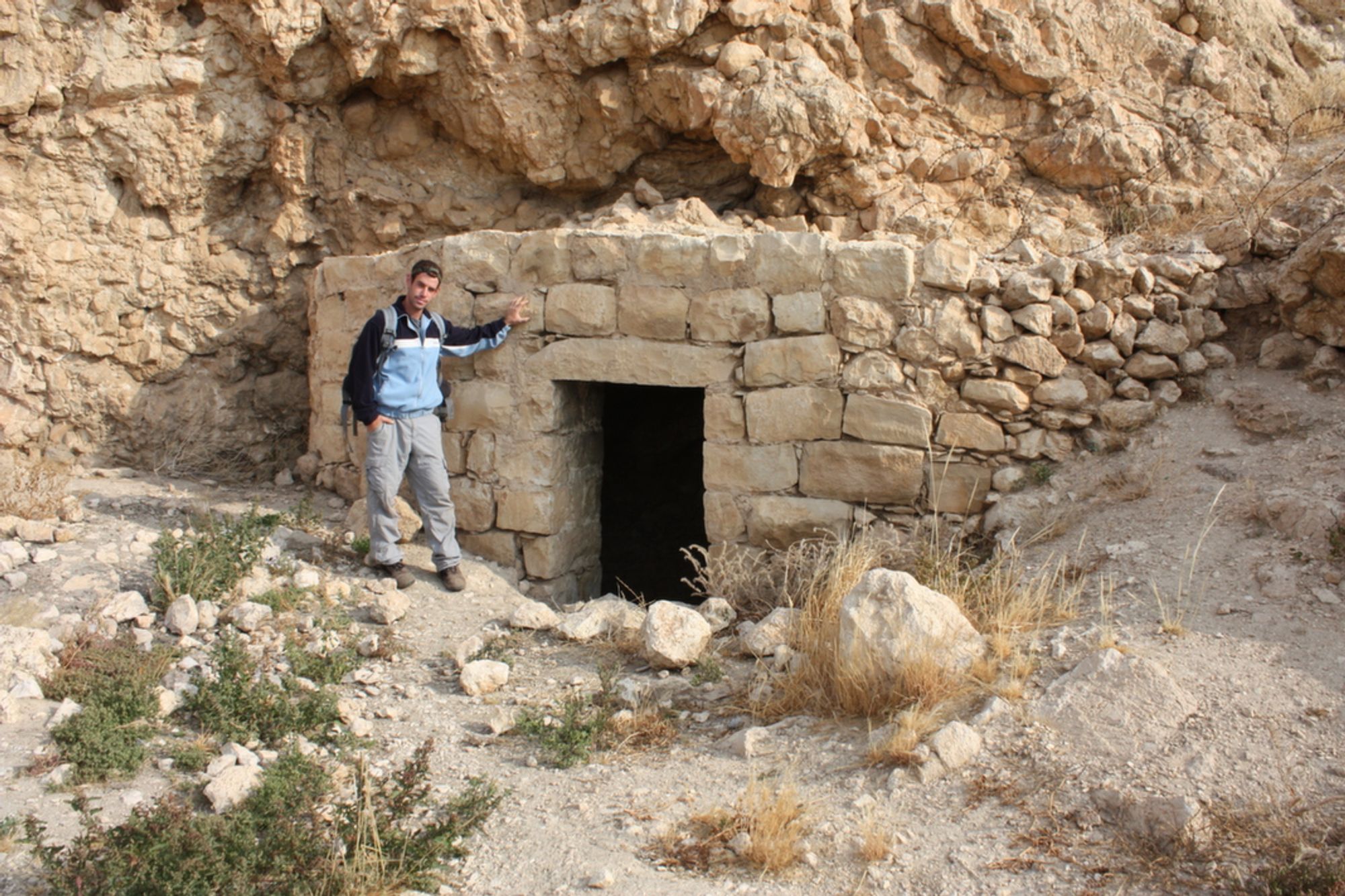
The cave entrance opens at the base of a cliff-like rock protrusion that stands out because of the lithological difference between it (limestone) and the surrounding rock (mainly chalk). In front of the entrance there is a small horizontal terrace bounded at its edge by a sharp drop-off of the ground. The entrance area is blocked by a double-faced stone wall in the center of which a rectangular opening opens (dimensions 1.2X0.9 m), roofed by a large lintel stone. The opening leads to an elongated room extending east. The room floor is horizontal and covered with goat droppings and a little fine sediment. The room ceiling is not uniform, mainly because of deep dissolution domes opening along it. The north wall of the room continues in a uniform line dictated by a geological slip plane (azimuth 60).
On the eastern side of the room there is a low niche extending to the southeast. Opposite the niche, at the bottom of the north wall of the east of the room, there is a low opening leading north to the inner part of the cave. This part consists of an elongated space (9.5X3.5) extending to the northwest. The floor of the space is covered with gray sediment and piles of stones that collapsed from the ceiling. The ceiling of the space is high (up to 3 m above the floor) and slopes toward the space walls. A step in the ceiling at the center of the space separates its inner (low) part from its outer (high) part. In the east wall of the space, near the step in its ceiling, there is a small opening leading to a tiny passage extending east. The rounded outline of the passage is a phreatic feature that 'survived' in this area of the cave.
Notes:
- The cave entrance is located a few tens of meters northwest of the parking lot next to the Bika Monument.
- Several tens of insectivorous bats of the greater mouse-tailed bat and lesser mouse-tailed bat species were observed in the cave (April). Other animals observed in the cave: a carcass of a blackstart was found in the center of the entrance room. The walls of this room are also adorned with a few mason wasp nests. Several species of spiders, dried beetles and many dried individuals of a brown millipede were found in all parts of the cave. In the cave entrance area, egg clusters of a fan-footed gecko or gecko were seen. An adult gecko was observed in the entrance space. Cave ticks are present in all parts of the cave.
- In the various parts of the cave, as well as on the terrace in front of it, Classical-period and earlier pottery sherds were found.
Written by: Boaz Langford