Yifat Cave, Hermon
- Grid ref.
- 221457/301678
- Elevation
- 1628 m above sea level
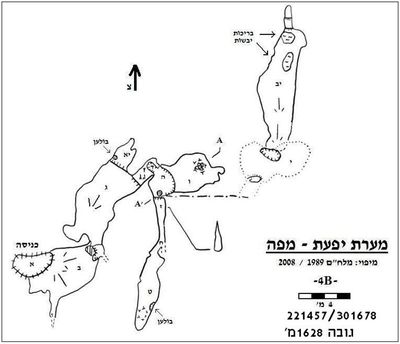 Cave mapView the map (PDF)
Description of the cave:
Yifat Cave was surveyed and studied in the 1990 Hermon survey, and its description appears in the booklet 'Nikrot Tzurim' no. 16. The description follows:
" This is an interesting 'aging' system of small chimneys, and a fine example of the development of a vadose system in highly fractured rock, as found on Hermon.
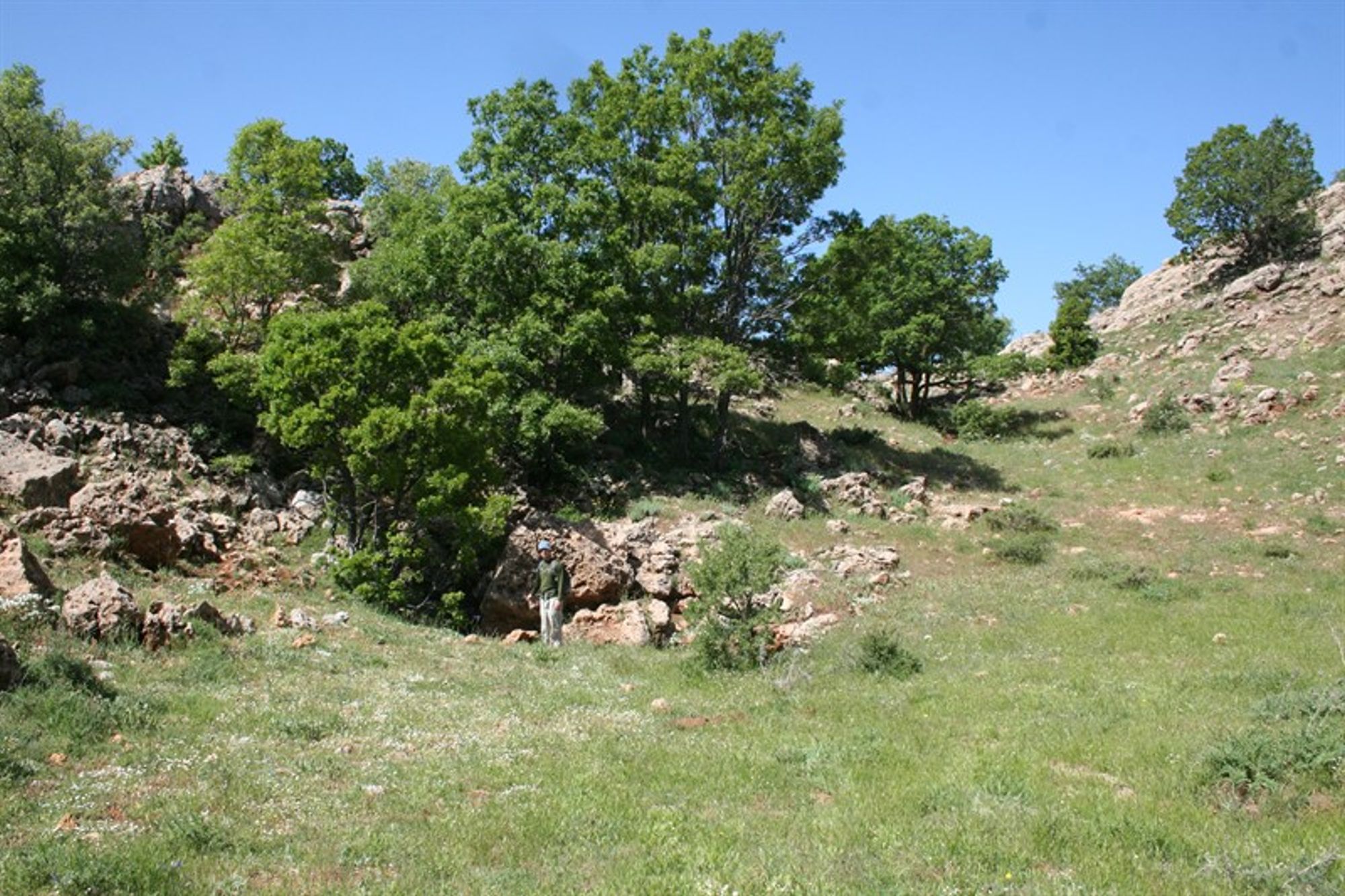
A bowl-like dissolution doline developed on the surface. Its dimensions are approximately 30X50 m and its depth about 8 m. Its walls are rocky, and in its center is terra rossa soil in which the traces of snowmelt flowing into the cave entrance are clearly visible. Because of the dip of the beds at the site, the dissolution doline developed asymmetrically, in a pear shape (the long axis trends at an azimuth of 75 degrees). Indeed, the walls are higher on the southwest side of the doline. In addition to the gray limestone, dolomitic limestone is also exposed in the doline. On the surface, on the northern side of the doline, cave travertine can be seen.
The cave entrance is located near the southwestern wall of the doline. The entrance is a collapse doline, the result of the collapse of the roof of chimney A. Rocks several meters across lie stacked one on another, and the cave can be entered through the gaps between them. During snowstorms the Yifat ridge is also covered in snow - the doline fills with snow and the cave entrance is blocked. The entrance remains blocked for a few days to several weeks (as happened, for example, in the winter of 5747 (Hebrew calendar)).
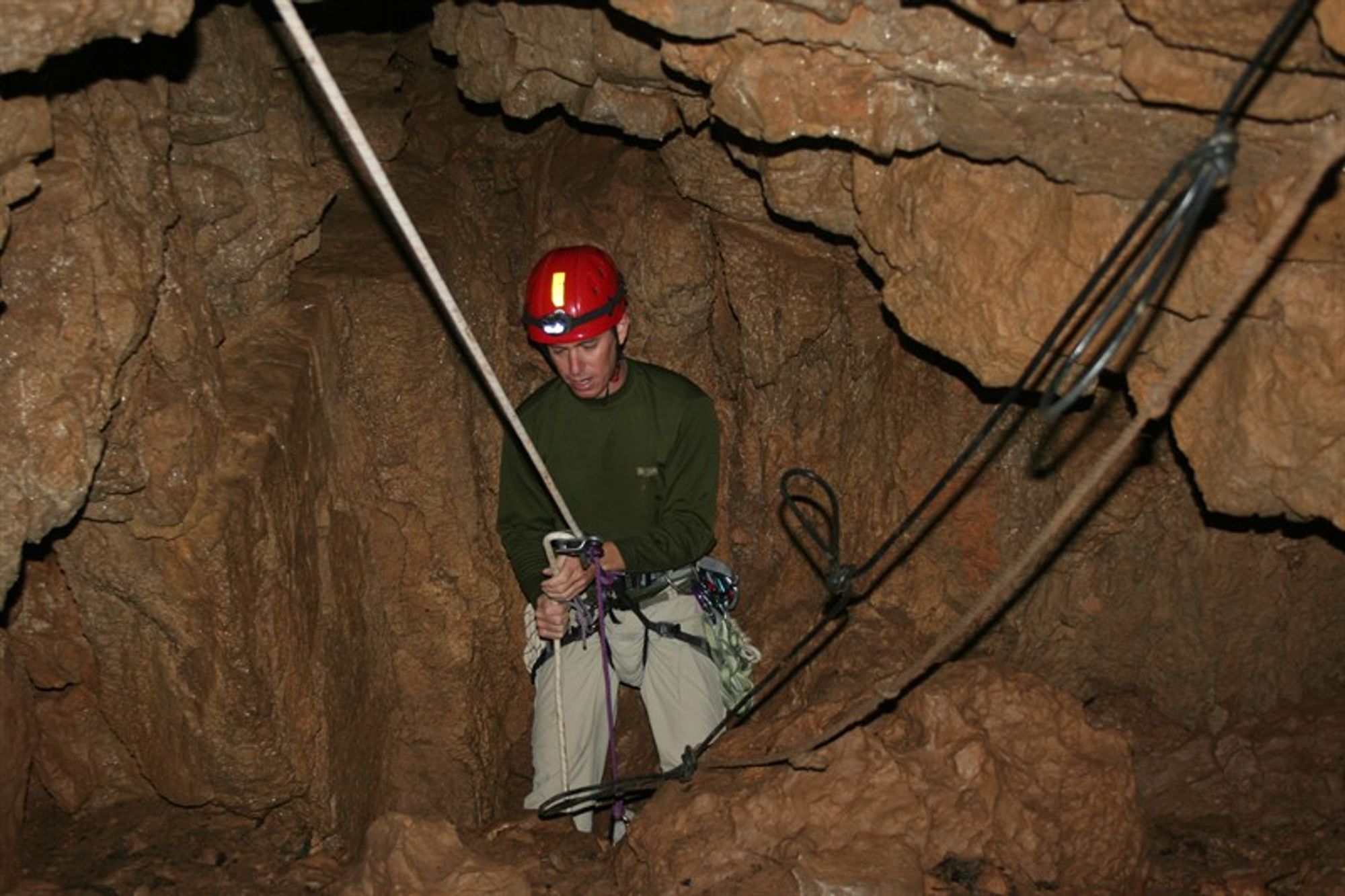
The system has 5 chimneys and developed in two fairly parallel arms trending north-northeast, but today only chimney A is directly connected to the surface. The entrance is through chimney A, which is about 7 m deep and about 2 m in diameter. It is an aging chimney that is currently undergoing clogging and filling processes because its roof has collapsed and it has filled with rock fragments and sediment. Bedding is clearly visible in its walls (bed thickness about 0.15 m). The rock is highly fractured and crumbling, which causes many collapses.
From the bottom of chimney A a talus slope continues east into chamber B (3X6 m). At the southern end of chamber B is a passage whose end is blocked by stalactites, containing a travertine sheet and a large stalactite. Chamber B is connected to chamber C by a pit about 1.5 m deep (the result of rock collapse). Chamber C is large (3X8 m) and high (about 7 m); its angular walls and the rock talus on its floor attest to the many collapses that took place in it. Along the cracks on its walls there are travertine sheets, elephant ears and stalactites.
Most of the doline's water (snowmelt) is now drained into chimney A and flows through chamber B to chamber C. There, in the floor of the chamber, in the northern corner, is a sinkhole through which the water seeps downward. This sinkhole is impassable, but beyond it there is a deep space. The floor of chamber C is very muddy and full of soil and sediment from the surface. We found impressive evidence of the water seepage on 6.12.86: on the northwestern wall of the chamber, at a height of 3 m, there was a dark band of mud and silt remains that attested to a large volume of water that had been stored there. The abundant mud on the floor clogged the sinkhole and prevented rapid drainage of the water.
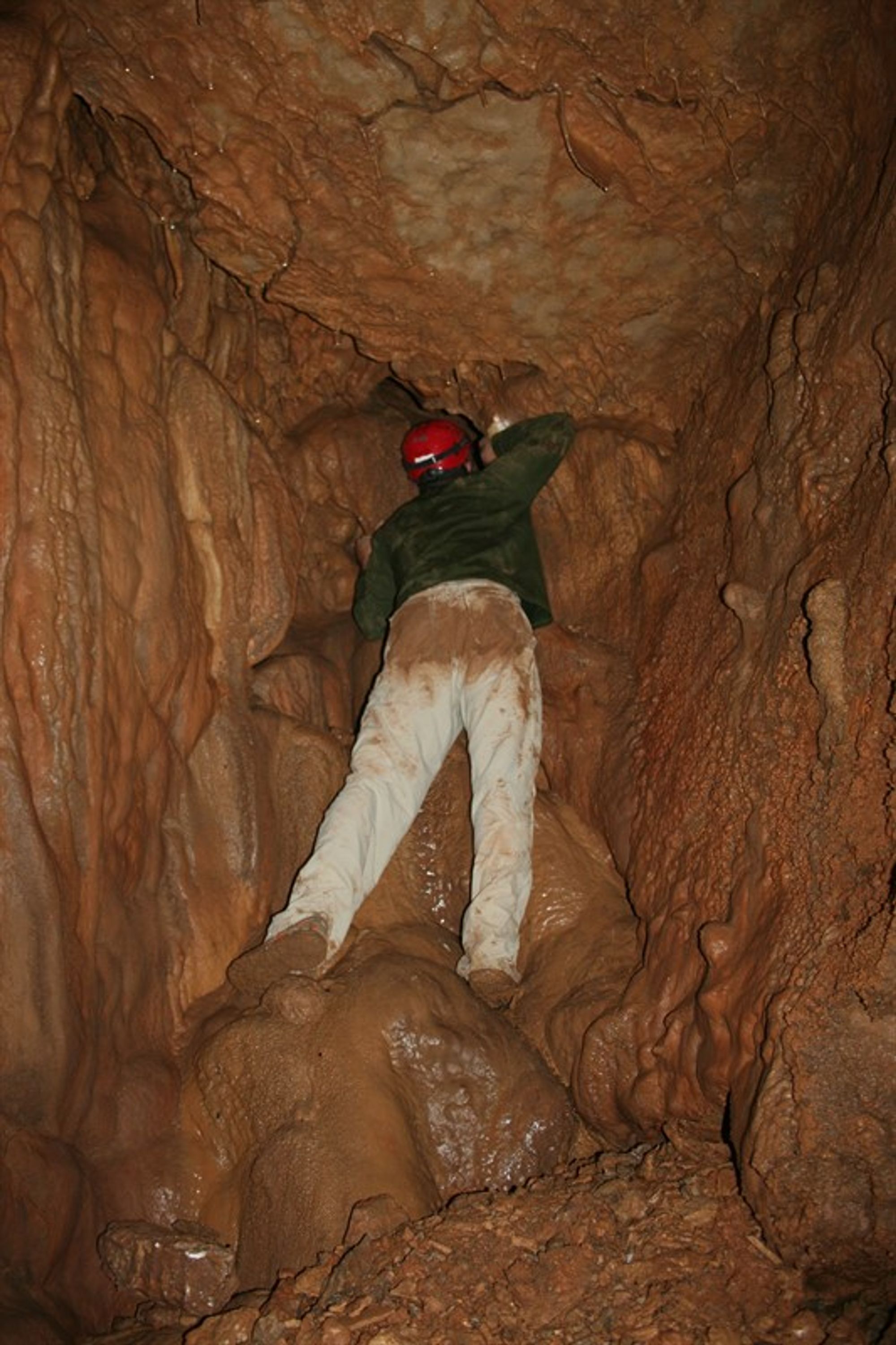
In the northeastern corner of chamber C, 3.5 m above the floor, a passage about 2 m long continues, connecting the second wing of the cave to its other part. Here, climbing into the passage requires the help of another person. At point D, which is the head of the first chimney in the second wing, there are well-developed deposition features - large elephant ears, stalactites and three short, thick stalagmites (about 0.1 m in diameter). The second wing developed along a main fracture whose average direction is 185 degrees. The connections between the three chimneys in this wing are the result of rock collapse and dissolution.
From point D a narrow chimney (about 1 m) with an irregular cross-section continues downward, with a total depth of 7.5 m. On its way down it crosses two chambers (E and J), which were formed due to a collapse in the roof of chamber E (see the unfolded vertical projection). The descent from point D to the floor of chamber E is not complicated, but it is advisable to use a rope. On the eastern side of chamber E is a step of rock fragments and clays 2 m high, impressive evidence of the filling and clogging processes of the chimney in chamber F. This is the most impressive chimney in the system: its height is about 7 m, its roof is blocked with rocks, its horizontal cross-section is nicely rounded, and its lower walls have elephant ears, stalactites and stalagmites. At a height of 2.5 m from its floor runs a clay layer 5 to 10 cm thick, which interrupts the continuity of the chimney wall's fine development.
At the southern end of chamber E one descends to chamber G (a rope is recommended), to the continuation of the main fracture in the wing. The fracture is narrow and getting narrower, to the point of real difficulty in passing through it. Its ceiling gradually lowers to about 2 m - its height at point H. Here the central fracture joins another fracture at a bearing of 190 degrees, whose end leads to another chimney (at the southern end of chamber I), about 6 m high, with a sinkhole at its bottom that a person cannot pass. On the walls of the fractures there are concentrations of cave corals.
Let us return to the chimney at point D: its bottom is in chamber J. Here there is a sinkhole through which another space can be seen, but it cannot be passed through. Above the sinkhole are beautiful travertine dams (over a total area of 0.3X0.6 m) that were dry in May 1987. On the flow surface of the chimney not many dissolution marks are visible, and it does not appear that a large quantity of water flows through it. It is not clear why the chimneys in this system are not deeper: in this preliminary survey, apart from the chimney in chamber F, no clay horizons or marl that would certainly have limited the downward development of the chimneys were found. It is possible that this stems from the heavy fracturing, which causes collapses and blocks the chimneys while they are still at the beginning of their development. "
During a visit to the cave in 2008 it became possible to pass through the sinkhole at the bottom of chamber J. On the other side of the sinkhole there is another chamber - chamber K - and its description follows:
The width of the passage through the sinkhole is about 0.8X1 m, and from it a sloping descent leads to the bottom of chamber K. This chamber developed on a north-south axis and appears to have formed along a fracture along which chambers H and I also developed.
The chamber's ceiling is high, its floor slopes north, and all of the chamber's walls are covered with abundant cave deposits (stalactites, cave corals, pool deposits and flowstone). At the northern end of the chamber there is a pair of dry pools, beyond which lies the end of the chamber.