Hever Stalagmites Cave
- Location
- Nahal Hever
- Elevation
- +226 m
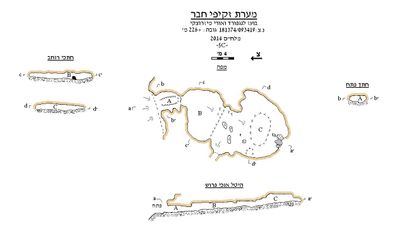 Cave mapView the map (PDF)
Description of the cave:
Hever Stalagmites Cave is a small cave (total length 23 m) that formed under confined-aquifer conditions that acted in limestone of Turonian age (Shivta Formation). The cave was discovered by Gideon Hadas, who published its existence in the Ein Gedi map survey, where a "karst cave with stalactites and Roman potsherds" was reported. After its discovery the cave was surveyed by an ICRC team, which mapped the space.
The cave entrance opens at the bottom of a low rock step, in the upper part of the southern bank of a channel that drains into Nahal Hever from the southwest, a short distance above the high waterfall in the stream.
The entrance is square and measures 2.8X1.2 m. From the entrance a low, semi-lit space (A) extends south, in whose floor a shallow rectangular pit is dug, apparently the product of looting activity that took place at the site. In the inner part of the entrance space, 4 m south of the cave entrance, the space connects to a large chamber that forms the main space in the cave.
A step in the ceiling divides the chamber into two different sub-spaces. The northern sub-space (B) is somewhat low so that movement in it is possible only in a stoop. The floor of this area is horizontal and covered mainly with coarse gravel and some light sediment, in which a few pottery sherds are mixed. These were dated by Hadas to the Roman and Byzantine periods.
Cave deposits appear in the eastern wall adjacent to the inner part of this sub-space. The cave deposits look like a calcite horizon 0.3 m thick exposed in the upper part of the wall.
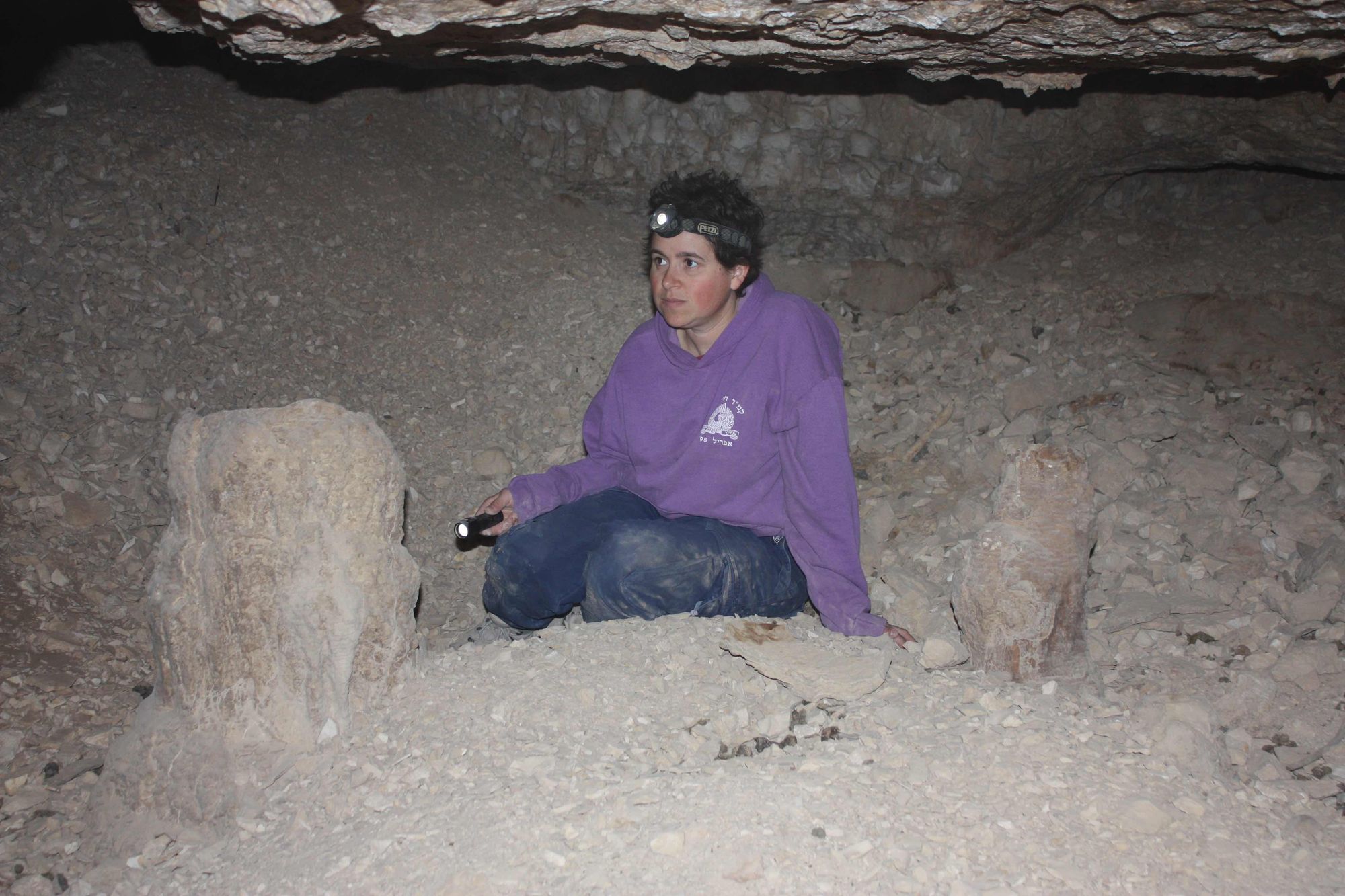
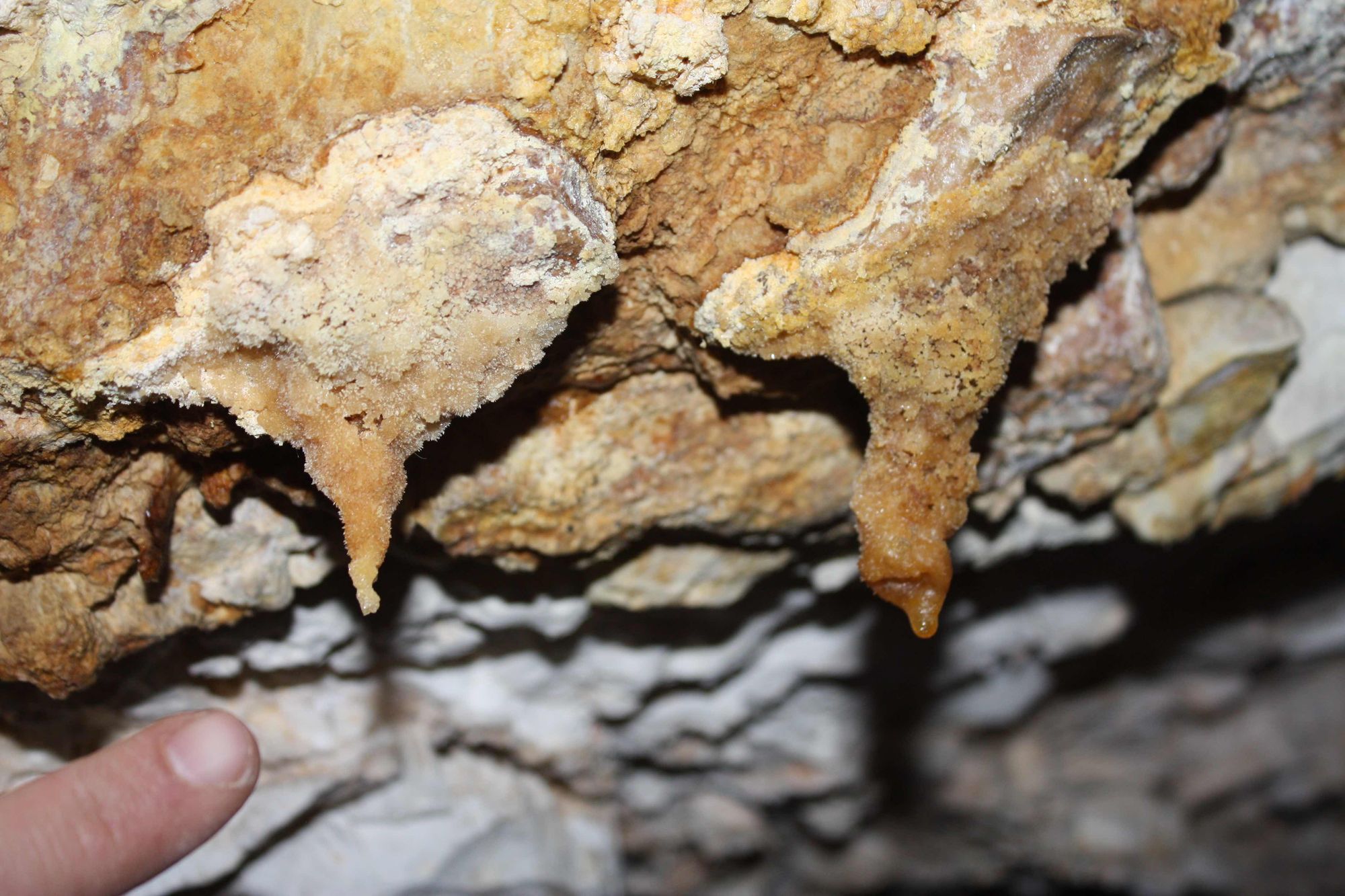
Additional and more impressive deposits appear south of the step in the ceiling, throughout the innermost part of the cave (C). The inner area looks like a rounded chamber with a sloping floor made up of coarse gravel and sediment. Coarse stalagmites protrude from the floor, rising to a height of several tens of cm. Additional broken stalagmites are scattered on the cave floor in all parts of the chamber. Tiny stalactites appearing on the ceiling are not the result of vadose deposition but a product of the urine of bats that roost in the cave. In the center of the cave ceiling opens a wide, worn dissolution dome, forming a relatively high point that is comfortable to stay in. The edges of the chamber, beside the dissolution dome, are low so that they can be approached only by crawling.
The presence of cave deposits in this desert region may be connected to a coarse conglomerate horizon that covers the channel banks above the cave space. It is possible that water seepage in periods with a flow regime different from that of today created the conditions for the formation of the stalagmites in the cave. On this basis it can be proposed that the development of the cave occurred in the phreatic zone, below the water table. With the uplift of the surface and the draining of water from the cave, the formation of the cave deposits became possible, formed at a relatively early stage of the channel's incision. During the deepening of the channel bed the cave space was cut and exposed in the stream bank.
Written by: Boaz Langford
Total length: 23 m